3V0-25.25 VMware Certified Advanced Professional - VMware Cloud Foundation 9.0 Networking Questions and Answers
When attempting to deploy or expand an edge cluster from an administrator encounters a failure: "Failed to validate the BGP Route Distribution". Prior to calling support, the administrator attempts to troubleshoot the issue. How should the administrator troubleshoot this issue?
An administrator is troubleshooting intermittent connectivity failures between two workloads connected to NSX VLAN segments using Traceflow. In-band Network Telemetry (INT) has been enabled in the NSX Global Configuration. How does Traceflow identify issues in a VLAN network?
An administrator is troubleshooting a BGP connectivity issue on a Tier-0 Gateway (Active/Active). The Tier-0 has the following configuration:
• Uplink VLAN 100: 192.168.100.0/24
• Uplink VLAN 101: 192.168.101.0/24
• BGP neighbors configured: 192.168.100.1 and 192.168.101.1
• A single static default route (0.0.0.0/0) exists with next-hop 192.168.100.1.
Symptoms observed on both Edge Nodes:
• Get BGP neighbors —> both neighbors stuck in Idle (Connect) — "No route to peer"
• Ping to 192.168.100.1 and 192.168.101.1 succeeds from the Edge nodes
• Get route shows the default route present only on VLAN 100 interface (fp-eth0), missing on VLAN 101 (fp-eth1)
What is the root cause of both BGP sessions remaining in Idle state?
An administrator has noticed an issue in a freshly deployed VMware Cloud Foundation (VCF) environment where the BGP neighborship between the Tier-0 gateway and a physical router remains in the Idle state. Pings between the uplink IPs are successful. What is the issue?
How should the Global Managers (GMs) and Local Managers (LMs) be distributed to ensure high availability and optimal performance in a multi-site NSX Federation deployment comprised of three sites? (Choose two.)
An administrator is configuring NSX resource sharing to allow shared access to multiple resources in the default space.
By default, which user role owns the shared resources for the default space?
Which two statements describe the recommended strategy for configuring and synchronizing security policies across Federated NSX sites? (Choose two.)
An administrator is enabling IPv6-to-IPv4 communication for workloads hosted in an NSX environment. The workloads use IPv6-only addressing, but the external systems they must reach are IPv4-only. To provide this translation service, the administrator decides to configure NAT64. Which two following characteristics about NAT64 are true? (Choose two.)
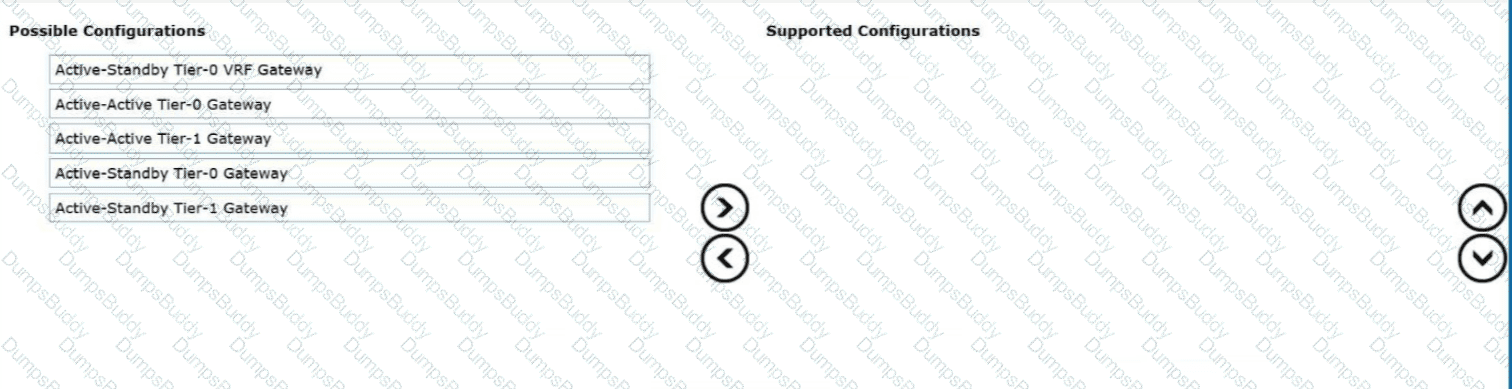
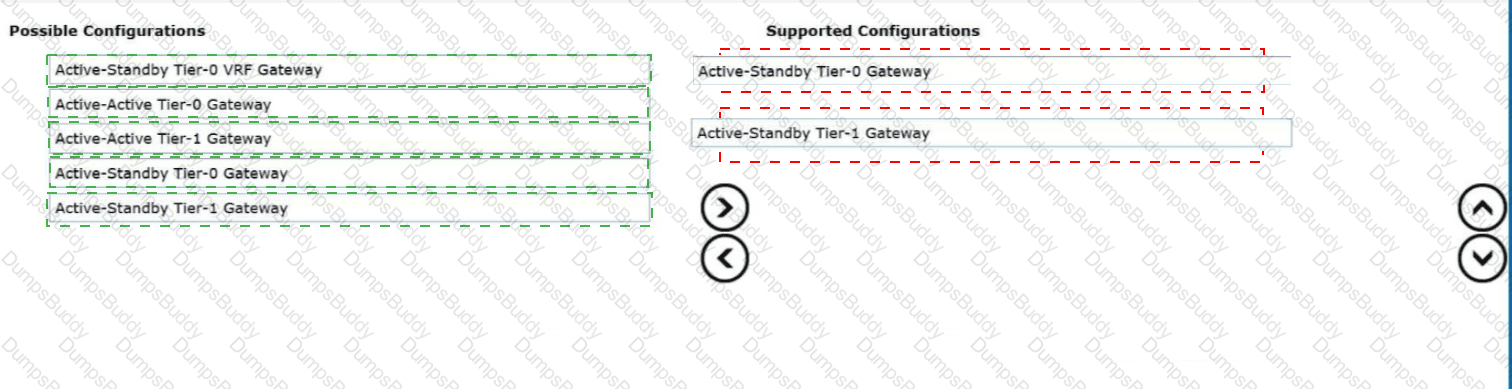
An administrator is responsible for the management of a VMware Cloud Foundation (VCF) Fleet that consists of two VCF instances that are located in different physical locations. The administrator has been tasked with configuring a VPN between the two locations and has been tasked with identifying the two supported NSX Gateway configurations for an IPSec VPN. Drag and drop two items from the list of Possible Configurations into the list of Supported Configurations in any order.(Choose two.)
An administrator is upgrading an existing VMware Cloud Foundation (VCF) environment. An NSX Edge Cluster is required to support north-south traffic for a workload domain. How would the administrator initiate the edge cluster deployment?
An administrator changed the SFTP server used for scheduled NSX Manager backups. The backup jobs now fail with the error "Host KEY Verification Failed." The connectivity and credentials are correct. How would an administrator resolve the error?
An administrator is troubleshooting why workloads in NSX cannot reach the external network 10.100.0.0/16. The Tier-0 Gateway is in Active/Active mode and has the following configuration:
• Uplink-1 (VLAN 100): 192.168.100.0/24 -> router R1 at 192.168.100.1
• Uplink-2 (VLAN 101): 192.168.101.0/24 -> router R2 at 192.168.101.1
• A static route for 10.100.0.0/16 was added with both next-hops (192.168.100.1 and 192.168.101.1).
• The Scope of this route is set to Uplink-1.
Symptoms:
• Virtual Machines (VMs) cannot reach 10.100.0.0/16
• Traceroute from the VM stops at the Tier-0 gateway with "Destination Net Unreachable"
• Pings from the Edge nodes to both 192.168.100.1 and 192.168.101.1 are success
What explains why workloads in NSX cannot reach the external network?
A large multinational corporation is seeking proposals for the modernization of a Private Cloud environment. The proposed solution must meet the following requirements:
• Support multiple data centers located in different geographic regions.
• Provide a secure and scalable solution that ensures seamless connectivity between data centers and different departments.
Which three NSX features or capabilities must be included in the proposed solution? (Choose three.)
The administrator must configure Border Gateway Protocol (BGP) on the Tier-0 Gateway to establish neighbor relationships with upstream routers. Which two statements describe the Border Gateway Routing Protocol (BGP) configuration on a Tier-0 Gateway? (Choose two.)
An administrator is investigating reports that several Virtual Machines (VMs) deployed on an NSX virtual network segment are dropping packets. To troubleshoot the issue the administrator has attached two test VMs to the virtual network in order to inspect the packets sent between the two test VMs. What tool will allow the administrator to analyze the packet flow?
PDF + Testing Engine

Testing Engine
PDF (Q&A)