JN0-364 Service Provider Routing and Switching - Specialist (JNCIS-SP) Questions and Answers
Exhibit:
user@R1> show route 10.16.2.0/23 exact detail
inet.0: 12 destinations, 12 routes (11 active, 0 holddown, 1 hidden)
10.16.2.0/23 (1 entry, 1 announced)
*Aggregate Preference: 130
Next hop type: Reject
Address: 0x8f3fd44
Next-hop reference count: 2
State:
Age: 1:39:21
Task: Aggregate
Announcement bits (1): 0-KRT
AS path: I (LocalAgg)
Flags: Depth: 0 Active
AS path list:
AS path: I Refcount: 2
Contributing Routes (2):
10.16.2.0/24 proto Direct
10.16.3.0/24 proto Direct
Which destination IP address will be matched by the aggregate route shown in the exhibit?
Exhibit:
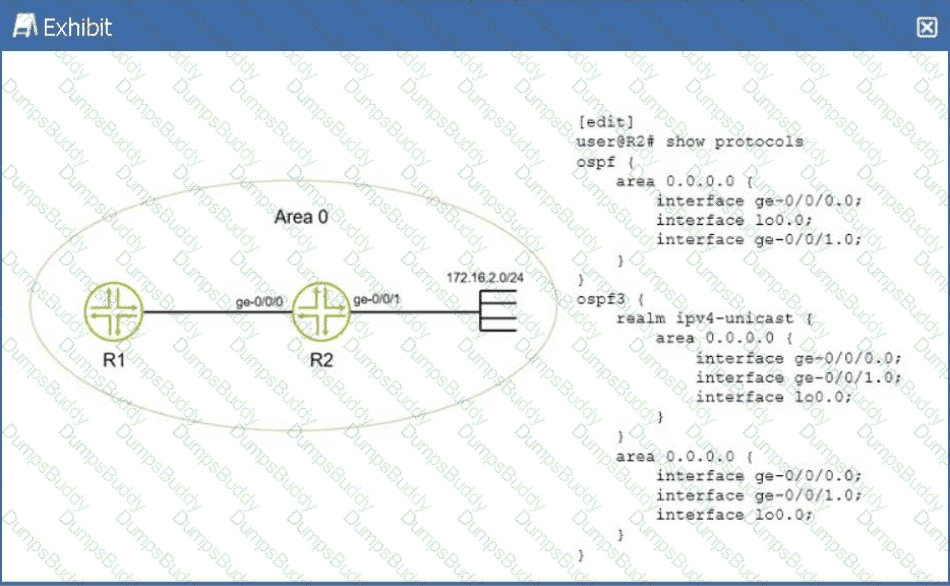
You have configured IPv4 and IPv6 in your network and all OSPF neighbors are established. You apply the configuration shown in the exhibit. Which statement is true in this scenario?
What information is determined by using the AS path attribute included in the BGP update message? (Choose two.)
You are a network architect designing a brand new network. You want to deploy RSVP LSPs in this network. You are currently in the process of choosing whether to run OSPF or IS-IS as your interior gateway protocol. In this scenario, which two statements are correct about IGP traffic engineering extensions in an RSVP network? (Choose two.)
Exhibit:
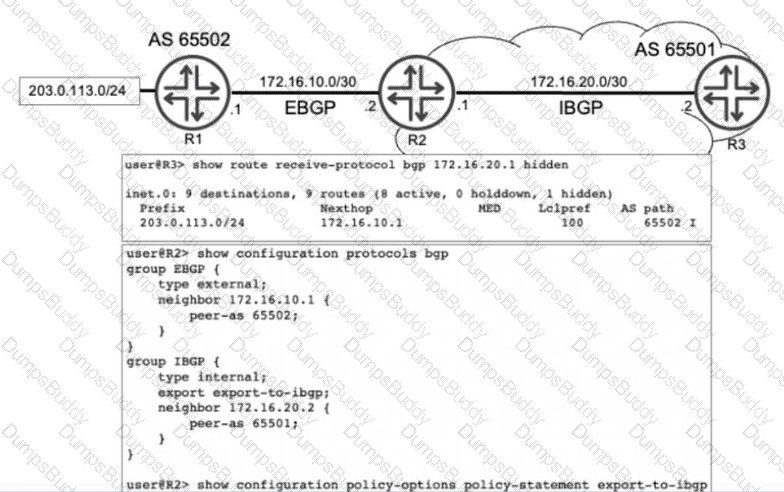
Referring to the exhibit, R1 is advertising prefix 203.0.113.0/24 to R2 over EBGP. R2 is configured to advertise this prefix into IBGP. R3 receives the 203.0.113.0/24 route, however the route is hidden. Which configuration statement do you need to add to R2 to solve this problem?
Which two statements regarding GRE and IP-IP tunnels are correct? (Choose two.)
Which OSPF packet type is used to initiate and maintain neighbor relationships?
Exhibit:
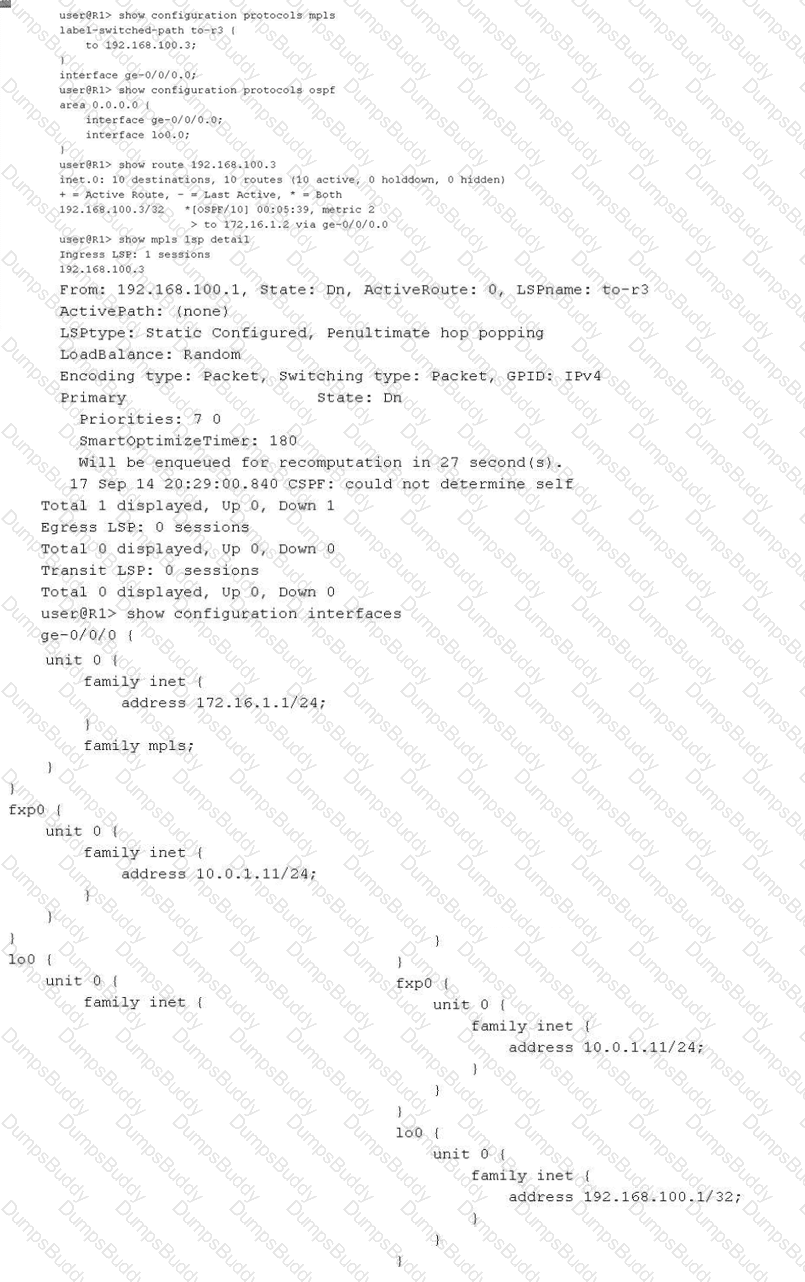
You have configured an MPLS LSP to 192.168.100.3. However, the LSP is in the down state. Referring to the exhibit, which two actions would solve this problem? (Choose two.)
Which two protocols would be used for dynamic routing in IPv6 environments? (Choose two.)
By default, which MPLS operation is performed by the penultimate router in an LSP on the transport label?
You must ensure that your routing platform with redundant REs continues to forward packets, even if one RE fails. Which technology would you use to accomplish this task?
You have configured an MPLS LSP that begins on R1 and terminates on R5 using the Junos default settings. Referring to the exhibit, which router will perform only label swap operations?
PDF + Testing Engine

Testing Engine
PDF (Q&A)