Professional-Data-Engineer Google Professional Data Engineer Exam Questions and Answers
Business owners at your company have given you a database of bank transactions. Each row contains the user ID, transaction type, transaction location, and transaction amount. They ask you to investigate what type of machine learning can be applied to the data. Which three machine learning applications can you use? (Choose three.)
You are deploying 10,000 new Internet of Things devices to collect temperature data in your warehouses globally. You need to process, store and analyze these very large datasets in real time. What should you do?
Your startup has never implemented a formal security policy. Currently, everyone in the company has access to the datasets stored in Google BigQuery. Teams have freedom to use the service as they see fit, and they have not documented their use cases. You have been asked to secure the data warehouse. You need to discover what everyone is doing. What should you do first?
You have spent a few days loading data from comma-separated values (CSV) files into the Google BigQuery table CLICK_STREAM. The column DT stores the epoch time of click events. For convenience, you chose a simple schema where every field is treated as the STRING type. Now, you want to compute web session durations of users who visit your site, and you want to change its data type to the TIMESTAMP. You want to minimize the migration effort without making future queries computationally expensive. What should you do?
You want to use a database of information about tissue samples to classify future tissue samples as either normal or mutated. You are evaluating an unsupervised anomaly detection method for classifying the tissue samples. Which two characteristic support this method? (Choose two.)
Your company uses a proprietary system to send inventory data every 6 hours to a data ingestion service in the cloud. Transmitted data includes a payload of several fields and the timestamp of the transmission. If there are any concerns about a transmission, the system re-transmits the data. How should you deduplicate the data most efficiency?
Your company is in a highly regulated industry. One of your requirements is to ensure individual users have access only to the minimum amount of information required to do their jobs. You want to enforce this requirement with Google BigQuery. Which three approaches can you take? (Choose three.)
You designed a database for patient records as a pilot project to cover a few hundred patients in three clinics. Your design used a single database table to represent all patients and their visits, and you used self-joins to generate reports. The server resource utilization was at 50%. Since then, the scope of the project has expanded. The database must now store 100 times more patientrecords. You can no longer run the reports, because they either take too long or they encounter errors with insufficient compute resources. How should you adjust the database design?
You are building new real-time data warehouse for your company and will use Google BigQuery streaming inserts. There is no guarantee that data will only be sent in once but you do have a unique ID for each row of data and an event timestamp. You want to ensure that duplicates are not included while interactively querying data. Which query type should you use?
Your company is performing data preprocessing for a learning algorithm in Google Cloud Dataflow. Numerous data logs are being are being generated during this step, and the team wants to analyze them. Due to the dynamic nature of the campaign, the data is growing exponentially every hour.
The data scientists have written the following code to read the data for a new key features in the logs.
BigQueryIO.Read
.named(“ReadLogData”)
.from(“clouddataflow-readonly:samples.log_data”)
You want to improve the performance of this data read. What should you do?
Your organization stores employee information in a BigQuery dataset. Your human resources (HR) admin team requires full access to the data, but the HR analyst team needs to conduct salary analysis without being able to access personally identifiable information (PII). You want to ensure that users have the correct level of access for their role managed through Dataplex, while reducing data duplication. What should you do?
You have developed three data processing jobs. One executes a Cloud Dataflow pipeline that transforms data uploaded to Cloud Storage and writes results to BigQuery. The second ingests data from on-premises servers and uploads it to Cloud Storage. The third is a Cloud Dataflow pipeline that gets information from third-party data providers and uploads the information toCloud Storage. You need to be able to schedule and monitor the execution of these three workflows and manually execute them when needed. What should you do?
You are developing a model to identify the factors that lead to sales conversions for your customers. You have completed processing your data. You want to continue through the model development lifecycle. What should you do next?
You are designing the architecture to process your data from Cloud Storage to BigQuery by using Dataflow. The network team provided you with the Shared VPC network and subnetwork to be used by your pipelines. You need to enable the deployment of the pipeline on the Shared VPC network. What should you do?
You work for a mid-sized enterprise that needs to move its operational system transaction data from an on-premises database to GCP. The database is about 20 TB in size. Which database should you choose?
You want to analyze hundreds of thousands of social media posts daily at the lowest cost and with the fewest steps.
You have the following requirements:
You will batch-load the posts once per day and run them through the Cloud Natural Language API.
You will extract topics and sentiment from the posts.
You must store the raw posts for archiving and reprocessing.
You will create dashboards to be shared with people both inside and outside your organization.
You need to store both the data extracted from the API to perform analysis as well as the raw social media posts for historical archiving. What should you do?
You create a new report for your large team in Google Data Studio 360. The report uses Google BigQuery as its data source. It is company policy to ensure employees can view only the data associated with their region, so you create and populate a table for each region. You need to enforce the regional access policy to the data.
Which two actions should you take? (Choose two.)
MJTelco needs you to create a schema in Google Bigtable that will allow for the historical analysis of the last 2 years of records. Each record that comes in is sent every 15 minutes, and contains a unique identifier of the device and a data record. The most common query is for all the data for a given device for a given day. Which schema should you use?
Given the record streams MJTelco is interested in ingesting per day, they are concerned about the cost of Google BigQuery increasing. MJTelco asks you to provide a design solution. They require a single large data table called tracking_table. Additionally, they want to minimize the cost of daily queries while performing fine-grained analysis of each day’s events. They also want to use streaming ingestion. What should you do?
MJTelco’s Google Cloud Dataflow pipeline is now ready to start receiving data from the 50,000 installations. You want to allow Cloud Dataflow to scale its compute power up as required. Which Cloud Dataflow pipeline configuration setting should you update?
MJTelco is building a custom interface to share data. They have these requirements:
They need to do aggregations over their petabyte-scale datasets.
They need to scan specific time range rows with a very fast response time (milliseconds).
Which combination of Google Cloud Platform products should you recommend?
Your financial services company has a critical daily reconciliation process that involves several distinct steps: fetching data from an external SFTP server, decrypting the files, loading them into Cloud Storage, and finally running a series of BigQuery SQL transformations. Each step has strict dependencies, and the entire process should notify you if not completed by 7:00 AM. Manual intervention for failures is costly and delays compliance reporting. You need a highly observable and robust solution that supports easy re-runs of individual steps if errors occur. What should you do?
You need to orchestrate a pipeline with several Google Cloud services: a batch Dataflow job, then a BigQuery query job followed by a Vertex AI batch prediction. The logic is sequential. You want a lightweight, serverless orchestration solution with minimal operational overhead. What service should you use?
You are updating the code for a subscriber to a Put/Sub feed. You are concerned that upon deployment the subscriber may erroneously acknowledge messages, leading to message loss. You subscriber is not set up to retain acknowledged messages. What should you do to ensure that you can recover from errors after deployment?
You store historic data in Cloud Storage. You need to perform analytics on the historic data. You want to use a solution to detect invalid data entries and perform data transformations that will not require programming or knowledge of SQL.
What should you do?
You work for a manufacturing plant that batches application log files together into a single log file once a day at 2:00 AM. You have written a Google Cloud Dataflow job to process that log file. You need to make sure the log file in processed once per day as inexpensively as possible. What should you do?
You are administering a BigQuery on-demand environment. Your business intelligence tool is submitting hundreds of queries each day that aggregate a large (50 TB) sales history fact table at the day and month levels. These queries have a slow response time and are exceeding cost expectations. You need to decrease response time, lower query costs, and minimize maintenance. What should you do?
Your company has recently grown rapidly and now ingesting data at a significantly higher rate than it was previously. You manage the daily batch MapReduce analytics jobs in Apache Hadoop. However, the recent increase in data has meant the batch jobs are falling behind. You were asked to recommend ways the development team could increase the responsiveness of the analytics without increasing costs. What should you recommend they do?
Your company is loading comma-separated values (CSV) files into Google BigQuery. The data is fully imported successfully; however, the imported data is not matching byte-to-byte to the source file. What is the most likely cause of this problem?
You need to compose visualizations for operations teams with the following requirements:
Which approach meets the requirements?
You need to compose visualization for operations teams with the following requirements:
Telemetry must include data from all 50,000 installations for the most recent 6 weeks (sampling once every minute)
The report must not be more than 3 hours delayed from live data.
The actionable report should only show suboptimal links.
Most suboptimal links should be sorted to the top.
Suboptimal links can be grouped and filtered by regional geography.
User response time to load the report must be <5 seconds.
You create a data source to store the last 6 weeks of data, and create visualizations that allow viewers to see multiple date ranges, distinct geographic regions, and unique installation types. You always show the latest data without any changes to your visualizations. You want to avoid creating and updating new visualizations each month. What should you do?
Suppose you have a dataset of images that are each labeled as to whether or not they contain a human face. To create a neural network that recognizes human faces in images using this labeled dataset, what approach would likely be the most effective?
You work for an economic consulting firm that helps companies identify economic trends as they happen. As part of your analysis, you use Google BigQuery to correlate customer data with the average prices of the 100 most common goods sold, including bread, gasoline, milk, and others. The average prices of these goods are updated every 30 minutes. You want to make sure this data stays up to date so you can combine it with other data in BigQuery as cheaply as possible. What should you do?
You work for a large fast food restaurant chain with over 400,000 employees. You store employee information in Google BigQuery in a Users table consisting of a FirstName field and a LastName field. A member of IT is building an application and asks you to modify the schema and data in BigQuery so the application can query a FullName field consisting of the value of the FirstName field concatenated with a space, followed by the value of the LastName field for each employee. How can you make that data available while minimizing cost?
You are choosing a NoSQL database to handle telemetry data submitted from millions of Internet-of-Things (IoT) devices. The volume of data is growing at 100 TB per year, and each data entry has about 100 attributes. The data processing pipeline does not require atomicity, consistency, isolation, and durability (ACID). However, high availability and low latency are required.
You need to analyze the data by querying against individual fields. Which three databases meet your requirements? (Choose three.)
You are designing the database schema for a machine learning-based food ordering service that will predict what users want to eat. Here is some of the information you need to store:
The user profile: What the user likes and doesn’t like to eat
The user account information: Name, address, preferred meal times
The order information: When orders are made, from where, to whom
The database will be used to store all the transactional data of the product. You want to optimize the data schema. Which Google Cloud Platform product should you use?
If you want to create a machine learning model that predicts the price of a particular stock based on its recent price history, what type of estimator should you use?
Which SQL keyword can be used to reduce the number of columns processed by BigQuery?
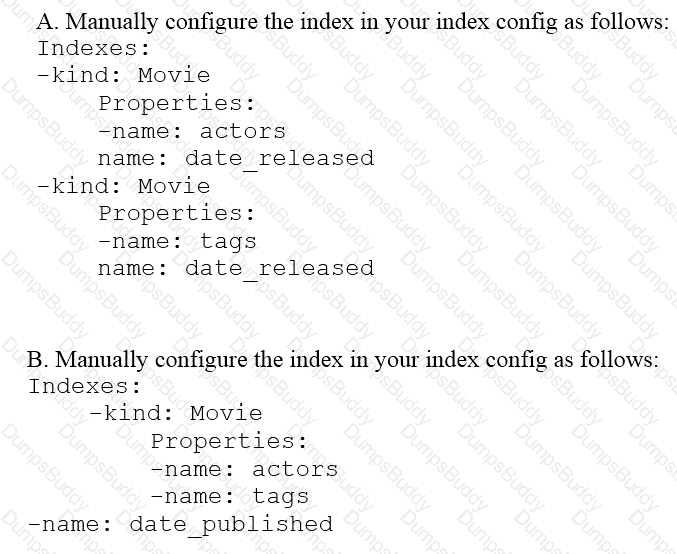
You are deploying a new storage system for your mobile application, which is a media streaming service. You decide the best fit is Google Cloud Datastore. You have entities with multiple properties, some of which can take on multiple values. For example, in the entity ‘Movie’ the property ‘actors’ and the property ‘tags’ have multiple values but the property ‘date released’ does not. A typical query would ask for all movies with actor=<actorname> ordered by date_released or all movies with tag=Comedy ordered by date_released. How should you avoid a combinatorial explosion in the number of indexes?
Your company produces 20,000 files every hour. Each data file is formatted as a comma separated values (CSV) file that is less than 4 KB. All files must be ingested on Google Cloud Platform before they can be processed. Your company site has a 200 ms latency to Google Cloud, and your Internet connection bandwidth is limited as 50 Mbps. You currently deploy a secure FTP (SFTP) server on a virtual machine in Google Compute Engine as the data ingestion point. A local SFTP client runs on a dedicated machine to transmit the CSV files as is. The goal is to make reports with data from the previous day available to the executives by 10:00 a.m. each day. This design is barely able to keep up with the current volume, even though the bandwidth utilization is rather low.
You are told that due to seasonality, your company expects the number of files to double for the next three months. Which two actions should you take? (choose two.)
By default, which of the following windowing behavior does Dataflow apply to unbounded data sets?
Which row keys are likely to cause a disproportionate number of reads and/or writes on a particular node in a Bigtable cluster (select 2 answers)?
Dataproc clusters contain many configuration files. To update these files, you will need to use the --properties option. The format for the option is: file_prefix:property=_____.
Which of the following IAM roles does your Compute Engine account require to be able to run pipeline jobs?
Which TensorFlow function can you use to configure a categorical column if you don't know all of the possible values for that column?
Flowlogistic is rolling out their real-time inventory tracking system. The tracking devices will all send package-tracking messages, which will now go to a single Google Cloud Pub/Sub topic instead of the Apache Kafka cluster. A subscriber application will then process the messages for real-time reporting and store them in Google BigQuery for historical analysis. You want to ensure the package data can be analyzed over time.
Which approach should you take?
Flowlogistic wants to use Google BigQuery as their primary analysis system, but they still have Apache Hadoop and Spark workloads that they cannot move to BigQuery. Flowlogistic does not know how to store the data that is common to both workloads. What should they do?
Flowlogistic’s management has determined that the current Apache Kafka servers cannot handle the data volume for their real-time inventory tracking system. You need to build a new system on Google Cloud Platform (GCP) that will feed the proprietary tracking software. The system must be able to ingest data from a variety of global sources, process and query in real-time, and store the data reliably. Which combination of GCP products should you choose?
Flowlogistic’s CEO wants to gain rapid insight into their customer base so his sales team can be better informed in the field. This team is not very technical, so they’ve purchased a visualization tool to simplify the creation of BigQuery reports. However, they’ve been overwhelmed by all thedata in the table, and are spending a lot of money on queries trying to find the data they need. You want to solve their problem in the most cost-effective way. What should you do?
You need to store and analyze social media postings in Google BigQuery at a rate of 10,000 messages per minute in near real-time. Initially, design the application to use streaming inserts for individual postings. Your application also performs data aggregations right after the streaming inserts. You discover that the queries after streaming inserts do not exhibit strong consistency, and reports from the queries might miss in-flight data. How can you adjust your application design?
Your company is running their first dynamic campaign, serving different offers by analyzing real-time data during the holiday season. The data scientists are collecting terabytes of data that rapidly grows every hour during their 30-day campaign. They are using Google Cloud Dataflow to preprocess the data and collect the feature (signals) data that is needed for the machine learning model in Google Cloud Bigtable. The team is observing suboptimal performance with reads and writes of their initial load of 10 TB of data. They want to improve this performance while minimizing cost. What should they do?
You are creating a model to predict housing prices. Due to budget constraints, you must run it on a single resource-constrained virtual machine. Which learning algorithm should you use?
Your company has hired a new data scientist who wants to perform complicated analyses across very large datasets stored in Google Cloud Storage and in a Cassandra cluster on Google Compute Engine. The scientist primarily wants to create labelled data sets for machine learning projects, along with some visualization tasks. She reports that her laptop is not powerful enough to perform her tasks and it is slowing her down. You want to help her perform her tasks. What should you do?
An external customer provides you with a daily dump of data from their database. The data flows into Google Cloud Storage GCS as comma-separated values (CSV) files. You want to analyze this data in Google BigQuery, but the data could have rows that are formatted incorrectly or corrupted. How should you build this pipeline?
You are designing a basket abandonment system for an ecommerce company. The system will send a message to a user based on these rules:
No interaction by the user on the site for 1 hour
Has added more than $30 worth of products to the basket
Has not completed a transaction
You use Google Cloud Dataflow to process the data and decide if a message should be sent. How should you design the pipeline?
You want to process payment transactions in a point-of-sale application that will run on Google Cloud Platform. Your user base could grow exponentially, but you do not want to manage infrastructure scaling.
Which Google database service should you use?
PDF + Testing Engine

Testing Engine
PDF (Q&A)