NCP-BC-7.5 Nutanix Certified Professional - Business Continuity (NCP-BC) 7.5 Questions and Answers
An administrator is migrating from a Protection Domain-based deployment to a Prism Central (PC)-based deployment. What occurs if a snapshot is deleted before the protection policy is applied to the migrated entities?
An administrator is managing a mission-critical Inventory-VM that is part of a Protection Domain (PD) named PD_Production.
Monday: A scheduled snapshot of PD_Production is successfully taken.
Tuesday: Due to a configuration error during a cleanup task, the administrator accidentally removes Inventory-VM from the PD_Production Protection Domain. The VM continues to run, but it is no longer being snapped or replicated.
Wednesday: A database corruption occurs on Inventory-VM. The administrator finds the local snapshot from Monday and performs an In-place Restore (Revert) to recover the data.
Following the successful completion of the In-place Restore, what is the status of Inventory-VM regarding its data protection?
A VM is protected in an Async Protection Policy with a schedule for every 1 hour. The replications are completing successfully every hour. The VM hosts a critical application and cannot afford any data loss. The administrator unprotects the VM from the Async Policy and protects the VM in a Synchronous policy. The administrator also notices that the VM is not entering the " Sync " state and is stuck in syncing for a long time. The administrator notices the error in the logs:
Enabling stretch for entity TestVM failed while notifying vm service due to error
Acropolis failed to handle VmSyncRepEnable request for VM TestVM
Failed to connect to remote Anduril
What port needs to be allowed between the clusters to fix the issue?
An administrator configures disaster recovery between an on-premises AZ and a Nutanix Cloud AZ. After enabling DR and assigning protection policies to several VMs with volume groups, the administrator initiates failover and notices the VMs do not have their volume groups attached. Investigation reveals:
The clusters are successfully paired in Prism Central.
Protection policies and replication schedules are configured correctly.
Recovery plan validation completes successfully.
Required firewall ports between sites are confirmed open.
Management IP addresses are reachable in both directions.
Despite this, the administrator observes the volume groups are still not attached. Which network-related prerequisite is most likely misconfigured?
An administrator at a retail company is preparing to apply a critical OS security patch to a production SQL Server VM. Before starting, the administrator ensures the VM is part of a Protection Domain and manually creates a local snapshot (Recovery Point). Ten minutes after the patch is applied, the SQL service fails to start, and the database logs indicate corruption in the system registry. The administrator needs to return the VM to its functional state from ten minutes ago as quickly as possible. The administrator decides to perform a Restore from the local snapshot. Under which condition would an In-place Restore (Revert) fail, forcing the administrator to use the Clone (Out-of-place) option instead?
An administrator executes an Unplanned Failover. The VMs recover at the Recovery Site and are powered on. However, the application owners report that the VMs are completely isolated and cannot communicate with any other services on the network. The administrator checks the Recovery Plan and notices the Network Mapping section was left blank.
What is the expected configuration for VMs recovered without a valid Network Mapping?
What is the bandwidth limit of a single Nutanix Cloud Gateway for IPSec traffic?
An administrator is managing a Nutanix environment via Prism Central and has two VMs running on AHV:
" ERP-PROD " : A mission-critical VM protected by a Synchronous replication schedule (0 RPO) to a secondary site.
" REPORTING-DEV " : A non-critical VM protected by an Asynchronous replication schedule (hourly RPO) to the same secondary site.
Following a corrupted application update, the administrator decides to manually recover both VMs locally.
What will be the outcome of this manual recovery attempt?
A VM is protected in an Async Protection Policy and added to a Recovery Plan. An administrator is attempting to perform a planned failover of the VM. How many recovery points are created and replicated during the planned failover process?
A mission-critical VM utilizing an NVIDIA vGPU profile for high-end graphical processing is replicated from a primary Nutanix cluster to a secondary disaster recovery site. After failover of a VM using an NVIDIA vGPU profile, the VM boots but hardware acceleration does not function. What action is required?
An administrator is validating a newly created Recovery Plan and receives the following warning:
IP addresses xxx.xxx.xxx.xxx cannot be preserved/mapped for VM REPORTVM01.
IP addresses cannot be preserved/mapped for entities
IP might be already in use or will be used by some other VM for recovery. IP cannot be mapped.
Only one IP address can be preserved for a vNIC in an IP address management enabled network.
What can the administrator do to resolve this warning without changing the existing IP address assigned to the VM?
A Nutanix protection policy is configured with:
RPO: 1 hour,
Retention period: 5 days,
Retention type: Roll-up.
After six days of continuous operation, approximately how many hourly recovery points will still be available for restores for the most recent 24-hour period?
Two AHV clusters are 4 ms RTT apart. The business requires:
0 RPO
Automatic failover
No application performance degradation
Hybrid HCI nodes with 100 TB capacity
What storage configuration must be validated before enabling synchronous replication?
An organization uses Nutanix Disaster Recovery with automatic virtual network creation in the Nutanix Cloud AZ. After a successful failback operation from the Nutanix Cloud AZ to the on-premises site, what is the expected behavior regarding the dynamically created virtual networks at the recovery site?
How does Nutanix Disaster Recovery automatically handle Container Mapping if a storage container with the same name does not exist at the recovery Nutanix cluster?
An administrator incorrectly used the " Activate " functionality on the PD to test failover of VMs from production to DR cluster. The VMs were successfully restored on the DR side. What steps are needed to clean up the VMs on the DR side and resume normal operations on the Production cluster?
An administrator wants to run a test failover and maps the primary production virtual network to the recovery site production virtual network for the test. What are the two most likely outcomes? (Choose two.)
After a storage failover in a synchronous replication environment, users report higher I/O latency and degraded performance compared to pre-failover levels. Cluster health is normal, and replication is functioning correctly. Which post-failover cleanup action could the administrator perform to correct the performance issue?
An administrator finds replications for Marketing VMs are failing to replicate. After doing some digging the administrator was able to find the following:
Connectivity was confirmed on ports 2020 and 2009 between the clusters
All other VMs are replicating successfully
Cluster wide storage has plenty of remaining space
No firewall exists between the sites
Marketing VMs are running Windows, successful VMs are running Linux
What could be causing the Marketing VMs to fail replications?
During the Recovery Plan configuration, the administrator maps the " Test Network " setting to the " Production Network " VLAN on the Recovery Site. What is the expected outcome when the administrator executes a Test Failover for this plan?
An administrator is evaluating Nearsync for critical VMs in a Nutanix Disaster Recovery environment. What is the minimum RPO, in minutes, supported by Nearsync replication?
An administrator has received the following alert:

Replication was skipped for protection domain < Protection Domain Name > of the latest snapshot < Snapshot ID > to remote site < Remote Cluster Name > . Replication was skipped as a newer Recovery Point was available snapshots that may have been skipped.
The administrator begins gathering troubleshooting information and determines the following:
The VM has been replicating to this cluster successfully for at least 6 months
The bandwidth has been sufficient to this point and hasn ' t caused an issue before
Network connectivity is good and all necessary ports remain open and reachable
There aren ' t hardware issues, and software is up to date
What else could have caused this alert?
A solution architect designs a protection policy in Prism Central to protect a specific set of VMs. The design calls for synchronous replication to two separate availability zones (AZs) simultaneously to ensure zero data loss at multiple physical locations. Which configuration limitation prevents the implementation of this specific design?
Which combination of Replication Schedules within the same Recovery Plan will cause the recovery to fail?
An administrator is tasked with ensuring the VMs do not experience downtime during an upcoming network maintenance on the primary cluster. The VMs are protected by a Protection Policy and are configured under a Recovery Plan. What failover mechanism should the administrator use to ensure the VMs are available on the target cluster before the maintenance window?
An administrator notices that storage utilization continues to increase at both the primary and recovery sites after implementing a third-party backup solution that uses protection policies. Which configuration should be reviewed first?
Refer to Exhibit:
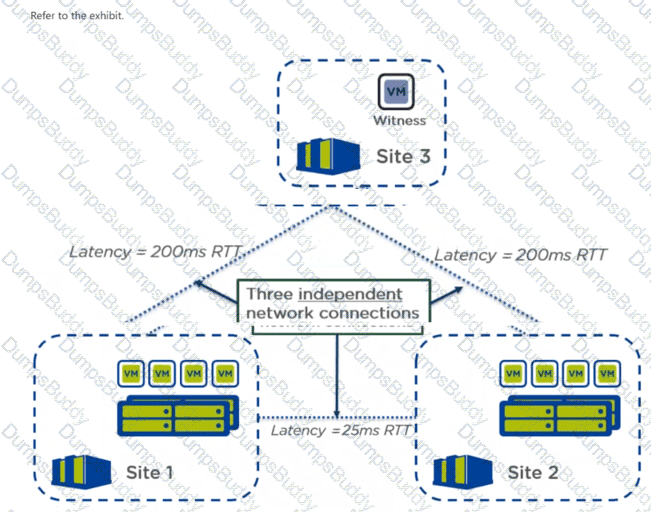
An administrator is configuring Metro Availability in their environment, as shown in the diagram. What issue in the configuration will prevent Metro from working correctly?
PDF + Testing Engine

Testing Engine
PDF (Q&A)