Pre-Winter Sale Limited Time 65% Discount Offer - Ends in 0d 00h 00m 00s - Coupon code: netbudy65

L4M5 Commercial Negotiation Questions and Answers

Questions 4

Where there are high levels of commitment to relationships between both the buyer and supplier, this is seen as collaborative and beneficial to negotiations. Is this statement correct?

Options:

A.

Yes, characteristics include risk management and strategic planning

B.

No, this can be classified as adversarial

C.

Yes, characteristics include arm's length transactions and minimal communication

D.

No, collaboration does not require commitments from either side

Buy Now
Questions 5

The stages of commercial negotiation involve which of the following characteristics?

Options:

A.

Preparation, proposal, bargain, leave

B.

Open, testing, bargaining, closing, revisiting

C.

Preparing, opening, bargaining, agreement, closure

D.

Opening, debating, promising, testing, disagreeing, closing

Buy Now
Questions 6

When might a buyer decide to use a distributive approach to a negotiation with a supplier?

Options:

A.

When they are dependent on that supplier in the future

B.

When there are various suppliers in the market producing a similar product

C.

When procuring an item that is not strategic to the organisation

D.

When a working relationship is important in the future

Buy Now
Questions 7

Which of the following is an advantage of a fixed-price agreement?

Options:

A.

Increased quality

B.

Longer payment terms

C.

Reduction in financial risk

D.

Lower storage costs

Buy Now
Questions 8

Which of the following is a variable cost?

Options:

A.

Rent

B.

Loan repayments

C.

Insurance

D.

Packaging

Buy Now
Questions 9

The sourcing manager has decided to adopt an adversarial style of negotiation to take advantage of the buyer's greater bargaining power over the suppliers. In what other circumstances should an adversarial relationship be used?

Options:

A.

When the supplier is likely to respond with further concessions to maintain a long-term relationship

B.

In all forms of negotiation as each party is always trying to gain advantage over the other

C.

In a monopoly market as the supplier will respond by conceding quantity discounts

D.

When the issues concerned are non-negotiable, for example, health and safety commitments

Buy Now
Questions 10

Which of the following are most likely to be abilities of a person with high emotional intelligence? Select TWO that apply.

Options:

A.

Complex idea comprehension

B.

Controlling one's own emotions

C.

Perceiving how others feel

D.

Reasoning and problem solvingAbstract thinking

Buy Now
Questions 11

A skilled negotiator will use a range of questioning techniques. If they wish to explore options with the other party without making any formal commitment, which style would they use?

Options:

A.

Leading

B.

Hypothetical

C.

Reflective

D.

Multiple

Buy Now
Questions 12

Lina Rawlins is a senior buyer working for a medical equipment company. Lina is in charge of the company’s largest supplier account, Great Barrington Gas (GBG), a medical equipment supplier. Recently GBG’s performance has declined, which has led to an increasing number of rejected items. Lina is aware of the seriousness of this, given the nature of the item, and has asked GBG to attend an urgent meeting. In the meeting, Lina asked the GBG representative “Can you tell me exactly what you are doing to ensure quality?” What type of question is Lina asking?

Options:

A.

Reflective

B.

Leading

C.

Hypothetical

D.

Probing

Buy Now
Questions 13

XYZ Ltd decides to go to market for a cleaning contract to service a number of offices. It knows that it will get a price which may, or may not, be better than the one it is currently paying. To gain leverage in the marketplace, the organisation decides to add other related services to the scope, such as gardening, security and maintenance, which increase the value of the contract. This is an example of which forms of spend consolidation?

Options:

A.

Purchasing consortia

B.

Volume consolidation across categories

C.

Volume pooling

D.

Volume redistribution

Buy Now
Questions 14

A breakeven analysis uses which of the following aspects as part of the analysis?

Options:

A.

Fixed cost

B.

Buying cost minus variable cost per unit

C.

Variable cost

D.

Selling price minus variable cost per unit

Buy Now
Questions 15

Maria is a professional services category buyer within the National Health Service. Due to the severe financial budget cutbacks the National Health Service is facing, the procurement team has been tasked with achieving cost savings so that funding available can be spent on patient care. Maria plans to achieve savings with one of her collaborative suppliers. Which negotiation approach should she undertake?

Options:

A.

Win-Lose

B.

Lose-Lose

C.

Win-Perceived Win

D.

Win-Win

Buy Now
Questions 16

A building firm has been awarded a contract to construct an office block. Which is a direct cost?

Options:

A.

Cost of materials

B.

Cost of legal fees

C.

Cost of insurance

D.

Cost of office space

Buy Now
Questions 17

A purchasing organisation wants a Win-Win (integrative) solution in negotiations with a key supplier. Which TWO approaches would be appropriate?

Options:

A.

Collaboration

B.

Problem solving

C.

Coercion

D.

Persuasion

E.

Transfer of risk

Buy Now
Questions 18

Why is rapport building with the supplier important during the opening phase of a negotiation?

Options:

A.

To assert dominance and to show who is in control of the meeting

B.

To establish trust and common ground between the parties

C.

To test the other party on their position and willingness to collaborate

D.

To persuade the supplier to accept concessions more readily

Buy Now
Questions 19

An experienced procurement professional is developing strategies for forthcoming negotiations with her key supplier. To avoid negotiation deadlocks, she identifies the reasons why negotiations could fail. Which of the following are most likely to be reasons for negotiation failures? Select TWO that apply.

Options:

A.

Underlying interests of TOP are overlooked

B.

MIL objectives are well established

C.

Both parties focus on common interests

D.

Buyer helps to create a co-operative atmosphere

E.

Unachievable objectives were set up

Buy Now
Questions 20

Fast & Easy Limited, a global fast food retailer, is in a negotiation with its major meat supplier. The supplier is asking for a 2% price increase, which Fast & Easy is strongly resisting. The supplier justifies this increase by stating that currency fluctuations, an unstable economic climate, and rising transport costs have necessitated this increase. Which influencing tactic is the supplier using?

Options:

A.

Rational persuasion

B.

Inspirational appeal

C.

Coalition

D.

Personal appeal

Buy Now
Questions 21

When is the best time in procurement process in which procurement should get involved so that the cost-saving opportunities are the greatest?

Options:

A.

Market consult stage

B.

Post-contract stage

C.

Specification stage

D.

Post-tender stage

Buy Now
Questions 22

A procurement manager is considering accepting a fixed price agreement for 12 months with an IT supplier. What are the advantages of fixed price agreements? Select TWO that apply.

Options:

A.

The supplier can reduce the costs to benefit the buyer

B.

The supplier will bear all the risk of cost fluctuations

C.

The supplier will reimburse the buyer for all costs incurred

D.

The administration for the 12 months will be simpler

E.

The supplier will always prioritise fixed cost projects over variable projects

Buy Now
Questions 23

Which of the following are behaviours that builds trust between the buyer and the supplier in business relationship? Select TWO that apply.

Options:

A.

Conducting transparent procurement process

B.

Over-inflated contingency funds

C.

Allowing supplier to involve in early product development

D.

Commercial espionage

E.

Tendency to blame other party

Buy Now
Questions 24

Which of the following are intangible values created by trust in business relationships? Select TWO that apply.

Options:

A.

Higher revenues

B.

Positive feedbacks from customers

C.

More focus on core business

D.

Increasing response time to request

E.

Frequent conflict escalation

Buy Now
Questions 25

Different types of relationships impact on commercial negotiations. At a negotiation, which one of the following sources would help to support leverage for the buyer?

Options:

A.

Legitimate power

B.

Personality power

C.

Powerful colleagues

D.

Friends power

Buy Now
Questions 26

A procurement manager has decided to bring in a junior member of their team to a negotiation meeting. Which of the following would be suitable roles for this junior member of the team?

Note taker

Expert

Observer

Chair

Options:

A.

1 and 2

B.

1 and 5

C.

2 and 3

D.

3 and 4

Buy Now
Questions 27

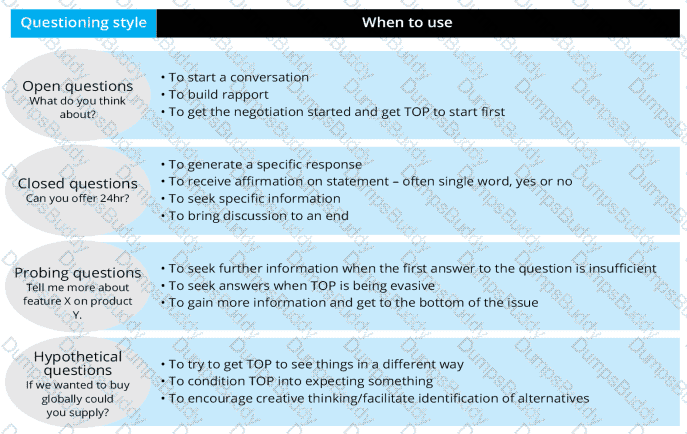
Which type of question should be used to receive affirmation on statement?

Options:

A.

Open

B.

Closed

C.

Leading

D.

Narrow

Buy Now
Questions 28

Which of the following are most likely to be direct costs of a steel manufacturer? Select THREE that apply.

Options:

A.

Cleaning services

B.

Coal

C.

Senior management salary

D.

Insurance for production lines

E.

Scrap metal

F.

Hourly production wages

Buy Now
Questions 29

During a negotiation, José Gómez (salesperson for a strategic supplier) says his sales director will not approve discounts on initial purchases. However, he offers a 5% discount on the aftercare package, which gives the same monetary saving. Sally Pampas needs both the product and the aftercare package and aims for a 5% discount off the purchase price. To achieve a win-win (integrative) outcome, Sally should:

Options:

A.

Decline the offer and walk away from the negotiation

B.

Accept the offer of a 5% discount on the aftercare package

C.

Ask José to apply a 15% discount on the purchase price

D.

Ask José to apply the 5% discount on the purchase price

Buy Now
Questions 30

Representatives from South African Department of Health is negotiating the price of hospital drugs with US pharmaceutical companies. Which of the following are most likely to be macro factors that influence the outcomes of the negotiation? Select TWO that apply.

Options:

A.

Forward integration

B.

Digitalisation of medicine

C.

Order quantity

D.

Regulations on health and safetySwitching costs of buyer

Buy Now
Questions 31

During which stage in the negotiation process would negotiators use tactics and exchange concessions?

Options:

A.

Bargaining

B.

Testing

C.

Proposing

D.

Closing

Buy Now
Questions 32

A negotiation meeting between a buyer and supplier has taken several hours. Both parties believe the negotiation is starting to reach a close. Before the supplier makes their closing statements, they are most likely to be doing which of the following?

Options:

A.

Gathering information and data

B.

Watching for verbal and visual buying signals

C.

Establishing connections and building rapport

D.

Raising last-minute objections

Buy Now
Questions 33

John Browne, a junior buyer for a corporation, is analysing the global supply market before undertaking negotiations and is wondering whether foreign exchange rates are important to factor into his research. Should John consider the foreign exchange rates?

Options:

A.

No, exchange rates only apply to the national economy

B.

No, as they only affect the bank's interest rates for loans

C.

Yes, as they can affect profit and turnover

D.

Yes, only if the organisation can handle foreign currencies in their accounts

Buy Now
Questions 34

Which of the following occur in the planning and preparation stage of negotiation? Select THREE.

Options:

A.

Using questions to elicit information

B.

Understanding the other party

C.

Defining the constituents

D.

Analysing the bargaining power

E.

Making as few concessions as possible

F.

Narrowing the range of solutions

Buy Now
Questions 35

Which of the following are most likely to harm trust between buyer and supplier in a commercial relationship? Select TWO that apply.

Options:

A.

Avoidance of submitting important documentations

B.

Reduced response time during contract performance

C.

Resolving some conditions that would otherwise have them competing for resources

D.

Subjective assessment of performance

E.

Exploring a disagreement to learn from each other's insights

Buy Now
Questions 36

Which of the following is a description of mark-up?

Options:

A.

Profit expressed as a percentage of the selling price

B.

Profit expressed as a percentage of costs

C.

Profit expressed as a percentage of fixed costs

D.

Profit expressed as a percentage of variable costs

Buy Now
Questions 37

Where a market consists of a large producer of a product with high market power, it is known as:

Options:

A.

A monopolistic structure

B.

An oligopoly structure

C.

A monopoly structure

D.

A monopsony structure

Buy Now
Questions 38

Which of the following may help the procurement professional increase expert power in commercial negotiation? Select TWO that apply.

Options:

A.

Personality

B.

Official positions

C.

Insights

D.

Ability to compensation

E.

Expertise knowledge

Buy Now
Questions 39

How can having a best alternative to a negotiated agreement (BATNA) support the buyer in a negotiation? Select THREE options that apply.

Options:

A.

It helps to be more assertive in a negotiation

B.

It reduces the likelihood of accepting a poor agreement

C.

It guarantees a win-win outcome

D.

It produces an unacceptable outcome

E.

It extends the length of the negotiation period

F.

It helps to identify the point at which the buyer should walk away

Buy Now
Questions 40

In a commercial negotiation, a procurement professional negotiates on his company's behalf. The power of buying organisation is the only factor that influences the behaviours of the other party. Is this assumption true?

Options:

A.

Yes, because the outcomes of negotiation are attributable to the buying organisation

B.

No, because personal power of negotiators also attributes to the outcomes

C.

No, because power of supplier is the only factor that influences the other party

D.

Yes, because buyer's brand, reputation and purchasing spend largely determine the outcomes

Buy Now
Questions 41

Which of the following are characteristics of the pull approach?

Aimed at securing compliance, often against resistance

Influencers are fully aware of the process, which is overt

Persuasion or interpersonal influence

Can secure commitment if influencers accept the viewpoint as fitting their goals

Options:

A.

1 and 3 only

B.

3 and 4 only

C.

1 and 2 only

D.

2 and 3 only

Buy Now
Questions 42

If the value of the British Pound in other currencies is strong, which of the following is most likely to occur?

Options:

A.

The price of UK products in the UK will rise

B.

The price of UK products in the UK will fall

C.

The price of UK products abroad in foreign currency will fall

D.

The price of UK products abroad in foreign currency will rise

Buy Now
Questions 43

Rose is a senior buyer from a skiing equipment retailer. Rose is concerned about the current ski boot shortage and the number of invoicing problems from a key supplier. She has decided to have a video conference with Victor, CEO of the supplier. Initially, she intends to threaten Victor with contract termination unless he can improve the situation. However, she is a little wary of doing this as the switching costs are high. Eventually, she decides to seek solutions by encouraging the other party to offer their views and ideas. Rose also prepares some ideas to discuss with Victor. Which of the following is the persuasion method that Rose intends to use in the forthcoming conference?

Options:

A.

Directive (push)

B.

Persuasive reasoning (push)

C.

Collaborative (pull)

D.

Visionary (pull)

Buy Now
Questions 44

Which of the following best describes Leverage quadrant in Kraljic matrix?

Options:

A.

Low risk, high importance

B.

High value, high complex

C.

Low risk, low importance

D.

High complex, low importance

Buy Now
Questions 45

Which of the following constitutes a key element to developing high-trust supplier relationships?

Options:

A.

Contract management

B.

Supplier audits

C.

Delivering on commitments

D.

Information gathering

Buy Now
Questions 46

The sourcing manager has decided to adopt an adversarial style of negotiation to take advantage of the buyer’s greater bargaining power over the suppliers. In what other circumstances should an adversarial relationship be used?

Options:

A.

When the issues concerned are non-negotiable, for example, health and safety commitments

B.

In a monopoly market as the supplier will respond by conceding quantity discounts

C.

In all forms of negotiation as each party is always trying to gain advantage over the other

D.

When the supplier is likely to respond with further concessions to maintain a long-term relationship

Buy Now
Questions 47

A supplier has offered international football tickets to the procurement manager while they are in the middle of a contract negotiation. What should the procurement manager do?

Options:

A.

Accept the offer of the tickets as this will enhance the relationship between both parties

B.

Accept the offer as this will not affect the relationship with the supplier

C.

Reject the offer as this may be seen as a conflict of interest during the negotiation

D.

Reject the offer as the procurement manager will have to repay the gesture

Buy Now
Questions 48

Which of the following is the internal factor that is taken into price of a product?

Options:

A.

Risk management

B.

Customer tastes

C.

Elasticity

D.

Exchange rate

Buy Now
Questions 49

’What specific tests do you carry out to ensure quality is achieved?’ This is an example of which type of negotiation question?

Options:

A.

Leading

B.

Probing

C.

Reflective

D.

Closed

Buy Now
Questions 50

Which of the following are most likely to be sources of conflict that can emerge from the content of commercial negotiations? Select TWO that apply.
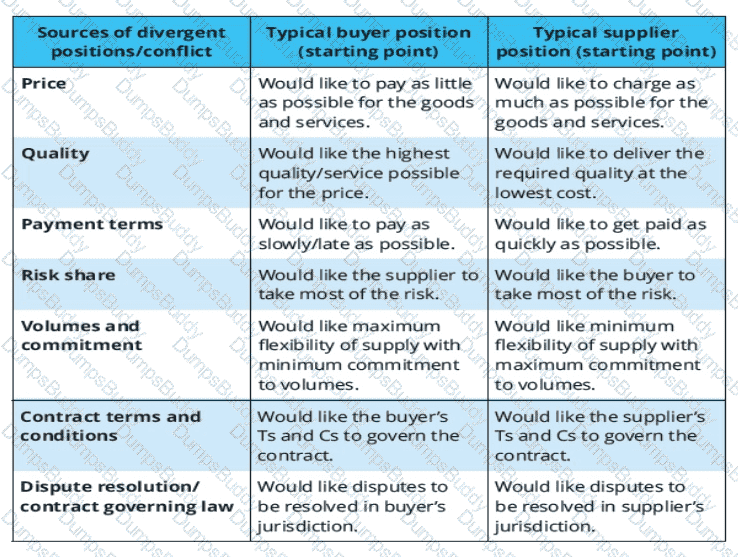
Options:

A.

Framework arrangement

B.

Payment terms

C.

Contract governing law

D.

Requisition

E.

Cultural differences

Buy Now
Questions 51

An oil refinery plant imports much of its crude oil from overseas. A procurement manager in the refinery suggests that fixing the crude oil contract price for 36 months would be beneficial for the company. Would this be a right thing to do?

Options:

A.

Yes, financial budgeting task would be a lot easier with fixed pricing arrangement

B.

No, fixed price should be only applied to contracts that last 60 months or longer

C.

No, the refinery would not be able to reap the benefits from falling commodity price and currency rates

D.

Yes, the supplier would bear the risk when the material price increased

Buy Now
Questions 52

Which of the following are most likely to be the potential cultural differences that can make transactions with an international supplier more problematic that with local suppliers? Select TWO that apply.

Options:

A.

Incoterms and logistics difficulties

B.

The use and interpretation of body language

C.

Currency exchange fluctuation

D.

The importance of timescales

E.

Payment mechanism

Buy Now
Questions 53

The bargaining power of buyers is likely to be high in relation to suppliers in which of the following situations?

Options:

A.

The buyer spend is a low proportion of the supplier's revenue

B.

The buyer does not have the option to make as an alternative to buy

C.

The buyer demand is urgent and cannot be postponed

D.

The buyer is large in size relative to the supplier

Buy Now
Questions 54

Procurement team is required to improve leverage with their suppliers through spend consolidation. To check whether there is any opportunity to consolidate spend, which of the following should be priority of procurement team?

Options:

A.

Spend analysis

B.

Value engineering

C.

Price analysis

D.

Total cost analysis

Buy Now
Questions 55

A negotiation process ends once the negotiating meeting has finished. Is this statement true?

Options:

A.

Yes, provided that the meeting results in a win-win for both parties

B.

Yes, because both parties have all of the emotional intelligence they need to proceed

C.

No, best practice would include a period of reflection after the meeting as part of the process

D.

No, the negotiation of terms should always continue after the meeting and until signed by the supplier only

Buy Now
Questions 56

Jayden works as a procurement manager for a large IT organisation. They are currently in their third round of negotiations with an increasingly frustrated software solutions provider. Ben is representing the supplier. Jayden has made eye contact in the latest meeting to confirm his understanding of each of Ben’s points. What communication technique is Jayden demonstrating?

Options:

A.

Bargaining

B.

Emotional intelligence

C.

Effective listening

D.

Asserting authority

Buy Now
Questions 57

Which of the following are examples of connected stakeholders in a private organisation? Select TWO that apply.

Options:

A.

Customers

B.

Local community

C.

Media

D.

Government

E.

Shareholders

Buy Now
Questions 58

Ma Bell was the sole provider of landline telephone service to most of the US in 1980s. This is an example of...?

Options:

A.

Monopsony

B.

Monopoly

C.

Monopolistic competition

D.

Perfect competition

Buy Now
Questions 59

A procurement expert has been asked to ensure they consider emotional intelligence in their negotiation strategy. They have agreed to this and have started planning their approach. Which of the following describes emotional intelligence?

Options:

A.

An individual's ability to gain leverage by persuading the other party to agree to their terms

B.

An individual's ability to fully understand another party's cost drivers and profit margins

C.

An individual's ability to understand their own feelings and those of other people

D.

An individual's ability to place themselves in a position of authority during a negotiation

Buy Now
Questions 60

Which of the following are hardball tactics in negotiations? Select TWO that apply.

Options:

A.

Expand the pie

B.

Snow job

C.

Good cop, bad cop

D.

Sweetening the deal

E.

Bridging

Buy Now
Questions 61

The activity of listening in a negotiation includes which of the following processes?

Hearing

Interpreting

Rapport

Influencing

Options:

A.

1 and 2 only

B.

2 and 3 only

C.

1 and 3 only

D.

2 and 4 only

Buy Now
Questions 62

An organisation should develop different relationships appropriate to each supply situation. Which ONE of the following analysis methods could help identify these?

Options:

A.

Resources and cost spectrum

B.

The relationship spectrum

C.

The colour spectrum

D.

A spectrum of non-critical items

Buy Now
Questions 63

In preparation for holding negotiation meetings with existing suppliers, category manager Stephen would like to appraise the bargaining strength of his organisation. Which of the following are examples of buyer power? Select TWO that apply:

Options:

A.

Ability to easily switch suppliers

B.

Suppliers are limited in number

C.

Collusion between competitor suppliers

D.

Buyer is large in size relative to suppliers

E.

High barriers of entry exist for new suppliers

Buy Now
Questions 64

Which of the following are common forms of collaborating approach in Thomas-Kilmann conflict resolution model? Select THREE that apply.

Options:

A.

Exploring a disagreement to learn from each other’s insights

B.

Yielding to another’s point of view

C.

Resolving some conditions that would otherwise have them competing for resources

D.

Trying to win at any cost

E.

Trying to find a creative solution to current problem

F.

Seeking a quick middle-ground position

Buy Now
Questions 65

Power is used only in adversarial negotiation situations to secure a ‘win’ outcome against the other side. Is this statement correct?

Options:

A.

Yes, it only in adversarial negotiation that the use of power is necessary, because of the win-lose outcome

B.

Yes, all negotiations entail a commercial contest which is always adversarial, as the powerful side gains

C.

No, the use of power can be necessary in integrative negotiations to help overcome time-wasting issues

D.

No, the use of power is not important in commercial negotiations as each side only looks for areas of agreement

Buy Now
Questions 66

Which of the following will shift the supply curve to the right?

Options:

A.

Changes in customer taste

B.

New disruptive technology

C.

Decreased market price of substitute products

D.

Increased customers' disposable income

Buy Now
Questions 67

Which of the following is active listening?

Options:

A.

Encouraging the other party to do all the talking

B.

Agreeing with what the other party has to say

C.

Summarising what has been said

D.

Ignoring what the other party has to say

Buy Now
Questions 68

During a negotiation, Jose Gomez, the salesperson for a strategic supplier, states that his sales director will not approve discounts against initial purchases. However, Jose offers a 5% discount against the aftercare package, which will provide the same monetary saving. Sally Pampas requires both the product and the aftercare package and has an objective to achieve a 5% discount off the purchase price. To achieve a win-win (integrative) negotiation, Sally should ...

Options:

A.

Accept the offer of a 5% discount against the aftercare package

B.

Ask Jose to apply a 15% discount against the purchase price

C.

Ask Jose to apply the 5% discount against the purchase price

D.

Decline the offer and walk away from the negotiation

Buy Now
Questions 69

Amelia needs to negotiate prices with a potential client that she has not met before. She was due to attend their offices next week, but the meeting has been cancelled. The potentialclient has offered a telephone call as an alternative, but Amelia has declined the offer as she feels negotiations cannot succeed without a face-to-face meeting. Is this the right decision?

Options:

A.

Yes, because when negotiating for the first time it is essential to meet face-to-face

B.

Yes, because you can only do negotiations face-to-face to observe non-verbal cues

C.

No, because it can be a useful introduction for conditioning expectations prior to a face-to-face meet

D.

No, because telephone negotiations enable stronger arguments which lead to better influence

Buy Now
Questions 70

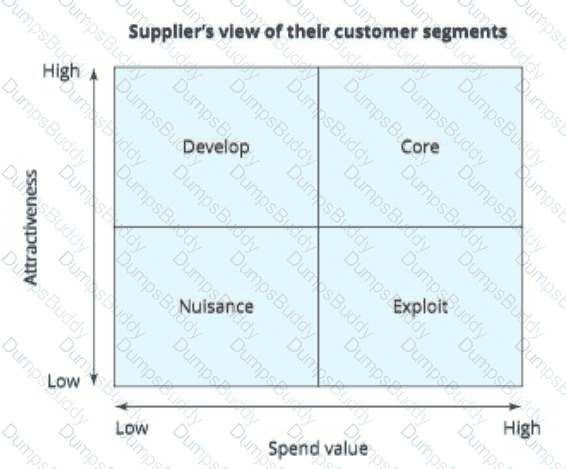
A buying organisation with a low spend and the reputation for paying late might be viewed by a supplier as which of the following?

Options:

A.

Develop

B.

Nuisance

C.

Core

D.

Exploit

Buy Now
Questions 71

The procurement manager of a private healthcare provider is running an IT project. Who are the stakeholders?

General public

Pharmaceutical suppliers

Senior Management

Software support developers

Options:

A.

1 and 3 only

B.

2 and 4 only

C.

3 and 4 only

D.

1 and 2 only

Buy Now
Questions 72

Logibox Ltd sets prices based on what consumers are prepared to pay. Which pricing strategy is this?

Options:

A.

Skimming pricing

B.

Penetration pricing

C.

Market pricing

D.

Premium pricing

Buy Now
Questions 73

Which of the following is potentially a major source of conflict?

Options:

A.

Power imbalance

B.

Information gathering

C.

Shared goals and values

D.

Teamwork

Buy Now
Questions 74

Which of the following are examples of non-verbal negotiation? Select THREE that apply.

Options:

A.

Asking the supplier to repeat their proposal

B.

Getting messages across with facial expressions

C.

/ Speaking softly with long pauses

D.

Communicating with the other party by using gestures

E.

Explaining to the supplier about the scope of the project

F.

Using the body language

Buy Now
Questions 75

Freefields Housing Authority (FHA) is a housing provider that has outsourced a range of management services using fixed-price long-term contracts. FHA’s regular supplier credit reviews have identified that some key outsourced service suppliers are at risk of insolvency due to high inflation rates observed in the macroeconomic climate. Which of the following actions would enable FHA to reduce this risk for the lifetime of the affected contracts?

Options:

A.

Allow affected suppliers to review and resubmit their fixed costs

B.

Introduce indexation of contracts linked to the Consumer Prices Index

C.

End the contracts and procure the services

D.

Offer advance payment terms to the affected suppliers

Buy Now
Questions 76

Which of the following are sources of power in organisational relationships?

Coercive power

Intruded power

Referent power

Tactical power

Options:

A.

1 and 2 only

B.

2 and 4 only

C.

1 and 3 only

D.

1 and 4 only

Buy Now
Questions 77

At the first stage of CIPS Procurement and Supply Cycle (Understand need), which of the following is the most important duty of procurement professional?

Options:

A.

Demand management

B.

Evaluating the interests from suppliers

C.

Undertaking 'reverse marketing'

D.

Deciding whether RFQ or ITT should be used

Buy Now
Questions 78

Which of the following would be considered appropriate influencing techniques in contract negotiation? Select TWO that apply.

Options:

A.

Ratification

B.

Rule ethics

C.

Framing and re-framing

D.

Validation

E.

Anchoring

Buy Now
Questions 79

Cost and price analysis is very important for buyers when they are preparing for a negotiation with supplier. Which of the following is a benefit of knowing supplier's fixed costs?

Options:

A.

The buyer would be able to know the right volume to reach break-even point

B.

The buyer would be able to know the point at which the supplier would reject the offer

C.

With the sole understanding of supplier's fixed cost, the buyer would be able to know the volume at which supplier maximises their profit in short-run

D.

The buyer would be able to get a comprehensive picture of supplier's efficiency

Buy Now
Questions 80

Absorption costing is when the total cost per each unit of output:

Options:

A.

Includes an allocation towards the activity cost of its creation

B.

Includes an allocation towards indirect costs used in its creation

C.

Includes an allocation for a proportion of total production costs

D.

Includes an allocation of producing an additional unit

Buy Now
Questions 81

A procurement professional is sourcing low value items. He conducts market analysis and realise that these items can be provided by many suppliers and switching cost between suppliers is relatively low. He also assume that the relationship between buyer and supplier will be transactional rather than long-term. According to Thomas-Kilmann conflict model instrument, which of the following is the most appropriate style that the procurement professional should adopt when negotiating with these suppliers?

Options:

A.

Avoiding

B.

Compromising

C.

Competing

D.

Collaborating

Buy Now
Questions 82

Which of the following is the purpose of using stakeholder support level scale?

Options:

A.

To identify stakeholder level of influence and interest and plot them on stakeholder map

B.

To identify stakeholder's needs and expectations

C.

To estimate the gap and the progress towards desired levels of support

D.

To identify key stakeholders

Buy Now
Questions 83

Collaborative approach in negotiation not only can fully satisfies the concerns of both, but also ensure that neither party will seek to be opportunistic in later time during the life of the contract. Is this statement true?

Options:

A.

Yes, because all parties must have exactly the same goals in integrative negotiation

B.

No, because any party may leverage its own advantage during the contract

C.

Yes, because both parties have well understood each other's goals when they engage in collaborative negotiation

D.

No, because the parties will always find a compromise solution in integrative approach

Buy Now
Questions 84

A procurement professional is dissatisfied with how a recent negotiation was concluded. What could they do to improve their negotiation approach?

Seek feedback from the supplier on their recent performance

Prepare for all negotiations with a WIN/LOSE (distributive) approach

Involve lots of people in future negotiations

Undertake reflective practice after each negotiation

Options:

A.

1 and 3

B.

2 and 3

C.

1 and 4

D.

3 and 4

Buy Now
Questions 85

Katie is preparing a negotiation with a strategic supplier. Through deep market analysis, she realises that her company and the supplier have equal bargaining power. Via regular communication, Katie knows that both parties are arguing on amount of liquidated damages and neither party shall concede all of their requirements but some are negotiable. Katie and her counterpart from supplying company still desire a long-term relationship and hope that the meeting between them will be a solution for current situation. Which of the following is the most appropriate approach that Katie should adopt to achieve the above outcome?

Options:

A.

Avoiding approach

B.

Competing approach

C.

Compromising approach

D.

Accommodating approach

Buy Now
Questions 86

Which of the following tactics would be appropriate in an integrative negotiation?

Options:

A.

Lowball/Highball

B.

Take it or leave it

C.

Expanding the Pie

D.

Mother Hubbard

Buy Now
Questions 87

Which of the following is considered a weakness of a ‘dealer’ style negotiator?

Options:

A.

May shift position quickly

B.

May be too assertive

C.

Focuses on the facts and not the people

D.

Very precise

Buy Now
Questions 88

Ranjit is sourcing security clothing and PPE from overseas suppliers. He wants to remove foreign-exchange fluctuation risk and has asked suppliers to quote in GBP. Will this remove the fluctuation risk for the hospital?

Options:

A.

No, as the value of the supplier’s currency may decrease

B.

Yes, as the risk will sit with the supplier

C.

No, as the risk will sit with the buyer

D.

Yes, as the value of GBP may increase

Buy Now
Questions 89

Which characteristics are likely to feature within an integrative negotiation?

Maximising the other party’s outcome to enhance relationships

Maximising joint outcomes

Short-term focus

Pursuit of goals held jointly with the other party

Options:

A.

1 and 3 only

B.

1 and 2 only

C.

3 and 4 only

D.

2 and 4 only

Buy Now
Questions 90

Which of the following is the best description of direct cost?

Options:

A.

Direct costs are only variable raw materials that constitute a product

B.

Direct costs include raw materials, labour and overheads

C.

Direct costs include only raw materials and labour of making the final product

D.

Direct costs include raw materials, labour and other expenses attributable to the final product

Buy Now
Questions 91

“Finding the middle ground between buyer and supplier is a satisfactory way to complete contract negotiations.” Is this statement correct?

Options:

A.

Yes, because both parties get as close to their result as possible

B.

Yes, because the buyer will always move further than the supplier

C.

No, because the other party may take advantage if you move position

D.

No, because it will damage your credibility in negotiations

Buy Now
Questions 92

What is the most likely outcome when two organisations with adversarial relationship negotiate with each other?

Options:

A.

Deadlocked

B.

Lose lose

C.

Win lose

D.

Win win

Buy Now
Questions 93

Which of the following would help build trust in a relationship?

Mediation attendance

Regular meetings

Keep promises

Coercion

Options:

A.

2 and 4 only

B.

2 and 3 only

C.

1 and 4 only

D.

1 and 3 only

Buy Now
Questions 94

A building firm has been awarded a contract to build a new office block, and the

building firm needs to separate its direct and indirect costs.

Which one of the following is a direct cost to the building of the new office block?

Options:

A.

Cost of materials

B.

Cost of legal fees

C.

Cost of insurance

D.

Cost of office space

Buy Now
Questions 95

Which of the following is categorised as fixed cost?

Options:

A.

Additional pallet hires due to higher demand in year-end season

B.

Land rental paid in advance

C.

Governments taxes

D.

Raw materials for next year production

Buy Now
Questions 96

Which of the following would cause a demand curve for a good to be price inelastic?

Options:

A.

There are a great number of substitutes for the good

B.

The consultancy service

C.

The luxury goods

D.

The necessary goods

Buy Now
Questions 97

When implementing value analysis or value engineering, which of the following acronyms reminds both buyer and supplier of ideas on removal, substitution and design-out of cost elements?

Options:

A.

SMART

B.

STOPS WASTE

C.

OWN-IT

D.

SAMOA

Buy Now
Questions 98

Which of the following is considered a strength of a ‘logical’ style negotiator?
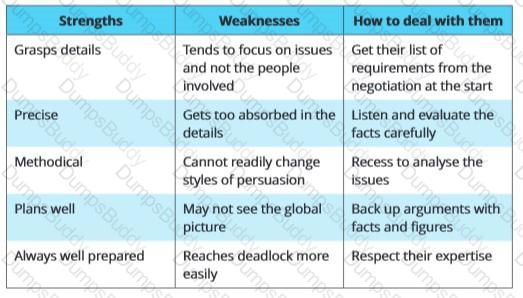
Options:

A.

Assertive

B.

Methodical

C.

Friendly and accessible

D.

Interrelate issues easily and make quick decisions

Buy Now
Questions 99

Which of the following is the first step in the development of negotiation strategies?

Options:

A.

Determining your BATNA

B.

Developing scenarios around possible options

C.

Recognising TOP's needs and wants

D.

Defining overarching objectives

Buy Now
Questions 100

Which of the following are external factors in supplier pricing decisions? Select TWO.

Options:

A.

Competition in the market

B.

Cost of production

C.

Where the product is in its lifecycle

D.

Customer perception of value

E.

Costs of sales

Buy Now
Questions 101

Lina Rawlins, a senior buyer, asks a supplier: “Can you tell me exactly what you are doing to ensure quality?” What type of question is this?

Options:

A.

Hypothetical

B.

Reflective

C.

Probing

D.

Leading

Buy Now
Questions 102

Which of the following is a source of information on microeconomic factors?

Options:

A.

The marketing and corporate communications of suppliers

B.

Published economic indices such as the Retail Price Index (RPI)

C.

Analysis published in the mainstream and financial media

D.

Data published by financial markets and commodity exchanges

Buy Now
Questions 103

Macroeconomics can have an impact on commercial negotiations. Is this statement correct?

Options:

A.

Yes, because factors such as inflation might influence pricing decisions

B.

No, because these considerations only affect the buyer

C.

Yes, because sales volumes are a key factor in the discussions

D.

No, because these macroeconomics can be discussed and addressed with a WIN/WIN (integrative) strategy

Buy Now
Questions 104

Which of the following is the definition of safety margin?

Options:

A.

The difference between current or forecasted sales and sales at the break-even point

B.

The amount of revenue that remains after subtracting costs directly associated with production

C.

The production level at which total revenues for a product equal total expenses

D.

The incremental money generated for each product/unit sold after deducting the variable costs

Buy Now
Questions 105

Community Meal Partners (CMP) is a not-for-profit company that delivers cooked meals to older residents in their homes. CMP uses a fleet of bespoke vans with onboard ovens. In planning the future procurement of the fleet, CMP has conducted a review of the microeconomics of the van supply market and found that the vans are supplied by a monopoly supplier due to patented technology. Which of the following strategies could CMP utilise to optimise its bargaining position with the van supplier?

Options:

A.

Publicly seek alternative service solutions

B.

Renegotiate van lease prices with the supplier

C.

Procure shorter-term lease contracts

D.

Conduct regular and frequent tendering

Buy Now
Questions 106

Telephone is most likely to be used for which of the following negotiations?

Options:

A.

High value contract

B.

Contract for purchasing a specialised product

C.

Routine transactions

D.

Complex one-off purchase

Buy Now
Questions 107

A public agency opens a tendering process for a road building project that lasts approximately 1 year. They post their requirements on public journal and receive some interests. After conducting due diligence process and selecting the lowest bidder, the project commences. However, the supplier complains that price of material increases because of a shortage of supply, then they demands an 5% uptick in contract value. The agency investigates the increment and sees that there is indeed a fluctuation in prices of supplier's input. They are likely to accept the proposal, but they are also concerned that supplier may demand more. To avoid making another concession with the supplier, which of the following should be a priority action of the agency?

Options:

A.

Disapprove supplier's demands until they finish the project

B.

Seek approval from higher authority

C.

Document a contract variation that only allows another concession if some specific conditions arise

D.

Postpone the decision making until the budget is ready

Buy Now
Questions 108

Which of the following method should be used in negotiation if both parties want to communicate verbally and non-verbally without having to meet face-to-face?

Options:

A.

Web conferencing

B.

Telephone

C.

Teleconferencing

D.

In-person meeting

Buy Now
Questions 109

A buying organisation with a low spend but the reputation for paying on-time. In order to increase buyer's leverage in negotiation with suppliers, which of the following should be a priority of this buyer?

Options:

A.

Unclear tender award criteria

B.

Volume separation

C.

Spend concentration

D.

Unavailable technical support

Buy Now
Questions 110

Which of the following are most likely to turn buying organisation into an unattractive customer in supplier's perspective? Select TWO that apply.

Options:

A.

Demands for kickback

B.

Reduced paperwork in procurement processes

C.

Adopting clear and concise CSR policies

D.

Unclear tender award criteria

E.

Using SRM technology

Buy Now
Questions 111

Buyers should have the ability to analyse the costs of their purchases not only for determining their impact to their organisation’s cost but also for the purpose of reducing them during commercial negotiations to contribute to the profitability of their organisation. One way ofanalysing costs is to classify them into direct and indirect costs. Which ONE of the following is an explanation of ‘direct costs’?

Options:

A.

Costs that are only related to manufacturing firms where raw materials are directly converted into specific product units

B.

Costs of materials, labour, and other expenses that are directly identified with manufactured units of a product

C.

Costs that are connected with materials and labour, excluding expenses used directly in manufacturing products

D.

Costs of labour and expenses incurred directly whether or not the production fluctuates owing to demand or downtime

Buy Now
Questions 112

Different types of relationships impact negotiations. Which source of leverage would most support the buyer?

Options:

A.

Legitimate power

B.

Personality power

C.

Powerful colleagues

D.

Friends power

Buy Now
Questions 113

Which of the following are examples of variable costs?

Building and site rent

Annual insurance premium

Raw materials expenditure

Delivery costs for materials

Options:

A.

1 and 3

B.

2 and 3

C.

1 and 4

D.

3 and 4

Buy Now
Exam Code: L4M5
Exam Name: Commercial Negotiation
Last Update: Jan 19, 2026
Questions: 377

PDF + Testing Engine

$134.99

Testing Engine

$99.99

PDF (Q&A)

$84.99