DP-750 Implementing Data Engineering Solutions Using Azure Databricks Questions and Answers
You have an Azure Databricks workspace that contains a Delta table named Table 1. Table 1 has accumulated obsolete files.
You need to reduce storage costs. The solution must preserve 30 days of time travel history. Which two actions should you perform? Each correct answer presents part of the solution.
NOTE: Each correct selection is worth one point.
You have an Azure Databricks workspace.
Users report that a Databricks notebook that runs each day takes longer than expected to run.
When reading the Directed Acyclic Graph (DAG), you discover the following issues concerning the Apache Spark stage:
• Most tasks in the stage finish quickly.
• A few tasks in the stage run more slowly.
• The CPU is underutilized at the end of the stage.
• The slow tasks process many more input records.
• The stage is blocked while it waits for the few slow tasks.
What is the root cause of the issues?
Which ingestion option should you recommend for each data source? To answer, drag the appropriate options to the correct data sources. Each option may be used once, more than once, or not at all. You may need to drag the split bar between panes or scroll to view content.
NOTE: Each correct selection is worth one point.
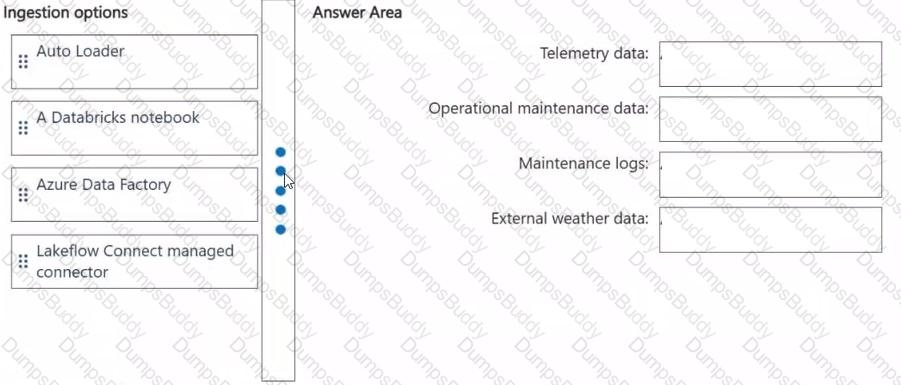
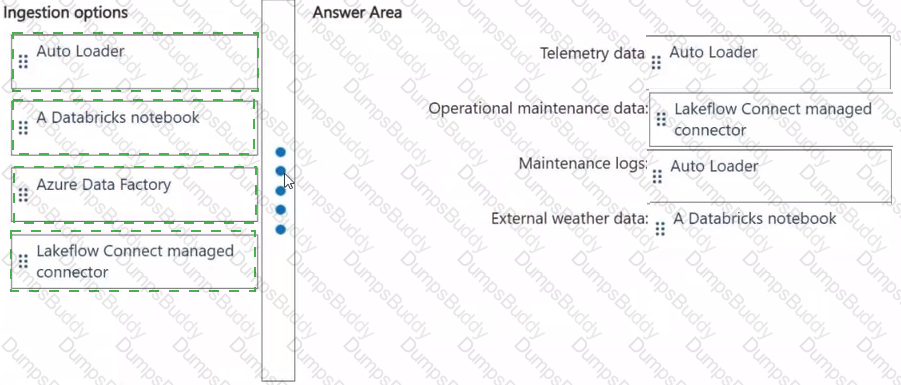
You need to configure compute for the ingestion of telemetry data. The solution must meet the data ingestion and processing requirements.
What should you do?
You need to recommend a compute type for the production ingestion workloads and BI workloads. The solution must meet the environment and compute requirements.
What should you recommend for each type of workload? To answer, select the appropriate options in the answer area.
NOTE: Each correct selection is worth one point.
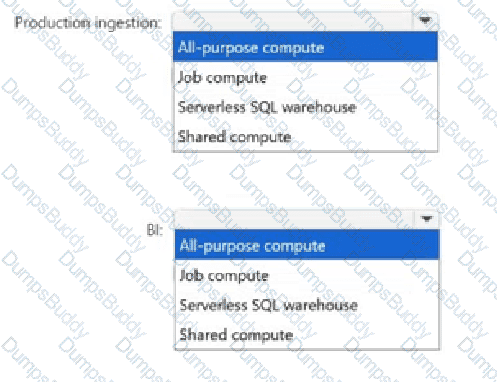
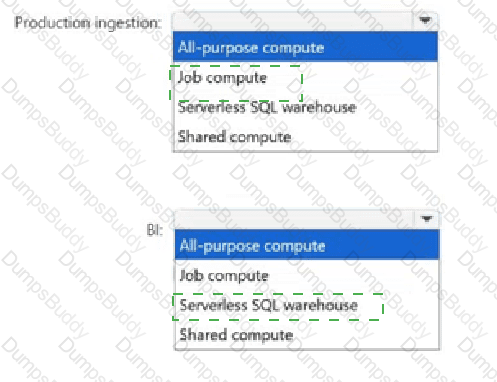
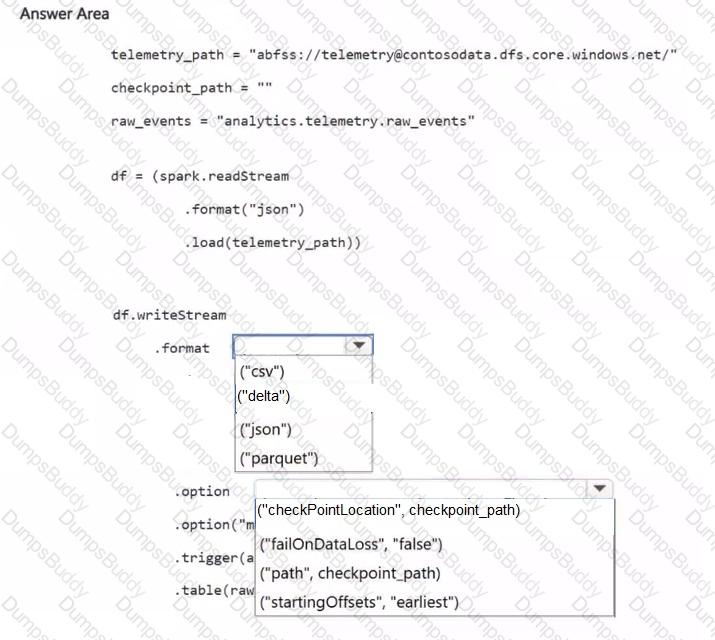
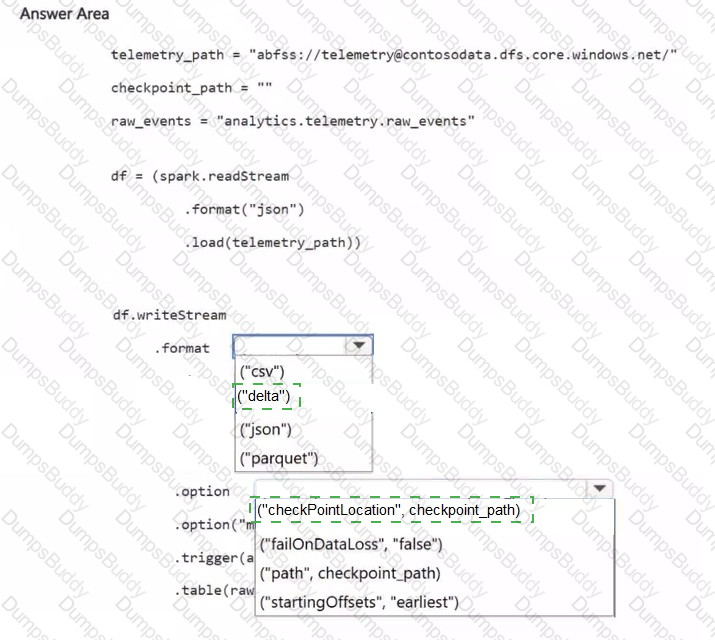
You need to complete the PySpark code for the Spark Structured Streaming pipelines. The solution must meet the data ingestion and processing requirements.
How should you complete the code segment? To answer, select the appropriate options in the answer area.
NOTE: Each correct selection is worth one point.
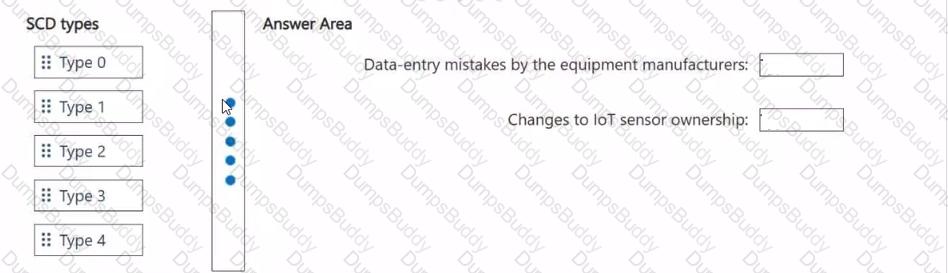
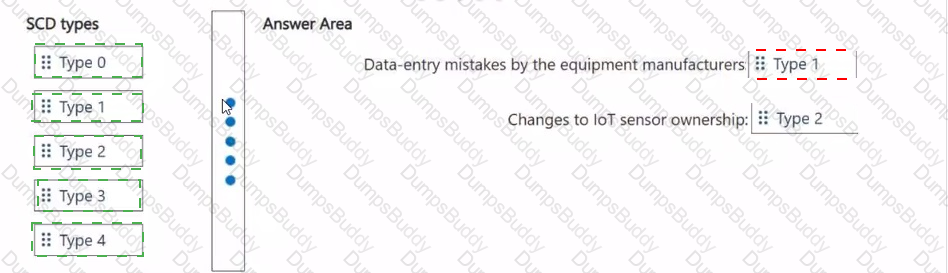
Which SCD type should you use to support the planned data modeling changes? To answer, drag the appropriate types to the correct issues. Each type may be used once, more than once, or not at all. You may need to drag the split bar between panes or scroll to view content.
NOTE: Each correct selection is worth one point.
You need to develop the task logic for a new job in Lakeflow Jobs that processes telemetry data.
Each task must contain only the appropriate logic for its step in the pipeline. The solution must support the planned changes and meet the data ingestion and processing requirements.
What should you do?
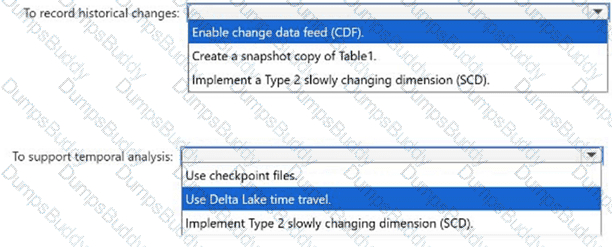
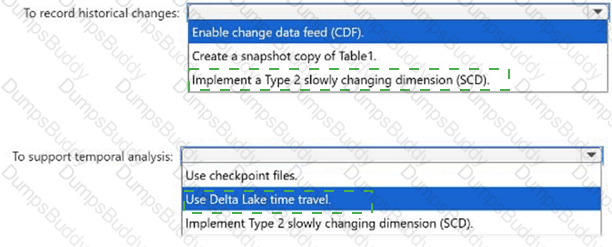
You have an Azure Databricks workspace that is enabled for Unity Catalog and contains a managed Delta table named Table1.
Table1 stores customer profile data.
Business users must analyze how customer profile records change over time. They must also be able to query earlier versions of the table.
You need to implement a solution that:
Maintains persistent historical versions of customer profile records for long-term analysis.
Allows users to query earlier versions of the Delta table.
Minimizes maintenance effort.
What should you do? To answer, select the appropriate options in the answer area.
NOTE: Each correct selection is worth one point.
You have an Azure Databricks workspace named Workspace1 that contains a lakehouse and is enabled for Unity Catalog.
You have a connection to a Microsoft SQL Server database named DB1.
You need to expose the schemas and tables of DB1 to meet the following requirements:
• The schemas and tables can be queried in Databricks.
• The schemas and tables appear alongside other Unity Catalog objects.
• The data is NOT copied into Databricks-managed storage.
Solution: You create a foreign catalog in Catalog Explorer.
Does this meet the goal?
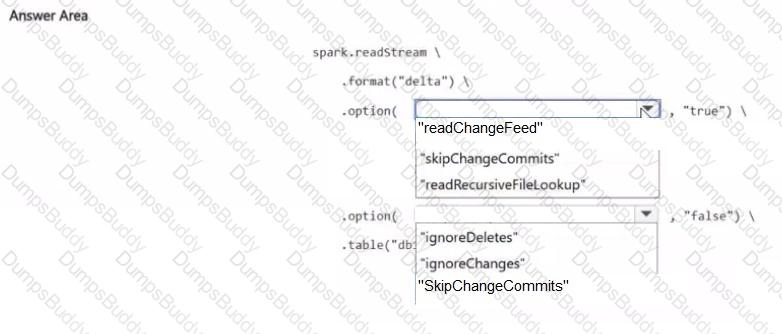
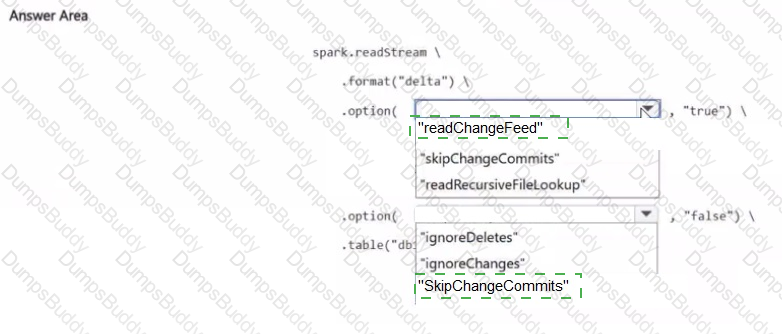
You have an Azure Databricks workspace that is enabled for Unity Catalog and contains a Delta table named db1.sales_orders.
dbl sales_orders is updated nightly and has change data feed (CDF) enabled.
You need to ingest all the changes from the dbl.sales.ordets table, including inserts, updates, and deletes, into a downstream pipeline.
How should you complete the PsySpark code segment? To answer, select the appropriate options in the answer area.
NOTE: Each correct selection is worth one point.
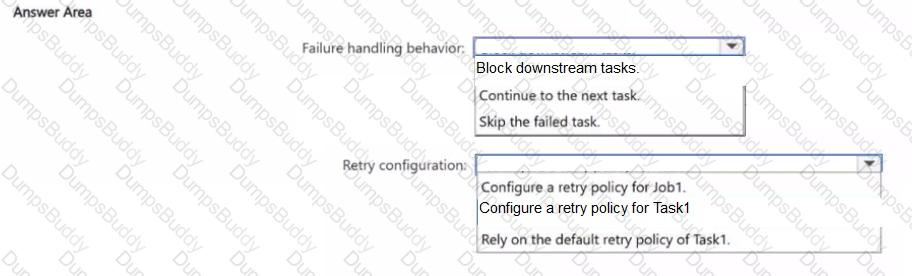
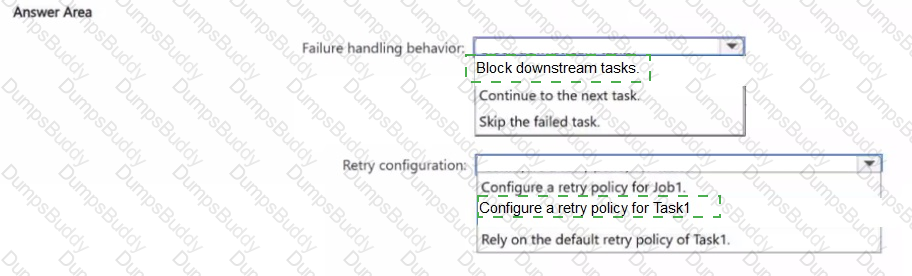
You have an Azure Databricks job named Job1 that contains an ingestion task named Task1 and transformation task named Task2. You need to ensure that if Task1 fails, the task retries automatically, and Task2 is prevented from running How should you configure Job1? To answer, select the appropriate options in the answer area.
NOTE: Each correct selection is worth one point.
You have an Azure Databricks workspace that is enabled for Unity Catalog.
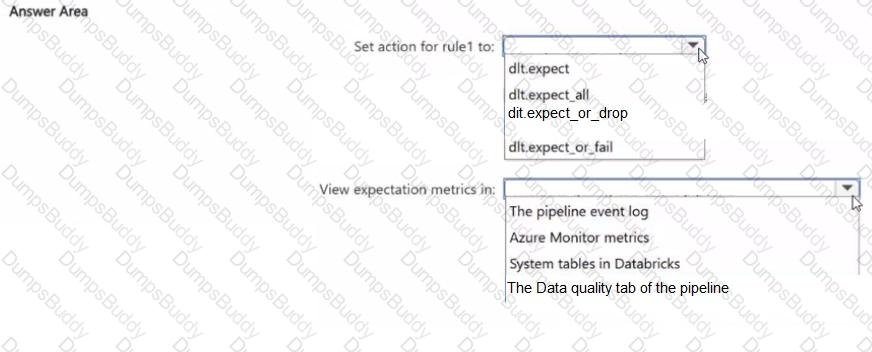
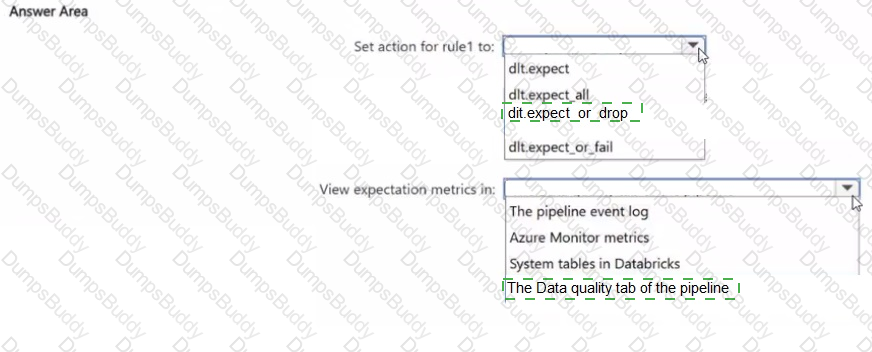
You have a Lakeflow Spark Declarative Pipelines (SDP) pipeline that writes records to a Delta table named Table1 by using a data quality rule named rule1
You need to meet the following requirements:
• Records that violate rule! must NOT be written to Table1. but the pipeline must continue processing valid records.
• Data engineers must be able to review expectation metrics by using minimal development effort.
What should you do? To answer, select the appropriate options in the answer area.
NOTE: Each correct selection is worth one point.
You have an Azure Databricks workspace that is enabled for Unity Catalog
You have an Apache Spark Structured Streaming job that writes data to a Delta table.
After the cluster restarts, the streaming job reprocesses previously ingested data
You need to prevent the streaming job from reprocessing the data after the cluster restarts.
What should you do?
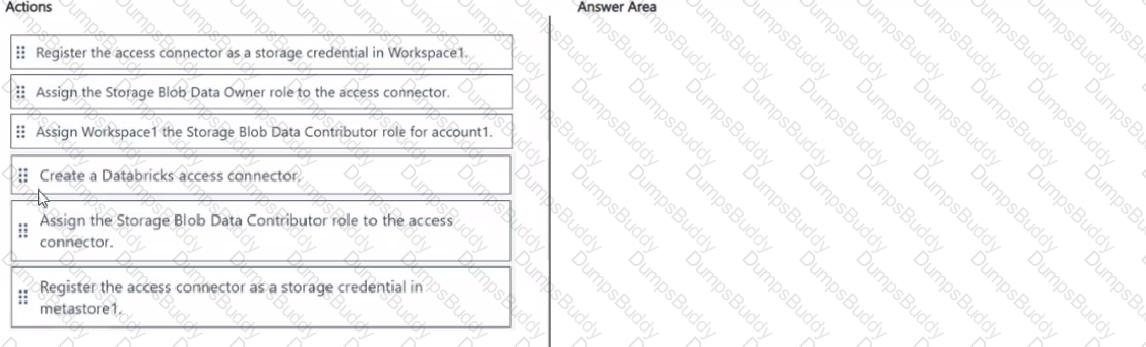
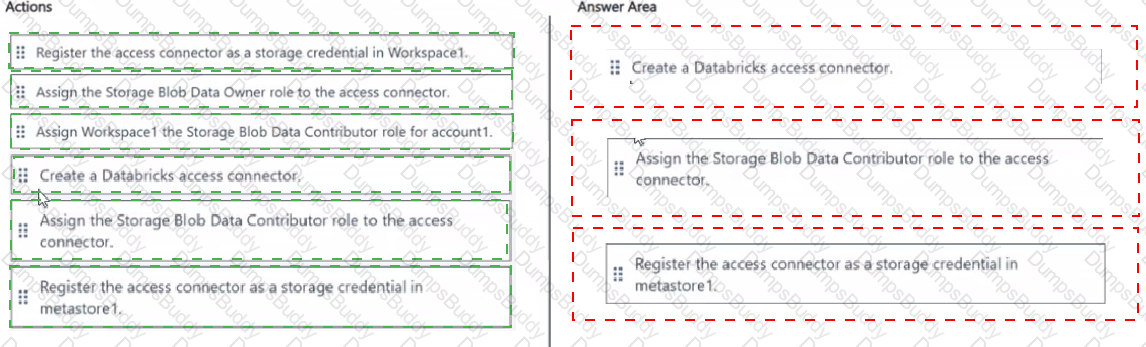
You have an Azure Databricks workspace named Workspace1 that is attached to a Unity Catalog metastore named metastore1
You need to register an Azure Storage account named account1 that has a hierarchical namespace enabled as an external location The external location must use a managed identity to authenticate to account1 and the solution must follow the principle of least privilege.
Which three actions should you perform in sequence ' To answer, move the appropriate actions from the list of actions to the answer area and arrange them in the correct order.
You have an Azure Databricks workspace.
You have an Apache Spark Structured Streaming job named Job! that processes data continuously and fails periodically due to transient errors
You need to ensure that Job! meets the following requirements
• Resumes processing from the point that Job1 failed
• Minimizes how long it takes to restart Job!
• Minimizes the costs to restart Job!
What should you do?
You have an Azure Databricks workspace that uses serverless compute.
You need to ingest data by using Lakeflow Jobs. New records must be processed as soon as they become available.
Which type of job trigger should you use for the ingestion?
PDF + Testing Engine

Testing Engine
PDF (Q&A)