Pre-Winter Sale 70% Discount Offer - Ends in 0d 00h 00m 00s - Coupon code: best70

NSE5_FWB_AD-8.0 Fortinet NSE 5 - FortiWeb 8.0 Administrator Questions and Answers

Questions 4

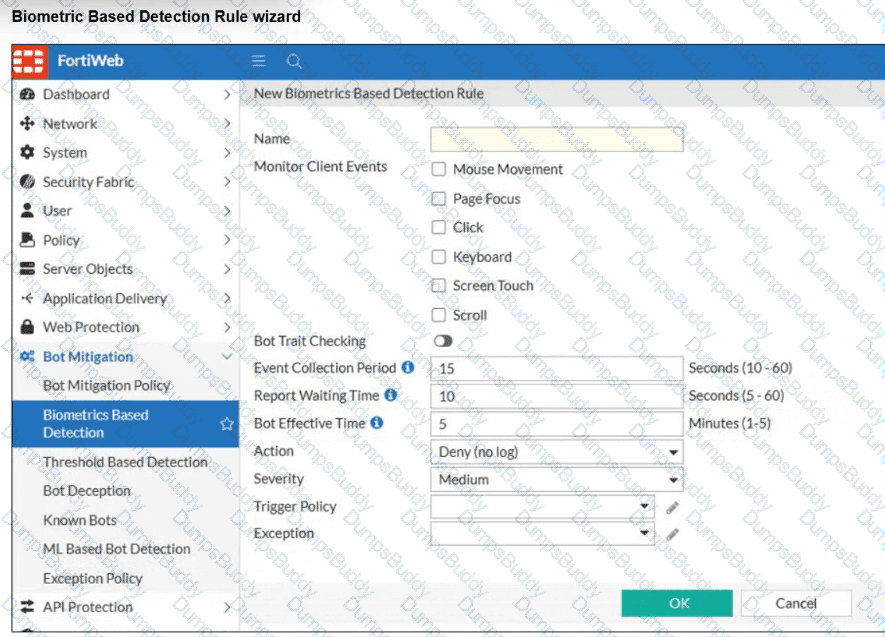
Refer to the exhibit.

NSE5_FWB_AD-8.0 Question 4

You are a FortiWeb administrator reviewing the biometrics-based detection rule shown in the exhibit. Your goal is to configure a rule that detects bots that avoid typical human interactions like using a mouse or clicking. You also want to log the detection event and apply a high-severity alert.

Based on the current configuration, which settings should you change to meet this goal?

Options:

A.

Select Screen Touch and Page Focus , set the severity to Low , and keep action as Deny (no log) .

B.

Select Keyboard and Scroll , change the action to Alert , and set the severity to High .

C.

Select Mouse Movement and Click , change the action to Alert , and set the severity to High .

D.

Do not select any client events to monitor, enable Bot Trait Checking , keep the current severity, and keep the action as Deny (no log) .

Buy Now
Questions 5

You recently deployed two FortiWeb devices in an active-active (A-A) high availability (HA) cluster.

During routine maintenance, you want to confirm that the cluster is synchronizing the correct configuration areas and that both FortiWeb devices behave consistently in production.

As the FortiWeb administrator, which two configuration areas should you examine to verify that HA synchronization is functioning correctly? (Choose two.)

Options:

A.

Check the network configuration on both FortiWeb devices—such as interfaces and static routes—to ensure they are aligned.

B.

Review policy configurations, including server policies and protection profiles, to confirm they match across the cluster.

C.

Review inspection and mitigation log files to determine if they are being replicated across both FortiWeb devices.

D.

Verify whether firmware images and upgrade history are synchronized between the FortiWeb devices.

Buy Now
Questions 6

You are a FortiWeb administrator investigating an SQL injection attack on your company’s customer portal. The network firewall and intrusion prevention system (IPS) did not stop the attack.

You decide to deploy a web application firewall (WAF) to help prevent this type of attack.

Which two actions can you take to block application-layer threats? (Choose two.)

Options:

A.

Focus on client-side risks, such as protecting user browsers.

B.

Inspect general network traffic equally between clients and servers.

C.

Detect and block threats like SQL injection, cross-site scripting (XSS), and other Layer 7 attacks.

D.

Filter and analyze HTTP/S requests to block attacks targeting the web server.

Buy Now
Questions 7

A FortiWeb administrator wants to stop coordinated scraping traffic coming from several IP addresses, each making only a few requests so thresholds never trigger.

Which tactic should the administrator deploy to identify botnets using shared behavioral signals instead of volume?

Options:

A.

A DoS protection profile with extremely low request limits for the entire site.

B.

A static blocklist for all IP addresses seen in logs, even if most appear only once.

C.

Bot mitigation with device fingerprinting to correlate clients by behavior, headers, and JavaScript challenges instead of IP address volume.

D.

A web application firewall (WAF) rule that blocks every user agent that is not on a manually created allowlist.

Buy Now
Questions 8

A third-party penetration test reveals that users can bypass login controls through a mobile API. Your current FortiWeb configuration includes zero trust network access (ZTNA) profiles and cookie security, but API protection and client management are not enabled. The security team asks you to recommend the most effective way to close this gap.

Which FortiWeb adjustment would best prevent future unauthorized API access?

Options:

A.

Switch to a reverse-proxy mode to bypass cookie-based controls.

B.

Enable API protection and client management to enforce identity checks on mobile API traffic.

C.

Replace ZTNA with bot protection to reduce false positives.

D.

Log only API traffic and rely on FortiAnalyzer for future alerts.

Buy Now
Questions 9

A FortiWeb administrator wants to create a machine learning (ML)-based bot detection system.

Which three actions must the administrator take to build and activate this ML model? (Choose three.)
Options:

A.

Collect traffic samples for training.

B.

Verify the model manually on test data only.

C.

Apply Bayesian analysis to the model output.

D.

Build the detection model using collected data.

E.

Run the model in the live environment.

Buy Now
Questions 10

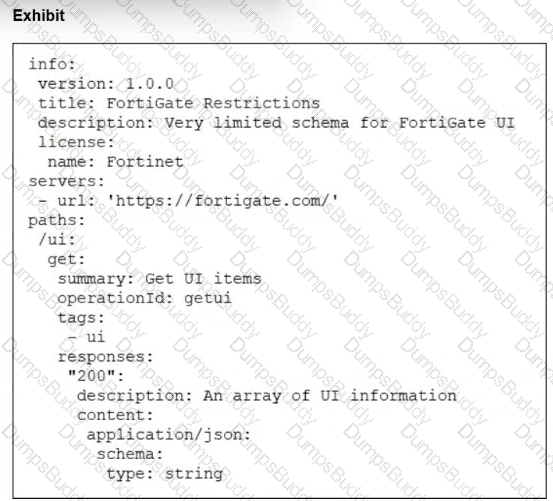
Refer to the exhibit.

NSE5_FWB_AD-8.0 Question 10

What does the exhibit show?

Options:

A.

The FortiGate UI interface in HTML.

B.

A sample response returned by the FortiGate API at https://fortigate.com/ui.

C.

The result of a show ui details command on a FortiWeb server.

D.

An API schema file.

Buy Now
Exam Code: NSE5_FWB_AD-8.0
Exam Name: Fortinet NSE 5 - FortiWeb 8.0 Administrator
Last Update: Sep 18, 2026
Questions: 36

PDF + Testing Engine

$134.99

Testing Engine

$99.99

PDF (Q&A)

$84.99