Halloween Sale Special 75% Discount Offer - Ends in 0d 00h 00m 00s - Coupon code: budy75

Databricks-Generative-AI-Engineer-Associate Databricks Certified Generative AI Engineer Associate Questions and Answers

Questions 4

A Generative Al Engineer wants their (inetuned LLMs in their prod Databncks workspace available for testing in their dev workspace as well. All of their workspaces are Unity Catalog enabled and they are currently logging their models into the Model Registry in MLflow.

What is the most cost-effective and secure option for the Generative Al Engineer to accomplish their gAi?

Options:

A.

Use an external model registry which can be accessed from all workspaces

B.

Setup a script to export the model from prod and import it to dev.

C.

Setup a duplicate training pipeline in dev, so that an identical model is available in dev.

D.

Use MLflow to log the model directly into Unity Catalog, and enable READ access in the dev workspace to the model.

Buy Now
Questions 5

A Generative Al Engineer is working with a retail company that wants to enhance its customer experience by automatically handling common customer inquiries. They are working on an LLM-powered Al solution that should improve response times while maintaining a personalized interaction. They want to define the appropriate input and LLM task to do this.

Which input/output pair will do this?

Options:

A.

Input: Customer reviews; Output Group the reviews by users and aggregate per-user average rating, then respond

B.

Input: Customer service chat logs; Output Group the chat logs by users, followed by summarizing each user ' s interactions, then respond

C.

Input: Customer service chat logs; Output: Find the answers to similar questions and respond with a summary

D.

Input: Customer reviews: Output Classify review sentiment

Buy Now
Questions 6

A Generative AI Engineer has been asked to build an LLM-based question-answering application. The application should take into account new documents that are frequently published. The engineer wants to build this application with the least cost and least development effort and have it operate at the lowest cost possible.

Which combination of chaining components and configuration meets these requirements?

Options:

A.

For the application a prompt, a retriever, and an LLM are required. The retriever output is inserted into the prompt which is given to the LLM to generate answers.

B.

The LLM needs to be frequently with the new documents in order to provide most up-to-date answers.

C.

For the question-answering application, prompt engineering and an LLM are required to generate answers.

D.

For the application a prompt, an agent and a fine-tuned LLM are required. The agent is used by the LLM to retrieve relevant content that is inserted into the prompt which is given to the LLM to generate answers.

Buy Now
Questions 7

A Generative AI Engineer received the following business requirements for an external chatbot.

The chatbot needs to know what types of questions the user asks and routes to appropriate models to answer the questions. For example, the user might ask about upcoming event details. Another user might ask about purchasing tickets for a particular event.

What is an ideal workflow for such a chatbot?

Options:

A.

The chatbot should only look at previous event information

B.

There should be two different chatbots handling different types of user queries.

C.

The chatbot should be implemented as a multi-step LLM workflow. First, identify the type of question asked, then route the question to the appropriate model. If it’s an upcoming event question, send the query to a text-to-SQL model. If it’s about ticket purchasing, the customer should be redirected to a payment platform.

D.

The chatbot should only process payments

Buy Now
Questions 8

A Generative AI Engineer has created a RAG application which can help employees retrieve answers from an internal knowledge base, such as Confluence pages or Google Drive. The prototype application is now working with some positive feedback from internal company testers. Now the Generative Al Engineer wants to formally evaluate the system’s performance and understand where to focus their efforts to further improve the system.

How should the Generative AI Engineer evaluate the system?

Options:

A.

Use cosine similarity score to comprehensively evaluate the quality of the final generated answers.

B.

Curate a dataset that can test the retrieval and generation components of the system separately. Use MLflow’s built in evaluation metrics to perform the evaluation on the retrieval and generation components.

C.

Benchmark multiple LLMs with the same data and pick the best LLM for the job.

D.

Use an LLM-as-a-judge to evaluate the quality of the final answers generated.

Buy Now
Questions 9

A Generative AI Engineer is developing an agent system using a popular agent-authoring library. The agent comprises multiple parallel and sequential chains. The engineer encounters challenges as the agent fails at one of the steps, making it difficult to debug the root cause. They need to find an appropriate approach to research this issue and discover the cause of failure. Which approach do they choose?

Options:

A.

Enable MLflow tracing to gain visibility into each agent ' s behavior and execution step.

B.

Run MLflow.evaluate to determine root cause of failed step.

C.

Implement structured logging within the agent ' s code to capture detailed execution information.

D.

Deconstruct the agent into independent steps to simplify debugging.

Buy Now
Questions 10

A Generative Al Engineer has developed an LLM application to answer questions about internal company policies. The Generative AI Engineer must ensure that the application doesn’t hallucinate or leak confidential data.

Which approach should NOT be used to mitigate hallucination or confidential data leakage?

Options:

A.

Add guardrails to filter outputs from the LLM before it is shown to the user

B.

Fine-tune the model on your data, hoping it will learn what is appropriate and not

C.

Limit the data available based on the user’s access level

D.

Use a strong system prompt to ensure the model aligns with your needs.

Buy Now
Questions 11

A Generative AI Engineer is developing an LLM application that users can use to generate personalized birthday poems based on their names.

Which technique would be most effective in safeguarding the application, given the potential for malicious user inputs?

Options:

A.

Implement a safety filter that detects any harmful inputs and ask the LLM to respond that it is unable to assist

B.

Reduce the time that the users can interact with the LLM

C.

Ask the LLM to remind the user that the input is malicious but continue the conversation with the user

D.

Increase the amount of compute that powers the LLM to process input faster

Buy Now
Questions 12

A Generative Al Engineer is creating an LLM system that will retrieve news articles from the year 1918 and related to a user ' s query and summarize them. The engineer has noticed that the summaries are generated well but often also include an explanation of how the summary was generated, which is undesirable.

Which change could the Generative Al Engineer perform to mitigate this issue?

Options:

A.

Split the LLM output by newline characters to truncate away the summarization explanation.

B.

Tune the chunk size of news articles or experiment with different embedding models.

C.

Revisit their document ingestion logic, ensuring that the news articles are being ingested properly.

D.

Provide few shot examples of desired output format to the system and/or user prompt.

Buy Now
Questions 13

A Generative Al Engineer is building a system that will answer questions on currently unfolding news topics. As such, it pulls information from a variety of sources including articles and social media posts. They are concerned about toxic posts on social media causing toxic outputs from their system.

Which guardrail will limit toxic outputs?

Options:

A.

Use only approved social media and news accounts to prevent unexpected toxic data from getting to the LLM.

B.

Implement rate limiting

C.

Reduce the amount of context Items the system will Include in consideration for its response.

D.

Log all LLM system responses and perform a batch toxicity analysis monthly.

Buy Now
Questions 14

A Generative AI Engineer is evaluating a customer-support agent in Databricks. The team needs to score each response on a domain-specific policy: the answer must cite an approved refund rule and must not mention unsupported escalation paths. Built-in evaluation metrics do not capture this logic. The team wants the metric to run during agent evaluation in Databricks and return a repeatable, structured score for each trace.

Which approach should the engineer use?

Options:

A.

Use only latency and token-count metrics because custom policy checks are not supported in evaluation workflows.

B.

Log the traces to MLflow v3.x and review failures in the UI without defining a scorer.

C.

Add the policy text to the system prompt and rely on the model’s self-reported compliance as the evaluation result.

D.

Create a custom MLflow scorer that inspects agent outputs against the policy and pass it into the evaluation run.

Buy Now
Questions 15

A generative AI engineer is deploying an AI agent authored with MLflow’s ChatAgent interface for a retail company ' s customer support system on Databricks. The agent must handle thousands of inquiries daily, and the engineer needs to track its performance and quality in real-time to ensure it meets service-level agreements. Which metrics are automatically captured by default and made available for monitoring when the agent is deployed using the Mosaic AI Agent Framework?

Options:

A.

Operational metrics like request volume, latency, and errors

B.

Quality metrics like correctness and guideline adherence

C.

Both operational and quality metrics

D.

No metrics are automatically captured

Buy Now
Questions 16

A Generative AI Engineer has deployed a RAG application to production. Its Vector Search index is built from a Delta table that receives incremental updates every hour from an upstream ETL pipeline. The team wants the index to automatically reflect source-table changes without manual re-indexing and without changing the endpoint used by downstream applications.

Which approach should the engineer use?

Options:

A.

Replace the current index with a Direct Vector Access index and push updates through a custom streaming job.

B.

Update the pipeline mode to continuous mode rather than triggered mode.

C.

Schedule a job to rebuild the index every hour after the ETL pipeline finishes.

D.

Use a Delta Sync index so changes in the source Delta table are automatically synchronized to the index.

Buy Now
Questions 17

A company selling gourmet mushroom-growing supplies has a script that runs once per day to scrape various social media platforms for posts that mention its name. The scraped text data is loaded into a Delta table each night for a downstream processing task that summarizes each post and its sentiment for internal use. Given the small size of the company, it only receives a couple hundred posts per day.

Which solution best optimizes for cost and ease of implementation?

Options:

A.

Schedule a nightly job to call OpenAI’s batch inference API, save the results, and terminate the cluster.

B.

Schedule a nightly SQL query with ai_query() calling a pay-per-token endpoint.

C.

Schedule a nightly SQL query with ai_query() calling a provisioned-throughput endpoint.

D.

Schedule a nightly job that runs a notebook to download the model locally, process the records, and terminate the cluster.

Buy Now
Questions 18

A Generative Al Engineer is developing a RAG system for their company to perform internal document Q & A for structured HR policies, but the answers returned are frequently incomplete and unstructured It seems that the retriever is not returning all relevant context The Generative Al Engineer has experimented with different embedding and response generating LLMs but that did not improve results.

Which TWO options could be used to improve the response quality?

Choose 2 answers

Options:

A.

Add the section header as a prefix to chunks

B.

Increase the document chunk size

C.

Split the document by sentence

D.

Use a larger embedding model

E.

Fine tune the response generation model

Buy Now
Questions 19

A Generative AI Engineer is integrating Mosaic AI Vector Search into a Retrieval-Augmented Generation (RAG) system. The source data, comprising simple text entries, is stored in a Delta table. To simplify the workflow, the engineer plans to use an embedding model served via a Mosaic AI Model Serving endpoint to automatically compute embeddings during data synchronization from the Delta table to the vector search index.

Which method should the engineer use to achieve this integration?

Options:

A.

Delta Sync index with self-managed embeddings.

B.

Direct Vector Access index.

C.

Hybrid embedding computing.

D.

Delta Sync index with managed embeddings.

Buy Now
Questions 20

A Generative Al Engineer is setting up a Databricks Vector Search that will lookup news articles by topic within 10 days of the date specified An example query might be " Tell me about monster truck news around January 5th 1992 " . They want to do this with the least amount of effort.

How can they set up their Vector Search index to support this use case?

Options:

A.

Split articles by 10 day blocks and return the block closest to the query.

B.

Include metadata columns for article date and topic to support metadata filtering.

C.

pass the query directly to the vector search index and return the best articles.

D.

Create separate indexes by topic and add a classifier model to appropriately pick the best index.

Buy Now
Questions 21

A Generative AI Engineer needs to allocate costs for an agent deployed via Agent Framework behind AI Gateway. The finance team requires daily reporting by workspace and endpoint, including token usage and request counts. The engineer wants to query this data with SQL and join it to an internal cost-center mapping table.

Which table type best serves their needs?

Options:

A.

AI Gateway usage table.

B.

System Serving, Served Entities table.

C.

Inference Tables.

D.

MLflow experiment run tables.

Buy Now
Questions 22

A Generative AI Engineer is building an interactive catalog for a company’s inventory system that allows users to search for any item using a plain-text description. There are currently about 17,000 items, and new items are not frequently added. They need a solution that will be the most cost-effective and easy for the company to maintain.

Which solution should the engineer choose?

Options:

A.

Storage-optimized vector search with a Direct Vector Access index, triggered sync.

B.

Standard vector search with Databricks-managed embeddings and a Delta Sync index, continuous sync.

C.

Standard vector search with self-managed embeddings and a Delta Sync index, continuous sync.

D.

Standard vector search with Databricks-managed embeddings and a Delta Sync index, triggered sync.

Buy Now
Questions 23

A Generative AI Engineer has been asked to design an LLM-based application that accomplishes the following business objective: answer employee HR questions using HR PDF documentation.

Which set of high level tasks should the Generative AI Engineer ' s system perform?

Options:

A.

Calculate averaged embeddings for each HR document, compare embeddings to user query to find the best document. Pass the best document with the user query into an LLM with a large context window to generate a response to the employee.

B.

Use an LLM to summarize HR documentation. Provide summaries of documentation and user query into an LLM with a large context window to generate a response to the user.

C.

Create an interaction matrix of historical employee questions and HR documentation. Use ALS to factorize the matrix and create embeddings. Calculate the embeddings of new queries and use them to find the best HR documentation. Use an LLM to generate a response to the employee question based upon the documentation retrieved.

D.

Split HR documentation into chunks and embed into a vector store. Use the employee question to retrieve best matched chunks of documentation, and use the LLM to generate a response to the employee based upon the documentation retrieved.

Buy Now
Questions 24

A Generative Al Engineer at an automotive company would like to build a question-answering chatbot for customers to inquire about their vehicles. They have a database containing various documents of different vehicle makes, their hardware parts, and common maintenance information.

Which of the following components will NOT be useful in building such a chatbot?

Options:

A.

Response-generating LLM

B.

Invite users to submit long, rather than concise, questions

C.

Vector database

D.

Embedding model

Buy Now
Questions 25

A Generative Al Engineer has already trained an LLM on Databricks and it is now ready to be deployed.

Which of the following steps correctly outlines the easiest process for deploying a model on Databricks?

Options:

A.

Log the model as a pickle object, upload the object to Unity Catalog Volume, register it to Unity Catalog using MLflow, and start a serving endpoint

B.

Log the model using MLflow during training, directly register the model to Unity Catalog using the MLflow API, and start a serving endpoint

C.

Save the model along with its dependencies in a local directory, build the Docker image, and run the Docker container

D.

Wrap the LLM’s prediction function into a Flask application and serve using Gunicorn

Buy Now
Questions 26

Which of the following statements accurately identifies differences between the evaluation phase and the monitoring phase in the Generative AI application lifecycle within Databricks?

Options:

A.

The evaluation phase uses Mosaic AI Agent Evaluation and an evaluation dataset to assess an agent’s performance metrics and traces, while the monitoring phase relies on inference tables as source data for creating a metrics profile.

B.

The evaluation phase logs and traces live API calls in production, while the monitoring phase runs metrics on inference tables containing those traces.

C.

The evaluation phase ensures the agent’s responses comply with business rules in production, whereas the monitoring phase is focused on SLA and performance metrics.

D.

The evaluation phase uses all inference history to assess agent performance and readiness for production, while the monitoring phase uses only new inference-table records to monitor performance.

Buy Now
Questions 27

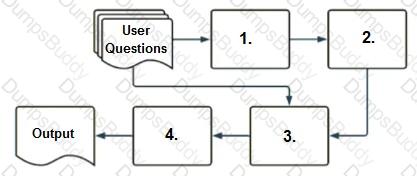
A company has a typical RAG-enabled, customer-facing chatbot on its website.
Databricks-Generative-AI-Engineer-Associate Question 27

Select the correct sequence of components a user ' s questions will go through before the final output is returned. Use the diagram above for reference.

Options:

A.

1.embedding model, 2.vector search, 3.context-augmented prompt, 4.response-generating LLM

B.

1.context-augmented prompt, 2.vector search, 3.embedding model, 4.response-generating LLM

C.

1.response-generating LLM, 2.vector search, 3.context-augmented prompt, 4.embedding model

D.

1.response-generating LLM, 2.context-augmented prompt, 3.vector search, 4.embedding model

Buy Now
Exam Name: Databricks Certified Generative AI Engineer Associate
Last Update: Oct 18, 2026
Questions: 90

PDF + Testing Engine

$134.99

Testing Engine

$99.99

PDF (Q&A)

$84.99