Month End Special 75% Discount Offer - Ends in 0d 00h 00m 00s - Coupon code: budy75

CCAR-P Claude Certified Architect - Professional Questions and Answers

Questions 4

A security team is evaluating two proposed controls. Control A adds an outbound tool allow-list with destination restrictions and per-call review. Control B scores responses against a stable adversarial evaluation set after each model-version change.

Which two risk categories are correctly matched to these controls? (Select two.)

Options:

A.

Control A — prompt injection from adversarial content in retrieved data

B.

Control A — silent quality drift after a model-version upgrade

C.

Control A — data exfiltration via outbound tool calls

D.

Control B — data exfiltration via outbound tool calls

E.

Control B — silent quality drift after a model-version upgrade

Buy Now
Questions 5

You are identifying signals that a deployment should re-enter design rather than continue iterating in place.

Which signal most directly indicates the need for a new design cycle?

Options:

A.

A runbook step requires a clarification edit to improve on-call guidance accuracy, which can be handled as a documentation update without changes to component responsibilities or core contracts.

B.

A dashboard alert threshold needs a small numerical adjustment to reduce false-positive noise, which can be handled as an operational configuration change without a new design cycle.

C.

A minor copy edit is requested in a customer-facing string within the existing UI, which can be handled as a localized content change without altering component responsibilities or contracts.

D.

The system’s current architecture cannot meet the new requirements without changes to component responsibilities or core contracts.

Buy Now
Questions 6

You must present an architectural recommendation to deploy a Claude-based contract review assistant to a steering committee that includes the CFO, the general counsel, and the CIO. Each stakeholder cares about different aspects of the decision.

How should you structure the recommendation document?

Options:

A.

Lead with the technical architecture diagram and the full component list before any other section.

B.

Lead with detailed cost projections across the full multi-year horizon before the rationale section.

C.

Present the same dense narrative throughout with no stakeholder differentiation in any section.

D.

Lead with the architectural decision, then address each stakeholder’s primary concerns directly.

Buy Now
Questions 7

You are defining transparency practices for a customer-facing assistant whose responses are materially shaped by AI.

Which transparency practice most directly supports responsible deployment?

Options:

A.

Misrepresent the AI’s role in producing responses in order to make the assistant feel more trustworthy or more human, undermining informed user consent and organizational transparency.

B.

Refuse to answer any user question about how the responses were produced or whether AI was involved, treating the AI’s role as confidential operational information.

C.

Disclose AI involvement to end users in line with the organization’s transparency policy and provide a documented path to reach a human when needed.

D.

Disclose AI involvement only to internal staff and operators while withholding that information from the end users whose interactions are materially shaped by the AI system.

Buy Now
Questions 8

You are selecting a protocol for a single low-latency stateless tool call from a Claude-based assistant to an internal pricing service that already exposes a stable HTTP API.

Which integration mechanism is the most appropriate?

Options:

A.

A direct API call to the existing endpoint with the appropriate scoped credentials.

B.

A long-lived stateful session protocol for a stateless single-call interaction.

C.

A bespoke streaming protocol layered over an unrelated asynchronous message bus.

D.

An agent-to-agent handoff that introduces another Claude-based agent in front of the pricing service.

Buy Now
Questions 9

You are supporting an EU-based deployment with GDPR obligations.

Which combination of measures best supports the deployment’s GDPR posture?

Options:

A.

enterprise-tier deployment with a signed Data Processing Addendum, defined data-retention configuration, redaction of personal data not needed for the task, and documented data-subject-rights handling

B.

disabling all data-retention configuration, redaction controls, and data-subject-rights handling to simplify day-to-day operations, accepting the resulting GDPR compliance exposure

C.

using a personal Claude account tier for processing EU personal data at scale, with no signed Data Processing Addendum and no documented data-subject-rights handling procedure

D.

pasting full EU personal data into every prompt to “give Claude complete context” without considering purpose limitation, data minimization, or the organization’s Data Processing Addendum obligations

Buy Now
Questions 10

You are reviewing a peer’s end-to-end design for a Claude-based platform expected to scale to thousands of concurrent users.

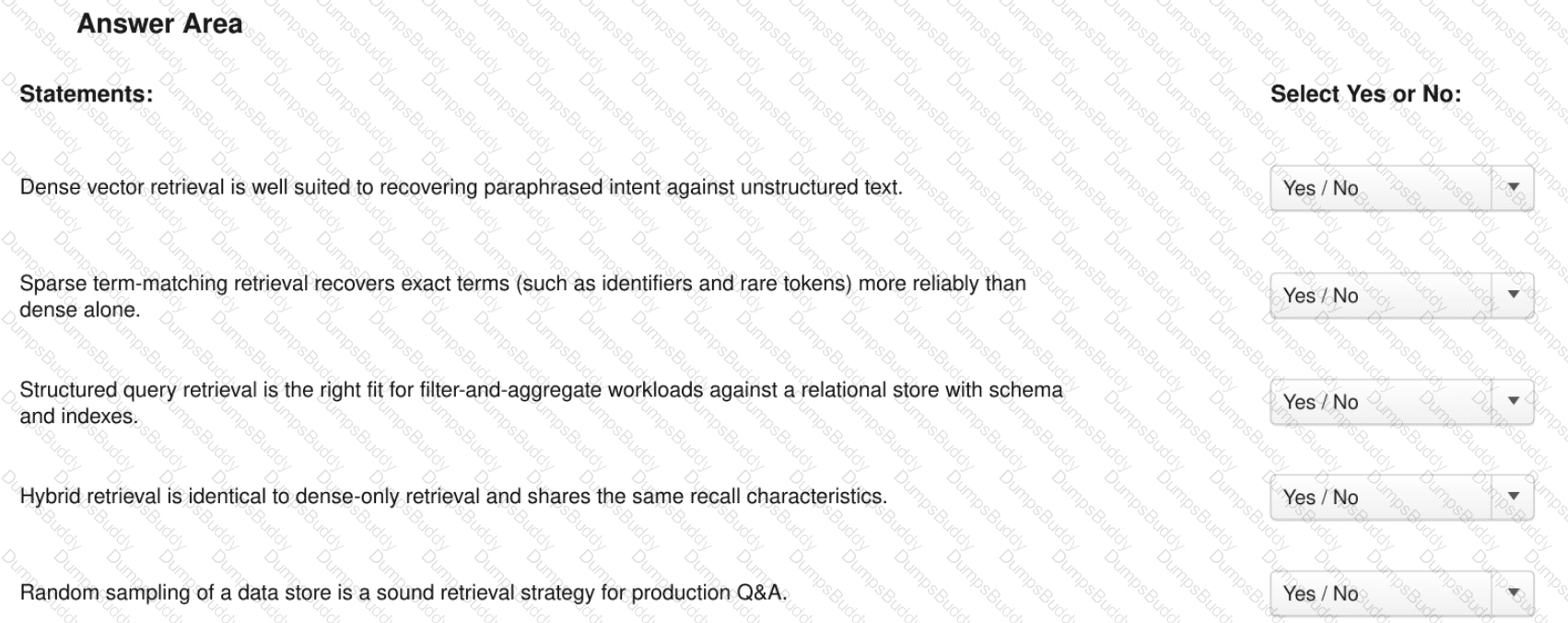
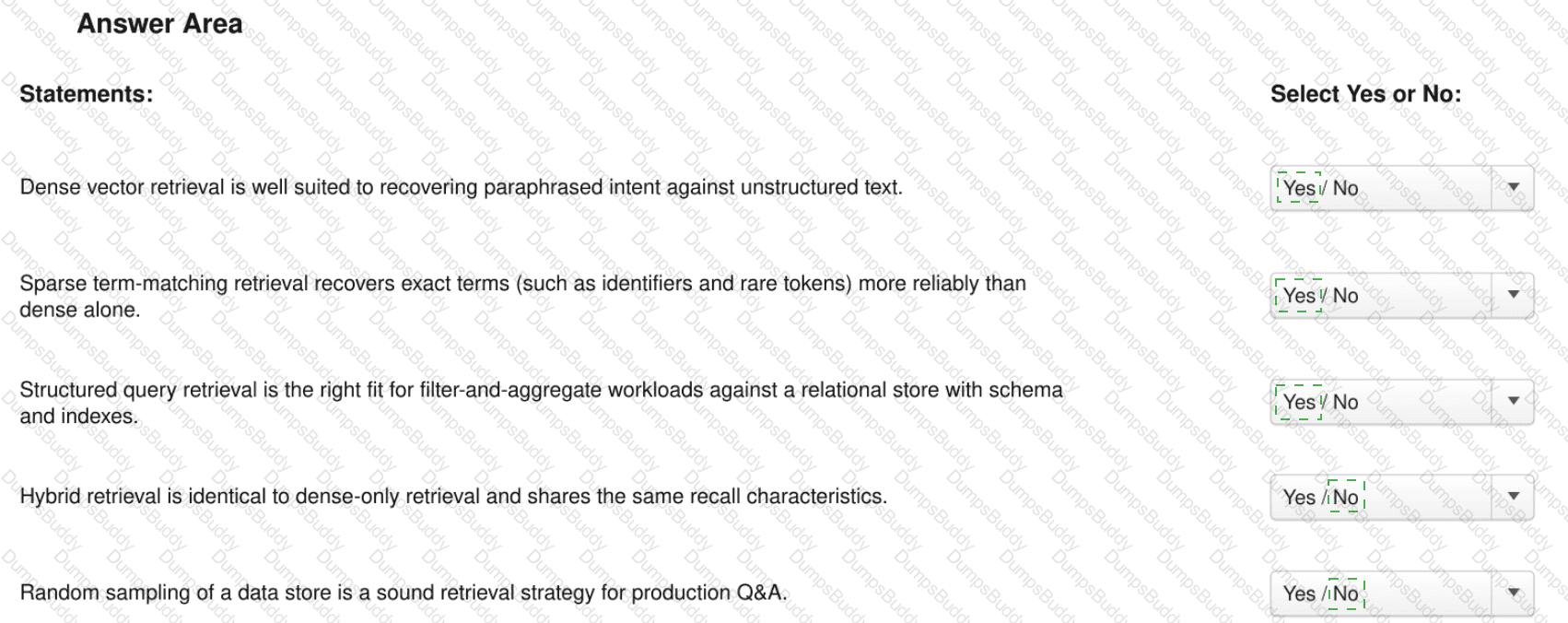
For each statement, indicate Yes if it reflects sound architectural practice. Otherwise, select No.
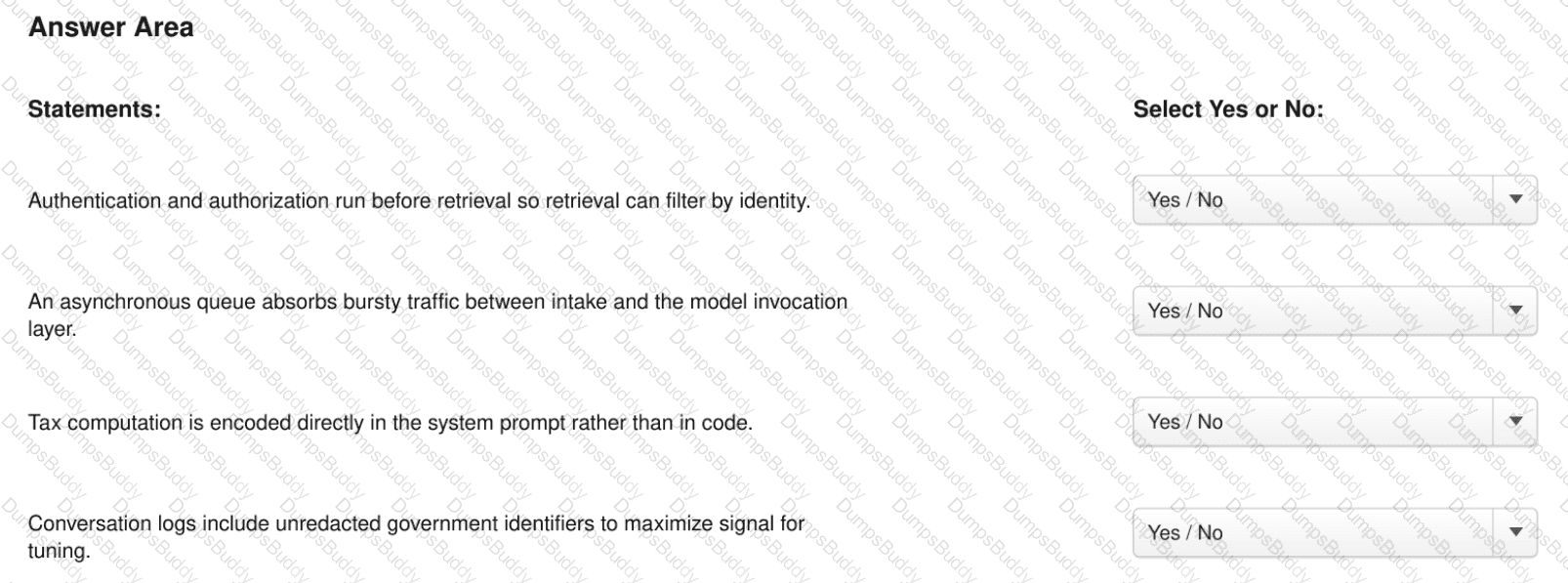
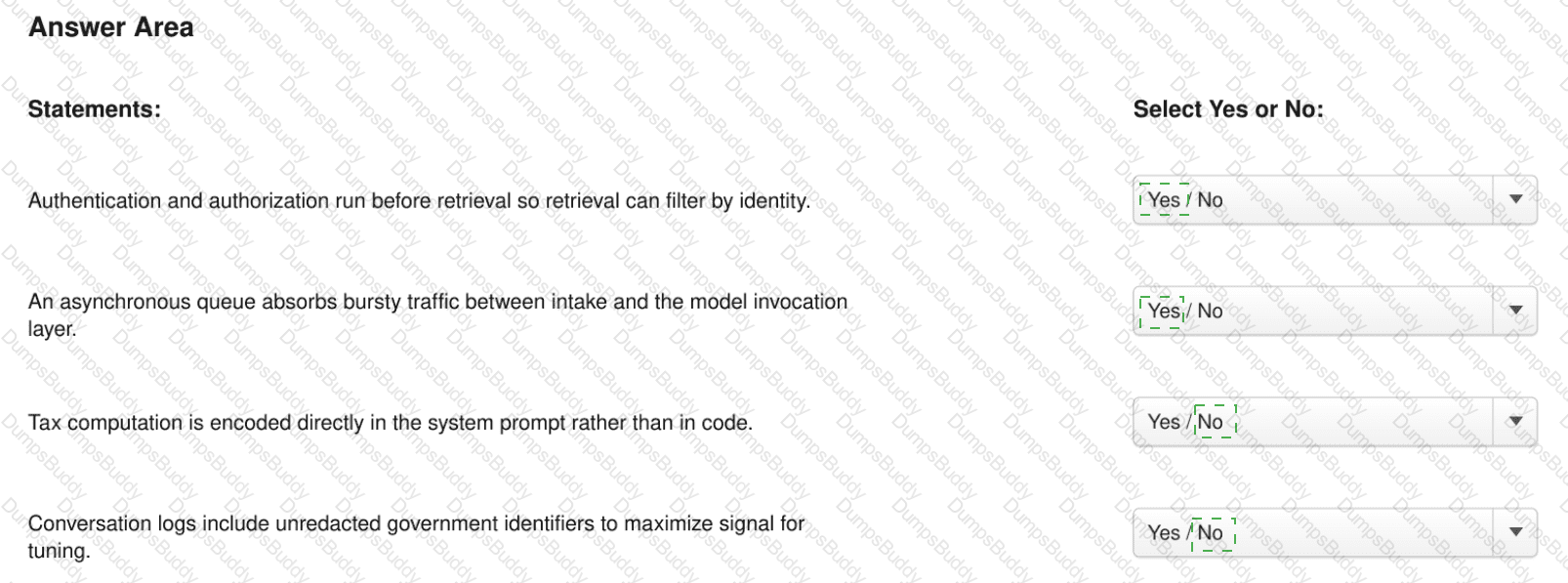
CCAR-P Question 10

Options:

Buy Now
Questions 11

You are choosing the level of detail for an implementation guide. The audience is a delivery team that will build the deployment.

Which guidance composition best serves them?

Options:

A.

Component responsibilities, contracts between components, sequence diagrams of the dominant flows, configuration parameters with defaults, and operational runbooks.

B.

Component responsibilities and interface contracts only, without sequence diagrams of the dominant flows, configuration parameters with defaults, or runbooks to guide operational tasks.

C.

An architecture overview and sequence diagrams for the dominant flows, without interface contracts, configuration-parameter tables, or operational runbooks for the delivery team to follow.

D.

An architecture overview and a list of known limitations, without component-level diagrams, interface contracts, configuration parameters, or operational runbooks to support implementation.

Buy Now
Questions 12

A Claude architect is leading the discovery phase for a new AI-powered customer service solution.

Which two activities are characteristic of structured discovery and requirement gathering for a Claude-based deployment? (Select two.)

Options:

A.

Facilitating stakeholder workshops to surface latency, accuracy, and compliance constraints before scoping begins.

B.

Selecting the Claude model tier based on the architect’s prior project experience before stakeholder input is collected.

C.

Generating an initial prototype and iterating based on user reaction rather than written requirements.

D.

Documenting explicit success criteria and failure thresholds that will gate production deployment.

E.

Deferring constraint documentation until the integration design phase to avoid scope creep.

Buy Now
Questions 13

You are a platform architect designing an internal Claude-based assistant that serves both finance analysts and external auditors. Each population must access only documents permitted by its role.

Where should role-based access control be enforced in the pipeline?

Options:

A.

Inside the system prompt as a natural-language instruction for Claude to ignore unauthorized documents.

B.

At the retrieval layer, before any role-restricted content reaches the prompt-construction step or the model.

C.

Nowhere in the pipeline; rely on the model’s general refusal behavior to reject unauthorized document access without any enforced access control.

D.

After the response is generated, by post-filtering content that should not have been retrieved.

Buy Now
Questions 14

You are comparing patterns for a batch document-classification job that follows fixed steps: extract metadata, classify, summarize, and persist.

Which pattern is the best fit and why?

Options:

A.

A workflow pattern, because agentic patterns do not support tool invocations and therefore cannot execute the persist step that writes results to the downstream store.

B.

An agentic pattern, because the open-ended planning capability of agents produces more consistent structured outputs than a fixed workflow graph on classification tasks.

C.

An agentic pattern, because agents are categorically more accurate than workflows and therefore always preferable regardless of step predictability.

D.

A workflow pattern, because the steps are well-defined and predictable per-request token cost is preferred over flexibility.

Buy Now
Questions 15

The compliance team has authored a regulatory disclosure procedure that must be applied identically across customer service, sales, and onboarding workflows. The procedure changes when regulators issue updates, currently four to six times per year. You are designing how the procedure will be packaged for use by Claude across all three workflows.

Which two design decisions should you include? (Select two.)

Each correct answer presents part of the solution.

Options:

A.

Package the procedure as a Claude Skill owned directly by the compliance team.

B.

Embed the procedure text into each workflow’s system prompt at integration time.

C.

Store the procedure in a shared retrieval corpus accessed by all three workflows.

D.

Have each workflow team rewrite the procedure for its own context.

E.

Reference the same Claude Skill from all three workflow integrations.

Buy Now
Questions 16

You are an architect supporting the iteration phase of a deployed Claude-based system.

Which activity most directly fits this phase?

Options:

A.

Rebuild the entire system architecture from scratch at the start of every iteration cycle regardless of what production telemetry, evaluations, and stakeholder feedback indicate is needed.

B.

Stop measuring production outcomes once the deployment has successfully launched, treating the go-live milestone as the end of the evaluation and iteration cycle.

C.

Discard the evaluation framework and reference set once the deployment is in production, accepting that future iterations will have no structured basis for measuring the impact of changes.

D.

Review production telemetry, sampled output evaluations, and stakeholder feedback to identify the highest-impact change for the next cycle, then plan the change against the evaluation framework.

Buy Now
Questions 17

You are listing characteristics of robust guardrail design for an enterprise deployment.

Which two characteristics belong on the list? (Select two.)

Each correct answer presents a complete solution.

Options:

A.

Centralized log retention for guardrail violations with quarterly review by the security team.

B.

Per-role tool allow-lists enforced at the orchestration layer before any tool call executes.

C.

User feedback channels that route reported guardrail failures into the product backlog for triage.

D.

Periodic refresh of the system prompt wording to keep refusal language current and clear.

E.

Adversarial-input coverage in the evaluation set with regression tracking on guardrail performance.

Buy Now
Questions 18

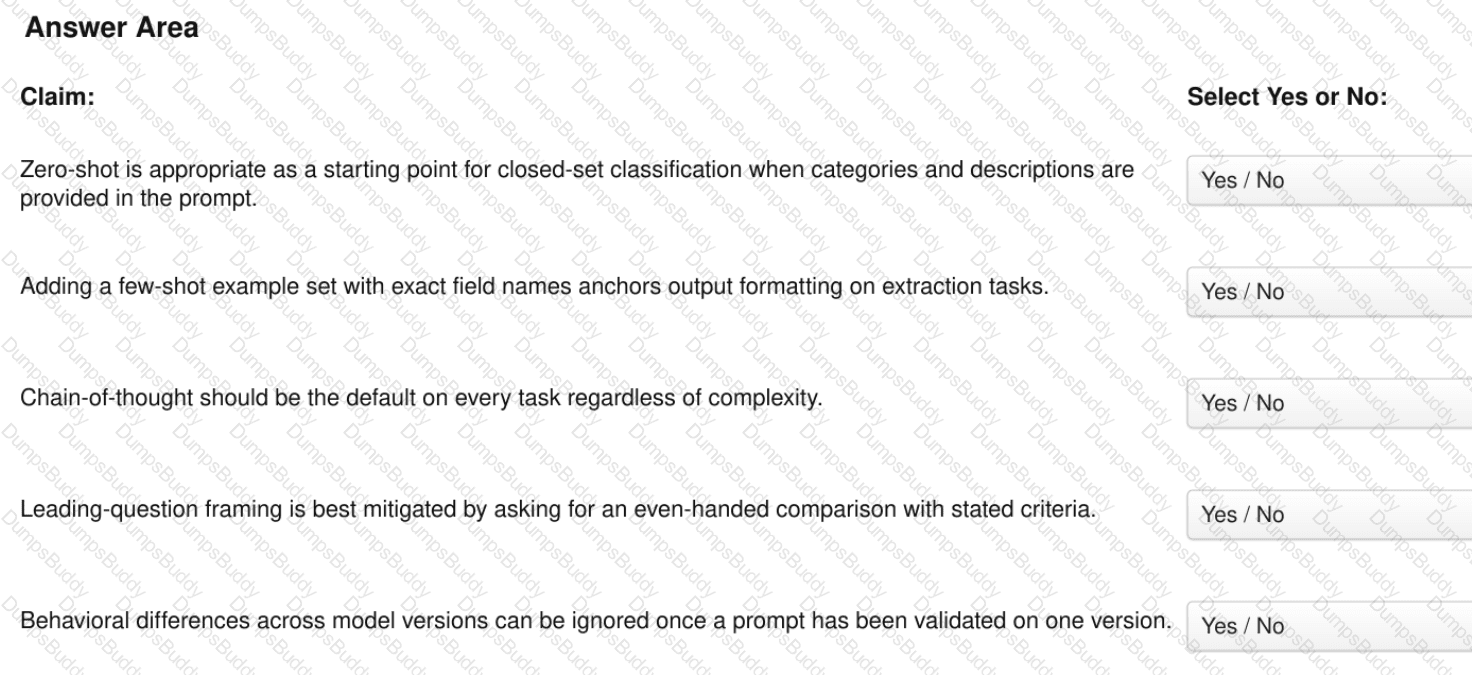
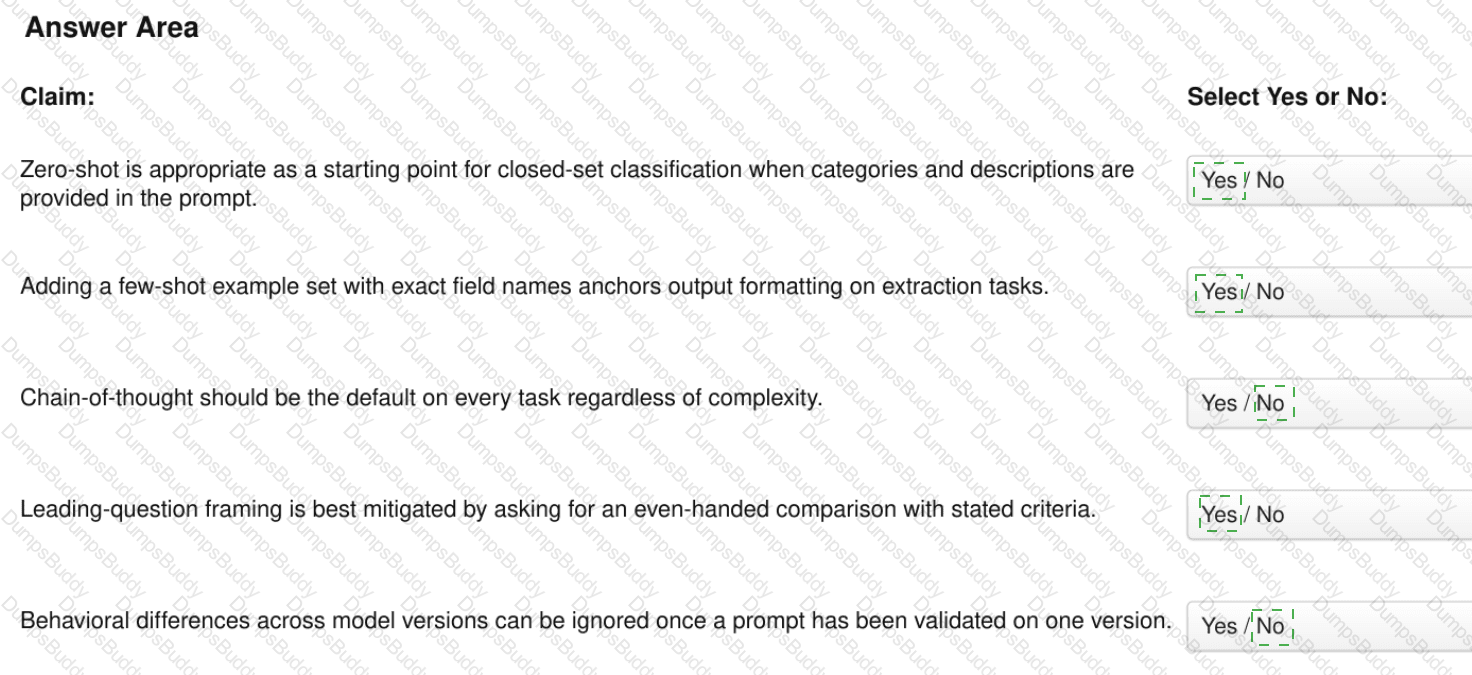
You are evaluating prompting claims in a peer’s design document.

For each claim, select yes if the claim reflects sound practice. Otherwise, select no.

CCAR-P Question 18

Options:

Buy Now
Questions 19

A team manager wants all engineers working on the same repository to share identical MCP server definitions without manual synchronization.

Which configuration approach satisfies this requirement?

Options:

A.

managed configuration pushed to all endpoints by the administrator

B.

environment variables set at the operating-system level on each workstation

C.

project-scope .claude/settings.json and .mcp.json files committed to the repository

D.

each engineer maintains a personal ~/.claude/settings.json with the shared definitions

Buy Now
Questions 20

A customer support team has proposed delegating customer refund decisions to a Claude-driven workflow with no human review for refunds under 50 USD. The team's reasoning is that small refunds are low-risk and human review would erase the efficiency gain.

Which Delegation-competency principle should guide your response?

Options:

A.

Delegation should always include human review on every decision the workflow produces.

B.

Delegation scope should reflect the type of risk involved, not the transaction size alone.

C.

Delegation scope should be set primarily by maximizing efficiency gains across the workflow.

D.

Delegation should be avoided entirely wherever financial transactions occur in the workflow.

Buy Now
Questions 21

You are evaluating a Claude-based deployment for adherence to a specific regulation.

Which two steps must be completed BEFORE mapping deployment data flows to specific regulatory clauses? (Select two.)

Each correct answer presents part of the solution.

Options:

A.

Compare the in-place controls against the regulatory requirements to identify any compliance gaps.

B.

Identify the applicability of the regulation based on data types, jurisdiction, and audience.

C.

Schedule the remediation work with the engineering team based on the prioritized gap findings.

D.

Document the identified gaps along with recommended remediations and residual risk for sign-off.

E.

Inventory the vendor-provided compliance tooling and confirm which compliance affordances are in place.

Buy Now
Questions 22

You are compiling team-setup practices for a Claude Code rollout across an engineering organization.

Which two practices belong on the list? (Select two.)

Each correct answer presents a complete solution.

Options:

A.

Use project scope for team-shared Model Context Protocol (MCP) servers and permission rules under version control.

B.

Apply managed configuration centrally for security-critical settings that must not be overridden by individual engineers.

C.

Use local scope for security-critical permission rules so each engineer can adapt them to ongoing work.

D.

Use user scope for team-shared MCP servers so every engineer on the team has consistent access.

E.

Use project scope for personal editor preferences so the preferences apply consistently within the project.

Buy Now
Questions 23

You are transitioning a Claude-based deployment from design into implementation.

Which handoff package most directly supports a clean transition?

Options:

A.

The most recent set of design presentation slides without component-level diagrams, interface contracts, an evaluation framework with a reference set, runbooks, or a known-limitations register.

B.

A verbal walkthrough conducted on the day of handoff with no written architecture overview, ADRs, component contracts, evaluation framework, runbooks, playbook, or known limitations.

C.

Architecture overview, ADRs, component contracts, evaluation framework with reference set, runbooks, on-call playbook, and known limitations.

D.

Source code alone with no integrating architecture overview, ADRs, component contracts, evaluation framework, runbooks, on-call playbook, or known-limitations register to support the delivery team.

Buy Now
Questions 24

The engineering lead at Trenova Systems, Inc. is evaluating two proposals for improving developer workflows using Claude-assisted tooling. Proposal A adds Claude Code to the IDE for inline code generation and review. Proposal B routes all code-generation requests through a shared Slack bot without IDE integration.

Which two observations most accurately evaluate these proposals against workflow-improvement objectives? (Select two.)

Options:

A.

Proposal B is superior because centralizing requests in Slack creates an auditable log of all code-generation activity.

B.

Proposal B introduces workflow friction by requiring developers to leave the IDE, undermining the productivity objective.

C.

Proposal A reduces context switching by providing AI assistance at the point of development without requiring a separate tool.

D.

Proposal B improves workflow velocity because Slack notifications create an asynchronous review queue.

E.

Both proposals are equivalent because the model capabilities are identical regardless of the integration point.

Buy Now
Questions 25

You are distinguishing functional from non-functional requirements during discovery.

Which item is a non-functional requirement?

Options:

A.

The system must extract a defined set of specific fields from invoice attachments and populate a downstream data record.

B.

The system must produce a draft response that a human reviewer can edit before sending.

C.

The system must classify inbound tickets into a defined set of categories.

D.

The system must respond at p95 latency under 800 milliseconds at the expected request volume.

Buy Now
Questions 26

You are auditing a procurement-assistant agent whose defined responsibility is to draft purchase requests for review.

For each tool currently configured on the agent, select yes if the tool should remain after a least-privilege audit. Otherwise, select no if it should be removed.
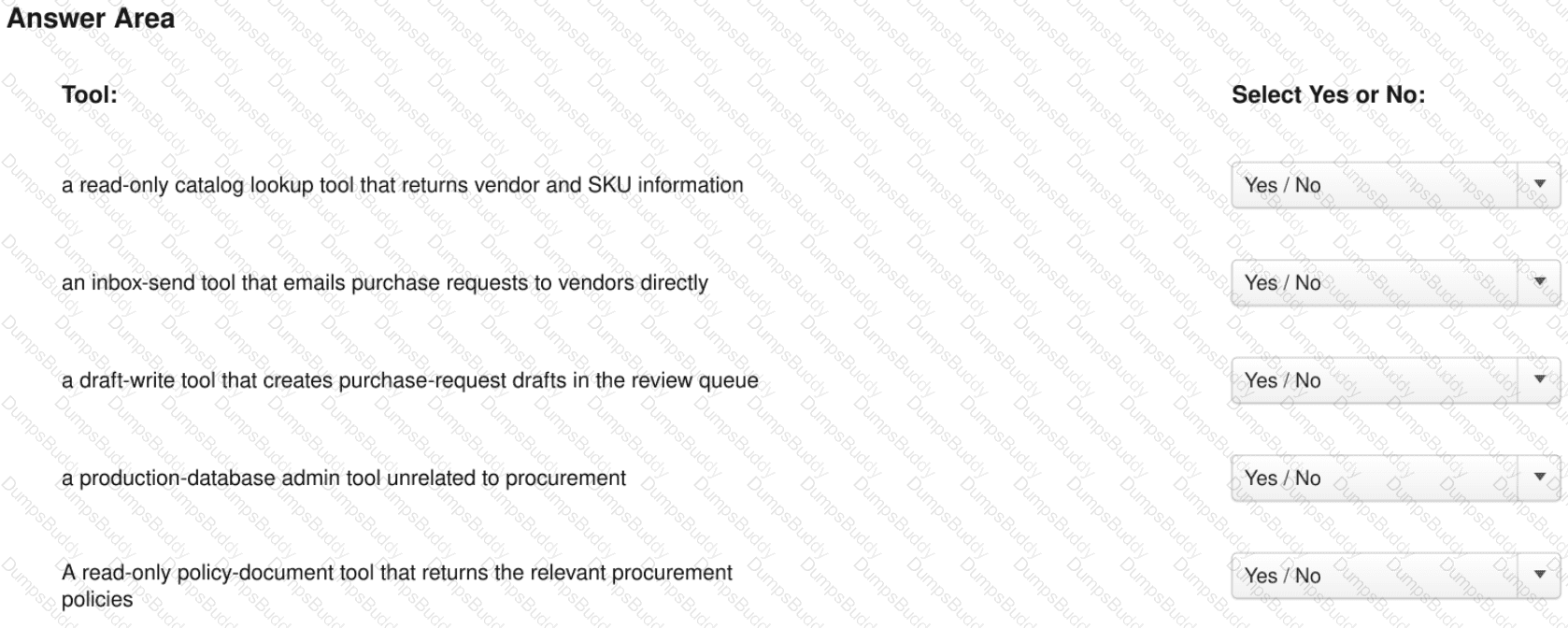
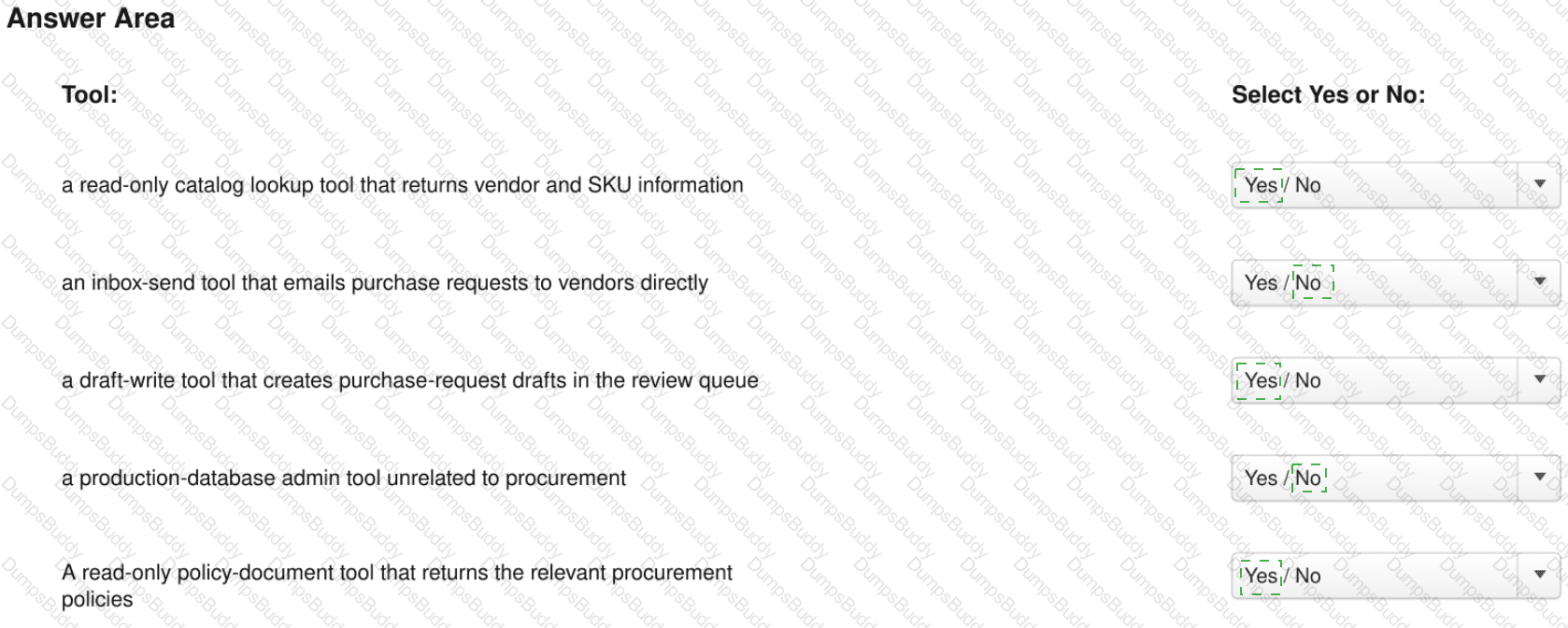
CCAR-P Question 26

Options:

Buy Now
Questions 27

A document analysis service processes legal filings averaging 80,000 tokens each. Each filing is queried by attorneys an average of 14 times during a case. The current architecture sends the full filing on every query. The CFO has asked you to reduce per-query costs while preserving response quality. The security officer requires that filing contents not be stored outside Fabrikam's tenancy.

Which optimization approach should you recommend?

Options:

A.

Summarize each filing once at intake and run all subsequent queries against the summary.

B.

Cache the filing as the prompt prefix for reuse across the 14 queries per case.

C.

Index filings in a vector store and retrieve only the relevant passages per query.

D.

Move the workload to a smaller Claude model to reduce the per-token cost paid.

Buy Now
Questions 28

You are evaluating an evaluation set used to score a Claude-based hiring-support tool. The set is drawn from one geographic region and one tenure band.

Which response is most appropriate?

Options:

A.

Discard all quantitative evaluation and replace it with qualitative impressions collected from a small, convenience-selected group that may not represent the tool’s full user population.

B.

Expand the evaluation set to cover the geographic regions and tenure bands the tool will serve, and rescore the system on the expanded set before broader release.

C.

Reduce the evaluation set further to a single demographic subgroup to simplify score interpretation, narrowing coverage rather than expanding it to match the intended user population.

D.

Continue using the narrow evaluation set drawn from one region and one tenure band because the existing benchmark scores are already high on that subset.

Buy Now
Questions 29

You are designing a test strategy for a Claude-based pipeline that handles sensitive financial data.

Which two test types should be prioritized to cover both safety under attack and cross-component correctness? (Select two.)

Options:

A.

Adversarial tests using prompt-injection and malformed-input cases.

B.

Regression tests against a stable reference set of previously known-good outputs.

C.

Smoke tests that verify core paths after each deployment.

D.

Integration tests that verify end-to-end pipeline behavior across all components.

E.

Unit tests targeting only individual prompt-template rendering logic.

Buy Now
Questions 30

A Claude architect is implementing safety controls for a customer-facing advice assistant that must never provide regulated investment recommendations.

Which two guardrail implementations most directly enforce this constraint? (Select two.)

Options:

A.

Increase response temperature to introduce variability that reduces the likelihood of specific recommendations.

B.

Add an output classifier that detects and blocks responses containing regulated investment-recommendation language.

C.

Limit session length to reduce the volume of queries processed per user per day.

D.

Log all user queries to a SIEM for post-hoc compliance review.

E.

Define explicit out-of-scope categories in the system prompt with fixed refusal phrasing for investment advice requests.

Buy Now
Questions 31

You are integrating Claude Code into a workflow that runs against a production database.

Which guardrail design most directly preserves safety on data-modifying operations?

Options:

A.

Allow Claude Code to write directly to the production database without subagent scoping, read-only credential defaults, or human confirmation gates on data-modifying operations.

B.

Configure the database MCP server with a fully privileged credential that can perform any read or write operation, and allow all operations to proceed without explicit human confirmation.

C.

Disable all logging and auditing on database operations through the MCP server to reduce alert noise, removing the observability needed to detect unintended data modifications.

D.

Configure the database MCP server with a read-only credential by default, restrict the subagent’s tool list to read-only operations, and require explicit human confirmation on any operation that would modify data.

Buy Now
Questions 32

A research summarization assistant has been deployed for six months. A user has flagged that a generated summary contained a fabricated citation. The product team has asked whether the incident requires architectural action or whether it is an isolated case.

Which two Diligence-competency actions should you take? (Select two.)

Each correct answer presents part of the solution.

Options:

A.

Sample recent summaries to estimate the fabrication frequency across the population.

B.

Disable the assistant immediately for all current users without any prior diagnostic analysis.

C.

Review whether citation-grounding controls exist anywhere in the current generation pipeline.

D.

Communicate to users that the assistant does not fabricate output as a matter of design.

E.

Treat the incident as an anecdotal isolated case and take no further investigative action.

Buy Now
Questions 33

A healthcare organization is evaluating two Claude-powered AI architectures for a clinical documentation assistant. Architecture X produces higher output quality scores but costs $0.18 per documentation session and averages 4.2 seconds per response. Architecture Y scores slightly lower on quality metrics but costs $0.09 per session and averages 2.1 seconds per response. The stated SLA requires responses under 3 seconds, and the annual volume is projected at 2 million documentation sessions.

Which evaluation approach correctly applies business value pillar analysis to this decision?

Options:

A.

Select Architecture Y based solely on the 50% cost reduction, since solution cost is the most important value pillar in healthcare budget-constrained environments.

B.

Select Architecture X because the higher quality scores justify the cost premium, and any SLA gap can be addressed through infrastructure optimization after deployment.

C.

Eliminate Architecture X on SLA grounds, then evaluate Architecture Y against the efficiency and solution cost pillars by calculating annual cost difference and assessing whether the quality delta materially impacts clinical workflow productivity.

D.

Recommend a hybrid approach using Architecture X for complex cases and Architecture Y for routine cases, without additional analysis, since this preserves quality where it matters most.

Buy Now
Questions 34

You are explaining the precedence of Claude Code configuration scopes to the team.

Which precedence ordering, from highest to lowest, is correct?

Options:

A.

Local → managed → user → command-line arguments → project

B.

Project → user → managed → local → command-line arguments

C.

Managed → command-line arguments → local → project → user

D.

User → project → local → command-line arguments → managed

Buy Now
Exam Code: CCAR-P
Exam Name: Claude Certified Architect - Professional
Last Update: Sep 1, 2026
Questions: 114

PDF + Testing Engine

$134.99

Testing Engine

$99.99

PDF (Q&A)

$84.99