- Home
- Cisco
- Cisco AI Technical Practitioner (AITECH)
- 810-110
- Cisco AI Technical Practitioner (810-110 AITECH) Questions and Answers
810-110 Cisco AI Technical Practitioner (810-110 AITECH) Questions and Answers
A developer uses an AI coding assistant to create a data-sorting function. The generated code is syntactically valid and returns the correct output, but it significantly increases CPU utilization. Which limitation of AI-generated code does this scenario demonstrate?
Options:
The model failed to adhere to the context window limits during generation.
The model lacked access to the standard library documentation.
The model prioritized functional correctness over algorithmic efficiency.
The model relied on deprecated or unsupported libraries.
Answer:
CExplanation:
AI-generated software may satisfy functional requirements while exhibiting inefficient algorithmic complexity, unnecessary resource consumption, or poor runtime performance. Option C is correct because the sorting function produces correct results but consumes excessive CPU resources.
Functional correctness establishes whether software produces the expected output for relevant inputs. Algorithmic efficiency considers how much time, memory, and computational capacity the implementation requires.
For example, an AI assistant might generate a sorting routine using an inefficient nested-loop algorithm rather than an optimized standard-library implementation.
Although both approaches may produce identical sorted results, their computational performance can differ substantially as input size increases.
Option A is incorrect because context-window limitations concern the information available during generation rather than the runtime efficiency of the resulting code.
Option B is unsupported because the scenario does not establish that the model lacked access to documentation.
Option D is unsupported because no deprecated or incompatible dependency is identified.
Developers should evaluate AI-generated code using complexity analysis, profiling, performance benchmarks, static analysis, and representative workload testing.
Correct output is necessary but insufficient for production readiness, particularly in performance-sensitive applications.
Specific Cisco AITECH Course Guide References: AI-Driven Software Engineering; Debugging and Correcting AI-Generated Outputs; Objective 5.5 — Code quality, debugging, and error handling; Objective 5.2 — AI-assisted code generation.
===================
Which threat involves an attacker deliberately contaminating a model's training dataset in order to influence how the model behaves in the future?
Options:
Gradient inversion
Algorithmic bias
Data poisoning
Direct prompt injection
Answer:
CExplanation:
Data poisoning is an adversarial machine learning attack in which an attacker intentionally modifies, inserts, or manipulates data used during model training or subsequent learning processes. Option C is correct because the attack directly targets the integrity of the dataset to influence future model behavior.
An attacker may introduce misleading examples, incorrect labels, malicious instructions, or manipulated records into a training corpus.
When the model learns from compromised data, its predictions or generated responses may reflect the attacker's intended distortion.
For example, an attacker could inject manipulated security incident descriptions into a training dataset to make a model systematically misclassify certain malicious activities as harmless.
Option A is incorrect because gradient inversion is a privacy attack that attempts to reconstruct information about training data from model gradients.
Option B is incorrect because algorithmic bias describes systematic model unfairness or distortion and does not necessarily involve deliberate adversarial contamination.
Option D is incorrect because direct prompt injection manipulates a model through instructions submitted during inference rather than by modifying its training dataset.
Defensive measures include dataset provenance tracking, integrity checks, controlled data ingestion, anomaly detection, and validation of training examples.
Specific Cisco AITECH Course Guide References: Generative AI Security and Privacy Fundamentals; Exam Objective 3.3 — AI-specific security threats and risks; Objective 3.4 — AI governance and risk management.
Cisco Learning Content
===================
Which action best demonstrates the principle of fairness when deploying a generative AI solution?
Options:
Redacting PII from the training dataset
Hosting the model in a carbon-neutral data center
Requiring users to sign Acceptable Use Policies
Auditing model outputs for bias
Answer:
DExplanation:
Fairness in responsible AI refers to designing, evaluating, and operating AI systems to reduce unjustified discrimination and systematically disadvantageous outcomes across relevant individuals or groups. Option D is correct because auditing model outputs for bias provides a direct method of evaluating whether an AI system produces unfair or discriminatory results.
Bias may originate from imbalanced training datasets, historical patterns, annotation practices, model behavior, or deployment conditions.
For example, an organization using generative AI to assist with recruitment documentation should evaluate whether generated recommendations systematically favor or disadvantage candidates based on protected characteristics.
An effective fairness audit may include representative test datasets, comparison of outputs across demographic groups, appropriate quantitative fairness metrics, and human review of potentially discriminatory patterns.
Option A is incorrect because redacting personally identifiable information primarily supports privacy protection. It does not guarantee fairness or eliminate proxy variables associated with protected characteristics.
Option B is incorrect because carbon-neutral infrastructure relates to environmental sustainability.
Option C is incorrect because Acceptable Use Policies establish behavioral and operational requirements but do not directly measure discriminatory model outcomes.
Fairness auditing should be ongoing because data distributions, user populations, and application environments can evolve over time.
Specific Cisco AITECH Course Guide References:
Generative AI Security and Privacy Fundamentals
Debugging and Correcting AI-Generated Outputs
Exam Objective 3.1: Fairness, transparency, accountability, bias mitigation, and safety
Cisco explicitly includes fairness and bias mitigation as responsible AI principles within its Ethics and Security domain.
===================
When comparing cloud-hosted AI models to locally hosted ones, what benefit do cloud-hosted API services provide?
Options:
Rapid elastic scaling for unpredictable inference demand
Elimination of per-token operational costs
Full control over data residency and privacy
Lower network latency for all end users
Answer:
AExplanation:
Cloud-hosted AI API services provide scalable computing infrastructure that enables organizations to increase or decrease inference capacity according to application demand. Option A is correct because elastic scaling allows applications to accommodate variable workloads without requiring organizations to provision and maintain all underlying computing resources.
Cloud AI providers operate infrastructure containing GPUs, specialized AI accelerators, distributed inference services, and workload management systems. These resources can support applications experiencing unpredictable demand, such as customer support assistants, enterprise knowledge systems, and automated code-generation services.
For example, an enterprise AI application might experience a substantial increase in inference requests during business hours. A suitably provisioned cloud service can accommodate increased demand through managed scaling, subject to provider capacity and configured quotas.
Option B is incorrect because cloud-hosted AI services commonly impose usage-based charges determined by input tokens, output tokens, model selection, or provisioned capacity.
Option C is incorrect because locally hosted models generally provide more direct infrastructure and data-location control, although cloud providers may offer regional hosting and contractual privacy protections.
Option D is incorrect because network latency depends on geographic proximity, connectivity, service load, and deployment architecture. Local inference may offer lower latency for certain workloads.
Cloud-hosted deployment therefore offers a significant advantage when infrastructure flexibility and scalable inference capacity are architectural priorities.
Specific Cisco AITECH Course Guide References:
AI Architect's Toolkit
Generative AI Ecosystem
Exam Objective 1.2: Cloud-hosted versus locally hosted models, including cost, latency, privacy, and scalability
Cisco identifies scalability as a central consideration when evaluating AI hosting architectures.
===================
When employees use a public AI chatbot within a corporate environment, what is a data privacy risk that should be considered?
Options:
The AI will provide biased technical advice.
The input data may be used for model training.
The AI will provide hallucinated technical specifications.
The data will be encrypted at rest instead of in transit.
Answer:
BExplanation:
Public AI chatbot services introduce data governance risks when employees submit confidential business information, customer records, proprietary source code, or internal operational documents. Option B is correct because information submitted to some public AI services may be retained or used for model improvement or training, depending on the provider's contractual terms, privacy policy, and service configuration.
For example, an engineer might paste proprietary network configuration files into a public chatbot for troubleshooting assistance. This could expose internal IP addresses, device configurations, authentication details, and other confidential information to an external service provider.
Even when information is not used for training, retention, logging, access controls, and data-processing locations remain important privacy considerations.
Option A is incorrect because biased technical recommendations represent a model reliability or fairness concern rather than the specific data privacy risk described.
Option C is incorrect because hallucinated specifications concern factual accuracy.
Option D is incorrect because encryption at rest and encryption in transit are independent security controls. Neither inherently replaces the other.
Organizations should establish approved AI usage policies, classify sensitive information, evaluate vendor data handling agreements, and restrict transmission of confidential material to unauthorized services.
Specific Cisco AITECH Course Guide References: Generative AI Security and Privacy Fundamentals; AI Architect's Toolkit; Exam Objective 3.2 — Corporate data privacy and security in AI systems; Objective 3.4 — AI governance and compliance.
Cisco Learning Content
===================
Which design principle helps stop an autonomous agent from getting stuck in an infinite loop and wasting tokens?
Options:
Removing system prompts
Implementing constraints
Using known patterns
Using smaller contexts
Answer:
BExplanation:
Autonomous AI agents may execute iterative cycles involving planning, tool use, observation, and further decision-making. Without operational limits, these cycles can continue unnecessarily, resulting in excessive token consumption and repeated actions. Option B is correct because implementing constraints establishes explicit boundaries on agent execution.
Important constraints include maximum iteration counts, tool-call limits, execution deadlines, token budgets, and predefined termination conditions.
For example, an AI troubleshooting agent might be permitted to perform no more than ten diagnostic iterations before producing a status report or requesting human intervention.
Additional safeguards can detect repeated tool calls with identical arguments, unchanged system states, or recurring unsuccessful actions.
Option A is incorrect because removing system prompts can eliminate important behavioral instructions and safety constraints.
Option C is incorrect because known workflow patterns may improve design consistency but do not independently enforce termination.
Option D is incorrect because reducing available context does not guarantee that an agent will terminate. It may instead cause the agent to lose information about previous actions.
Reliable agent design requires explicit stopping rules, error handling, progress monitoring, and resource consumption limits.
These controls improve operational predictability and prevent unnecessary expenditure.
Specific Cisco AITECH Course Guide References: AI-Powered Workflows and Agentic AI; Exam Objective 6.2 — Autonomous capabilities and orchestration; Objective 5.3 — AI workflow monitoring principles.
Cisco Learning Content
===================
Why might an AI practitioner use a model hub such as Hugging Face in the early phases of an AI project?
Options:
To generate a fine-tuned dataset tailored for a niche business problem.
To access and evaluate a wide variety of pre-trained models.
To ensure that the AI model will not produce biased outputs.
To monitor and cap the monthly API token usage costs.
Answer:
BExplanation:
A model hub provides a centralized environment for discovering, examining, comparing, and obtaining pretrained artificial intelligence models. Option B is correct because platforms such as Hugging Face Hub enable practitioners to evaluate multiple model architectures before selecting a solution.
During the initial stages of an AI project, teams must determine which available models satisfy their functional requirements, infrastructure constraints, latency objectives, and deployment conditions.
A model hub can provide access to model documentation, architecture details, parameter counts, licensing information, evaluation results, and compatible deployment frameworks.
For example, a practitioner developing a technical document classifier can compare language models based on accuracy, model size, inference requirements, and licensing restrictions.
Option A is incorrect because model hubs may provide datasets and supporting tools, but their primary purpose is not automatically generating fine-tuned datasets.
Option C is incorrect because repository availability does not guarantee that a model is unbiased, secure, or suitable for deployment.
Option D is incorrect because API token expenditure monitoring requires appropriate billing and observability systems.
Model selection should include evaluation of provenance, licensing, security, task-specific performance, and infrastructure compatibility.
Specific Cisco AITECH Course Guide References:
Generative AI Ecosystem
AI Architect's Toolkit
Customizing AI Models
Exam Objective 1.4: Model selection in AI model hubs and repositories
===================
In an AI workflow platform, what occurs to the execution flow when an agent enters a wait state initiated by an approval gate?
Options:
The workflow immediately escalates the task to a secondary AI agent for review.
The workflow continues to run in the background, consuming tokens until the human responds.
The workflow pauses execution, holding the state until a human reviewer provides an approval signal.
The workflow is automatically terminated and must be restarted from the beginning.
Answer:
CExplanation:
An approval gate introduces a controlled checkpoint into an AI workflow, preventing execution of a designated action until an authorized reviewer approves it. Option C is correct because the workflow enters a suspended or waiting state while preserving the information required to resume execution.
For example, an AI agent may prepare a network configuration change and submit it to an operations engineer for authorization.
The workflow can preserve the proposed configuration, target devices, execution context, and approval request identifier while waiting for a decision.
Once approval is received, the workflow resumes according to its defined transition rules. Rejection may trigger modification, cancellation, or escalation.
Option A is incorrect because a human approval gate does not inherently delegate the decision to another AI agent.
Option B is incorrect because a properly implemented wait state does not require continuous model inference or token consumption. The platform may maintain stored state without repeatedly invoking the model.
Option D is incorrect because suspension does not inherently terminate the workflow.
Reliable approval workflows should include persistent state, reviewer authentication, audit logging, expiration policies, and clearly defined rejection behavior.
These mechanisms support predictable execution and enforce human oversight for sensitive operations.
Specific Cisco AITECH Course Guide References:
AI-Powered Workflows and Agentic AI
Exam Objective 6.4: Human-in-the-Loop strategies
Exam Objective 5.3: AI workflow design and monitoring
===================
A network engineer must automate the conversion of legacy CLI configurations into structured YAML for Ansible playbooks. Which AI capability should be used for this task?
Options:
Vision Transformer
Diffusion Models
Large Language Models
Variational Autoencoders
Answer:
CExplanation:
Large Language Models (LLMs) can interpret natural language and structured or semi-structured text, making them suitable for transforming legacy network configuration syntax into modern automation formats. Option C is correct because the task requires understanding CLI configuration statements and converting their meaning into correctly structured YAML.
Legacy network configurations often contain interface definitions, IP addressing, routing statements, VLAN assignments, and access-control settings.
An LLM can analyze these commands, identify relevant configuration elements, and generate YAML structures suitable for use with Ansible modules or templates.
For example, interface configuration statements can be transformed into structured records containing interface names, descriptions, addresses, and administrative states.
Option A is incorrect because Vision Transformers primarily address visual information and are not the most appropriate architecture for converting text-based CLI configurations.
Option B is incorrect because diffusion models are primarily associated with iterative generative processes such as image synthesis.
Option D is incorrect because variational autoencoders are probabilistic generative architectures rather than the standard choice for semantic configuration translation.
Generated YAML must be validated for syntax, schema compatibility, and behavioral equivalence.
The conversion process should also account for platform-specific commands, unsupported features, and configuration dependencies.
Specific Cisco AITECH Course Guide References:
AI-Driven Software Engineering
AI Systems Integration with APIs
Exam Objective 5.2: AI-assisted code generation
Exam Objective 4.2: Formatting and data transformation
===================
What occurs when the amount of input text supplied to a large language model goes beyond the size of its context window?
Options:
The model increases its context window size.
The model loses the earliest part of the text.
The model caches the overflow data.
The model switches to a different algorithm.
Answer:
BExplanation:
A context window represents the maximum number of tokens that a large language model can process within a single inference context, subject to the model's architecture and deployment configuration. Option B is the intended answer because many conversational AI systems manage excessive context by truncating older information to preserve more recent messages.
For example, when a conversation becomes longer than the permitted context window, a sliding-window truncation mechanism may remove the earliest messages, causing the model to lose access to previously supplied details.
This can affect response accuracy, continuity, and the model's ability to follow instructions or reference information from earlier interactions.
Option A is incorrect because a model cannot automatically expand its architectural context capacity simply because the input exceeds its limit.
Option C is incorrect because overflow information is not inherently cached for later processing. Prompt caching and context management are distinct mechanisms.
Option D is incorrect because exceeding token capacity does not automatically trigger a change to another inference algorithm.
An important implementation distinction is that truncation is not universal. Some APIs reject oversized requests, while others summarize earlier context or apply configurable truncation strategies.
Therefore, Option B accurately represents a common context-management behavior rather than a mandatory characteristic of every LLM.
Specific Cisco AITECH Course Guide References:
Generative AI Ecosystem
AI Architect's Toolkit
Exam Objective 1.3: Context windows, token limits, and response management
Exam Objective 5.4: Context-window management and output quality
Cisco includes context-window management as a fundamental learning objective. AWS documentation independently confirms sliding-window truncation and alternative context-management strategies.
Cisco Learning Content+2
===================
An autonomous agent is intended to carry out bulk deletions of old customer records from a production database. Which design pattern should be used to avoid accidental data loss?
Options:
Implement a human-in-the-loop approval gate before the database write occurs.
Use a more powerful foundation model to ensure the agent is highly capable and less likely to make mistakes.
Increase the agent's token budget to allow for more thorough and complex reasoning loops.
Set the agent to autonomous mode to ensure it can react quickly to database changes.
Answer:
AExplanation:
Human-in-the-Loop (HITL) is an AI governance and workflow design pattern requiring human review or authorization before selected high-risk actions are executed. Option A is correct because bulk deletion of production customer records can cause irreversible data loss, operational disruption, and potential compliance violations.
In a properly controlled workflow, the autonomous agent first identifies records that meet established deletion criteria.
The agent then generates a proposed deletion plan specifying affected records, selection conditions, expected impact, and recovery options.
Before executing the database operation, the workflow enters an approval state requiring an authorized reviewer to evaluate the proposed changes.
Option B is incorrect because increasing model capability does not eliminate hallucinations, incorrect assumptions, or unauthorized actions.
Option C is incorrect because a larger token budget allows additional processing but does not guarantee more reliable decisions.
Option D is incorrect because unrestricted autonomy increases the potential impact of mistakes when handling sensitive production data.
Additional safeguards should include least-privilege database permissions, transaction controls, pre-deletion backups, deletion thresholds, audit logging, and tested rollback procedures.
HITL provides an explicit authorization boundary that prevents the agent from executing high-impact operations without appropriate oversight.
Specific Cisco AITECH Course Guide References:
AI-Powered Workflows and Agentic AI
Generative AI Security and Privacy Fundamentals
Exam Objective 6.4: Human-in-the-Loop strategies
Exam Objective 3.4: AI governance, risk management, and compliance
===================
A network engineer asks an AI, “Configure the router.” To ensure the generated output is tailored to the engineer’s specific network environment and hardware, which prompt-engineering principle should be used?
Options:
Specifying the desired output format.
Providing context and constraints.
Assigning a specific role or persona.
Using few-shot prompting examples.
Answer:
BExplanation:
Providing context and constraints is a foundational prompt engineering technique that enables an AI model to understand the technical environment, operational requirements, and restrictions associated with a requested task. Option B is correct because the instruction “Configure the router” lacks essential information needed to generate an appropriate configuration.
Network configurations depend on device models, operating system versions, network topology, routing protocols, interface assignments, addressing schemes, security policies, and operational requirements.
For example, a more effective prompt might specify a Cisco Catalyst 8300 router running a particular IOS XE release, an existing OSPF environment, required VLAN connectivity, and restrictions preventing changes to management interfaces.
This information reduces ambiguity and helps the model propose commands relevant to the actual environment.
Option A is incorrect as the best response because specifying a format controls how results are presented but does not establish network-specific requirements.
Option C is incorrect because assigning the persona of a network engineer does not automatically provide the necessary hardware or configuration information.
Option D is incorrect because few-shot examples demonstrate expected input-output relationships but are not a substitute for essential environmental details.
Generated configurations should undergo technical review, syntax validation, compatibility checks, and appropriate testing before deployment.
Specific Cisco AITECH Course Guide References: Prompt Engineering for Technical Precision; Objective 2.1 — Roles, instructions, and constraints; Objective 2.4 — Defensive prompting and error mitigation.
===================
In the software development lifecycle, which phase makes use of AI to review stakeholder documentation for logical inconsistencies and to generate structured user stories?
Options:
Requirements
Maintenance
Implementation
Testing
Answer:
AExplanation:
The requirements phase of the Software Development Lifecycle (SDLC) focuses on identifying, analyzing, documenting, and validating the functional and nonfunctional requirements of a software solution. Option A is correct because reviewing stakeholder documentation and generating structured user stories are fundamental requirements engineering activities.
Artificial intelligence can assist requirements analysts by processing business documents, meeting transcripts, project specifications, and stakeholder feedback to identify functional expectations and technical constraints.
For example, an AI assistant might analyze a stakeholder's request for a customer authentication system and generate user stories describing account registration, password recovery, multifactor authentication, and access control requirements.
AI can also identify ambiguous terminology, conflicting requirements, missing acceptance criteria, and dependencies between requested features.
Option B is incorrect because maintenance focuses on correcting defects, improving performance, and updating software after deployment.
Option C is incorrect because implementation involves translating approved designs and requirements into executable code.
Option D is incorrect because testing validates software behavior against requirements, although AI can also generate test cases from user stories.
AI-assisted requirements analysis improves documentation consistency, requirement traceability, and development readiness. Generated requirements nevertheless require stakeholder validation before implementation.
Specific Cisco AITECH Course Guide References:
AI-Driven Software Engineering
AI-Powered Discovery and Synthesis
Exam Objective 5.1: AI's role across the software development lifecycle
Cisco explicitly includes requirements analysis within its AI-assisted software development objectives.
===================
In the context of AI-assisted data analysis, what does the term "aggregation bias" refer to?
Options:
When data is omitted due to incompatible formats
When AI uses summary statistics instead of raw data
When a summary masks subpatterns
When AI fails to combine conflicting patterns
Answer:
CExplanation:
Aggregation bias occurs when combining observations into broader groups obscures meaningful differences, relationships, or patterns within individual subgroups. Option C is correct because an aggregated summary may conceal important variations that become visible only when data is analyzed at a more granular level.
In AI-assisted exploratory data analysis, models frequently summarize large datasets to identify general trends. However, excessive aggregation can produce misleading conclusions when distinct populations exhibit different characteristics.
For example, an organization might calculate an overall customer satisfaction score of 85%. This appears favorable, but segment-level analysis could reveal that enterprise customers have significantly lower satisfaction than small-business customers.
The overall summary conceals an important operational problem.
In certain situations, aggregation can also contribute to Simpson's paradox, where relationships observed within subgroups change or reverse when the groups are combined.
Option A is incorrect because omitting data due to incompatible formats is primarily a data integration or preparation problem.
Option B is incorrect because using summary statistics is not inherently biased; problems arise when aggregation conceals relevant differences.
Option D is incorrect because failure to combine conflicting patterns does not define aggregation bias.
Analysts should validate aggregated conclusions through segmentation, subgroup comparisons, and appropriate statistical analysis.
Specific Cisco AITECH Course Guide References: AI for Data Engineering and Exploration; Generative AI Security and Privacy Fundamentals; Exam Objective 4.1 — Exploratory data analysis; Objective 3.1 — Bias mitigation and responsible AI.
Cisco Learning Content
===================
An e-commerce company faces massive, unpredictable traffic spikes during holiday sales and needs to process millions of AI inference requests in a short timeframe. Which hosting approach balances reliability with cost efficiency for this scenario?
Options:
A hybrid deployment utilizing local servers for peak overflow, as it avoids cloud provider rate limits.
An edge-based deployment on user devices, as it distributes the compute load.
A purely cloud-hosted API deployment, as it provides elastic scale.
A purely local deployment, as it eliminates all external API costs.
Answer:
CExplanation:
Cloud-hosted inference APIs provide access to managed computing infrastructure that can scale according to changing application demand. Option C is the best answer because elastic capacity is particularly useful when workloads experience unpredictable, short-duration traffic spikes.
During holiday sales, an e-commerce platform might experience a dramatic increase in AI-powered customer support, recommendation generation, or transaction assistance requests.
Cloud services can provide managed inference capacity without requiring the organization to permanently purchase enough hardware for peak traffic.
Consumption-based pricing can also reduce the financial burden of maintaining underutilized infrastructure during periods of low activity.
Option A is incorrect as stated because using local servers does not automatically avoid cloud provider rate limits or guarantee sufficient overflow capacity.
Option B is less suitable because edge deployment introduces client-device compatibility, model distribution, and computational resource constraints.
Option D is incorrect because local deployment still incurs hardware, electricity, infrastructure maintenance, and operational costs.
Cloud elasticity does not guarantee unlimited capacity. Organizations must account for service quotas, provider rate limits, regional availability, and application-level scaling.
For very large predictable workloads, committed capacity or hybrid architectures may sometimes offer superior economics.
Specific Cisco AITECH Course Guide References: AI Architect's Toolkit; Generative AI Ecosystem; Objective 1.2 — Cloud versus local hosting, cost, latency, privacy, and scalability.
===================
A prototype application has high latency during the "time-to-first-token" phase. To ensure the AI has the needed information, the developer currently includes the entire 50-page technical manual in every prompt. What is the most effective approach to reduce latency while preserving prototype quality?
Options:
Implement a RAG approach to send only the most relevant sections of the manual.
Remove all formatting from the manual to reduce the character count.
Increase the max_tokens limit to allow the AI to process more information at once.
Switch to a larger model to handle the processing of the manual.
Answer:
AExplanation:
Retrieval-Augmented Generation (RAG) is an architectural approach that retrieves relevant information from an external knowledge source and supplies that information to a generative model during inference. Option A is correct because retrieving only the relevant portions of a 50-page technical manual significantly reduces unnecessary input-token processing while preserving task-specific information.
Time-to-first-token (TTFT) measures the interval between submitting an inference request and receiving the first generated token. Processing extensive input context can contribute to increased prefill latency.
A RAG pipeline typically divides the technical manual into passages, creates searchable representations, and retrieves relevant sections based on the user's query. Only selected passages are included in the prompt.
Option B is incorrect because removing formatting may save some tokens but does not address the fundamental inefficiency of transmitting the entire manual.
Option C is incorrect because increasing the output-token allowance does not reduce input processing time.
Option D is incorrect because larger models can have higher inference costs and latency.
RAG can improve response relevance and resource efficiency, although retrieval introduces its own processing overhead. Effective implementation requires appropriate chunking, indexing, retrieval evaluation, and source validation.
Specific Cisco AITECH Course Guide References: Customizing AI Models; AI Architect's Toolkit; Objective 1.5 — RAG and vector databases; Objective 5.4 — Token usage, latency, cost, and output quality.
===================
When using AI to collect external information for a technical report, what professional practice is required for attributing sources?
Options:
Enable the AI web search tool to automatically filter out all unverified external sources.
Trust the AI's internal knowledge base, as it is trained on vast amounts of data.
Request a URL for every claim, then verify the existence and accuracy of the source.
Utilize only the specific sources that the AI identifies as highly reliable in the chat.
Answer:
CExplanation:
Professional source attribution requires connecting factual claims to identifiable, relevant, and independently verifiable references. Option C is correct because requesting source URLs and checking their authenticity and supporting content reduces the risk of incorporating fabricated citations or unsupported statements into technical reports.
Generative AI systems can produce plausible references that do not exist or that fail to substantiate the accompanying claims.
For example, an AI research assistant might attribute a networking requirement to a particular technical standard, but the cited document may describe a different technology or specification.
The practitioner must therefore validate the reference, inspect the relevant passage, and confirm that the claim accurately represents the source.
Option A is incorrect because automated source filtering cannot guarantee that every retained reference is authoritative or accurate.
Option B is incorrect because extensive training data does not guarantee factual correctness, currency, or source traceability.
Option D is incorrect because model-generated assessments of source reliability should not replace independent verification.
A rigorous research process prioritizes official documentation, current technical standards, original research, and traceable evidence.
The quality of attribution depends on verifying both the source's existence and its actual support for the reported conclusion.
Specific Cisco AITECH Course Guide References: AI-Powered Discovery and Synthesis; Debugging and Correcting AI-Generated Outputs; Objective 4.4 — AI-assisted research and content drafting; Objective 2.4 — Mitigation of AI-generated errors.
===================
How does refactoring a legacy module with AI-generated missing docstrings and type hints enhance the codebase’s long-term quality?
Options:
It optimizes performance by reducing the number of CPU cycles required for execution.
It eliminates the requirement for unit testing by verifying the logic during generation.
It improves maintainability and developer comprehension by documenting intent and structure.
It increases the runtime execution speed by optimizing the underlying machine instructions.
Answer:
CExplanation:
Software maintainability refers to the ease with which developers can understand, modify, troubleshoot, and extend an existing codebase. Option C is correct because adding accurate docstrings and type hints improves code readability, communicates developer intent, and helps future maintainers understand function interfaces.
Docstrings describe the purpose, parameters, return values, and expected behavior of functions, classes, and modules.
Type hints provide additional information about expected argument types and return types, supporting static analysis and development tooling.
For example, a legacy Python function processing customer records may be difficult to maintain because its parameters and return values are undocumented.
An AI coding assistant can propose explanatory docstrings and type annotations based on the surrounding implementation.
Option A is incorrect because adding documentation does not inherently reduce the number of CPU cycles used by the program.
Option B is incorrect because documentation generation does not validate every execution path or eliminate the need for unit testing.
Option D is incorrect because type annotations and docstrings do not automatically optimize machine instructions.
Generated annotations and documentation must accurately represent actual implementation behavior.
Code reviews, static type checking, and unit tests remain essential for preserving correctness during modernization.
Specific Cisco AITECH Course Guide References: AI-Driven Software Engineering; Debugging and Correcting AI-Generated Outputs; Objective 5.5 — Code quality, documentation, debugging, and error handling.
===================
A CI/CD pipeline employs an AI quality gate to recommend defensive-programming patterns for new API integrations. What is the main benefit of this automated practice?
Options:
It bypasses the need for API keys by hardcoding authentication logic.
It improves system resilience by ensuring common failure modes are handled gracefully.
It reduces the total number of API calls required to perform the integration process.
It ensures that the API integration will execute without latency during peak production loads.
Answer:
BExplanation:
Defensive programming is a software engineering practice that anticipates potential failures, invalid inputs, unexpected system states, and external service disruptions. Option B is correct because incorporating defensive-programming recommendations into a CI/CD quality gate helps identify and address failure conditions before software reaches production.
API integrations frequently encounter timeouts, rate limits, authentication failures, malformed responses, and temporary service unavailability.
An AI-assisted quality gate can examine proposed code changes and recommend error handling, response validation, bounded retries, exponential backoff, and appropriate timeout policies.
For example, a network automation application interacting with an external management API should handle HTTP 429 rate-limit responses without entering an uncontrolled retry loop.
Option A is incorrect because hardcoding authentication credentials creates security vulnerabilities rather than improving resilience.
Option C is incorrect because defensive programming does not inherently reduce the number of API calls. Some reliability mechanisms may require additional requests.
Option D is incorrect because no programming technique guarantees zero network latency under peak load.
Defensive programming improves system stability, fault tolerance, and maintainability.
AI recommendations should be validated through automated tests, security analysis, and failure-injection scenarios before deployment.
Specific Cisco AITECH Course Guide References: AI-Driven Software Engineering; AI Systems Integration with APIs; Objective 5.3 — Workflow design and monitoring; Objective 5.5 — Error handling, debugging, and code quality.
===================
An autonomous agent is assigned to troubleshoot a network outage. It repeatedly runs the same diagnostic tool using identical parameters, fails each time, and keeps doing so until its token budget is depleted. Which design principle is absent from this agent?
Options:
A local LLM deployment to ensure the agent has lower latency for its tool calls.
A vector database integration to allow the agent to perform semantic search on historical logs.
A few-shot prompting strategy to provide the agent with more examples of successful troubleshooting.
A reasoning loop that evaluates tool execution results to adjust the plan.
Answer:
DExplanation:
An effective autonomous agent requires a feedback-driven reasoning loop that evaluates the outcomes of previous actions and modifies subsequent behavior accordingly. Option D is correct because the agent repeatedly executes an unsuccessful tool invocation without adapting its troubleshooting strategy.
Agentic systems commonly operate through iterative planning, action, observation, and evaluation cycles.
For example, an agent investigating a routing problem might execute a diagnostic command, inspect the returned error message, and determine whether an alternative command or diagnostic approach is necessary.
If the original command fails because of unsupported parameters, the agent should recognize the failure and avoid repeating the same ineffective operation.
Option A is incorrect because local model deployment does not address the absence of feedback-based decision-making.
Option B is incorrect because historical log retrieval can improve diagnostic context but does not guarantee proper execution-loop management.
Option C is incorrect because few-shot examples may improve behavior but cannot independently enforce adaptive planning.
A robust agent should incorporate tool-result evaluation, repeated-action detection, retry limits, escalation conditions, and explicit termination criteria.
These mechanisms prevent infinite loops, reduce unnecessary token expenditure, and support predictable troubleshooting operations.
Specific Cisco AITECH Course Guide References:
AI-Powered Workflows and Agentic AI
Exam Objective 6.2: Autonomous capabilities and orchestration
Exam Objective 5.3: Workflow monitoring principles
===================
Which of the following represents a use case for applying generative AI during the testing phase of the software development lifecycle?
Options:
Generating automated documentation
Generating synthetic test data
Drafting user stories
Performing static code analysis
Answer:
BExplanation:
Generative AI can support software testing by producing synthetic datasets that resemble expected application inputs without requiring the direct use of real customer or production records. Option B is correct because generating synthetic test data is a direct application of generative AI during the testing phase of the Software Development Lifecycle.
Synthetic test data can simulate typical user interactions, boundary conditions, exceptional inputs, and unusual combinations of application values.
For example, an AI system could generate fictional customer records containing valid email formats, international address structures, different account categories, and representative transaction histories.
Developers can use these datasets to test validation rules, database operations, API behavior, and application error handling.
Option A is incorrect as the best answer because generating automated documentation is primarily a documentation activity, although it can support several SDLC stages.
Option C is incorrect because drafting user stories belongs primarily to requirements analysis.
Option D is less appropriate because static code analysis examines source code without executing it and is not inherently a generative AI task.
Synthetic datasets should be evaluated for realism, boundary-condition coverage, privacy leakage, and consistency with application requirements.
Generated test data supplements, rather than replaces, comprehensive testing and quality assurance.
Specific Cisco AITECH Course Guide References: AI-Driven Software Engineering; Exam Objective 5.1 — AI across SDLC phases, including testing; Objective 5.2 — AI-assisted code generation and prototyping.
Cisco Learning Content
===================
To reduce hallucinations in a technical report, a practitioner directs an AI to “Use only the provided text to answer, and say ‘I don't know’ when the information is absent.” Which strategy is being applied?
Options:
Grounding constraints
Using multimodal AI
Expanding the context
Increasing temperature
Answer:
AExplanation:
Grounding constraints are instructions that limit an AI model's responses to specified evidence, authoritative documents, or permitted information sources. Option A is correct because the practitioner explicitly restricts the model to the provided text and requires acknowledgment when supporting information is unavailable.
Grounding helps reduce unsupported claims by discouraging the model from introducing unrelated facts or relying on information not established by the source material.
For example, an engineer summarizing a network security assessment may instruct an AI assistant to use only the supplied audit report and avoid inventing compliance findings or remediation details.
The instruction to acknowledge missing information is particularly important because models can otherwise produce plausible but unsupported technical statements.
Option B is incorrect because multimodal AI concerns processing multiple input types, such as text and images.
Option C is incorrect because expanding context capacity does not inherently improve factual grounding or eliminate fabricated statements.
Option D is incorrect because increasing temperature generally increases sampling variability rather than strengthening evidence-based accuracy.
Grounding instructions are valuable but insufficient by themselves. Stronger implementations verify source references, validate generated claims, and use retrieval mechanisms that supply relevant authoritative evidence.
Specific Cisco AITECH Course Guide References: Prompt Engineering for Technical Precision; Debugging and Correcting AI-Generated Outputs; Objective 2.4 — Hallucination mitigation and defensive prompting.
===================
Compared to a typical generative AI use case, which of the following represents an agentic AI use case?
Options:
Generating a meeting summary
Writing a poem about routing
Autonomously fixing a build
Translating a short email
Answer:
CExplanation:
Agentic AI refers to systems capable of pursuing objectives through coordinated, multi-step operations involving planning, reasoning, tool invocation, feedback evaluation, and authorized actions. Option C is correct because autonomously fixing a software build requires the AI system to investigate a problem and execute corrective operations rather than simply generate content.
An agentic development assistant might begin by examining a failed continuous integration pipeline, retrieving build logs, identifying the probable source of the failure, and inspecting relevant source files.
The agent can then propose or apply code changes, execute tests, evaluate the results, and continue troubleshooting until the build succeeds or a predefined execution limit is reached.
This represents an iterative observe-plan-act-evaluate workflow.
Option A is incorrect because generating a meeting summary is primarily a content synthesis task.
Option B is incorrect because writing a poem represents creative text generation.
Option D is incorrect because translating an email is a conventional language transformation task.
Although traditional generative AI capabilities can support every stage of an agentic workflow, the distinguishing characteristic is the ability to coordinate actions toward an operational objective.
Production agents should implement permissions, execution limits, audit trails, and human approval requirements for consequential changes.
Specific Cisco AITECH Course Guide References: AI-Powered Workflows and Agentic AI; AI-Driven Software Engineering; Exam Objective 6.1 — Agentic versus generative AI use cases; Objective 6.2 — Autonomous capabilities and orchestration.
Cisco AI Technical Practitioner (810-110 AITECH) — Questions 51–75
The 25 questions are continued in the existing sequence and evaluated against Cisco's official AITECH v1.0 exam blueprint and course outline. These cover Generative AI Models, Prompt Engineering, Ethics and Security, Data Research and Analysis, Development and Workflow Automation, and Agentic AI.
A developer is prototyping an AI assistant that must send a large amount of conversation history with every prompt. They observe that, as they enlarge the context window, the cost of each API call rises substantially. What is the main reason for this increase in cost?
Options:
The AI model's internal temperature and creativity settings are automatically adjusted upward to handle larger datasets, increasing the computational load.
Larger context windows require the AI to run on more expensive hardware in the cloud.
API providers bill based on the total number of tokens processed, which includes both the input prompt, including history, and the generated output.
Increasing the context window automatically triggers a more complex, high-reasoning model that is priced higher.
Answer:
CExplanation:
Cloud-hosted large language model APIs commonly use token-based pricing, where inference charges depend on the quantity of input and output tokens processed. Option C is correct because including extensive conversational history increases the number of input tokens submitted with each request, potentially increasing operational expenditure.
For example, consider an application sending 20,000 input tokens and producing 2,000 output tokens. If the provider charges $2 per million input tokens and $8 per million output tokens, the request costs approximately $0.056 before applicable discounts or additional fees.
As conversation history grows, repeated transmission of earlier messages can create substantial cumulative costs.
Option A is incorrect because temperature is a configurable sampling parameter and does not automatically increase when a longer prompt is submitted.
Option B is incorrect as the primary explanation because longer contexts can increase computational and memory requirements, but the observed billing increase is directly explained by the growth in processed tokens.
Option D is incorrect because expanding supplied context does not automatically select a different model.
Cost-management strategies include conversation summarization, selective history retention, prompt caching where supported, and retrieval of relevant past exchanges.
Specific Cisco AITECH Course Guide References: Generative AI Ecosystem; AI Architect's Toolkit; Objective 1.3 — Context windows and token limits; Objective 5.4 — Token usage and prototyping economics.
===================
A practitioner is tackling a complex architectural problem by dividing it into four prompts that run in sequence, where the output of each prompt becomes the input for the next prompt in the chain. Which prompt engineering technique does this describe?
Options:
Few-shot prompting
Meta-prompting
Prompt chaining
Chain-of-thought prompting
Answer:
CExplanation:
Prompt chaining is an advanced prompt engineering technique in which a complex task is decomposed into smaller, sequential operations, with the output of one prompt serving as the input or contextual foundation for the next. Option C is correct because the scenario explicitly describes four interconnected prompts executing in a defined sequence.
In an AI-assisted architectural design workflow, the first prompt might analyze business requirements, the second generate a proposed architecture, the third evaluate security and scalability constraints, and the fourth produce a final technical design specification.
Each stage depends on information generated during the preceding stage. This approach improves task decomposition, supports intermediate validation, and makes complex reasoning workflows easier to manage.
Option A is incorrect because few-shot prompting provides examples demonstrating the desired input-output relationship rather than chaining multiple prompts.
Option B is incorrect because meta-prompting focuses on generating, evaluating, or refining prompts themselves.
Option D is incorrect because chain-of-thought prompting encourages intermediate reasoning steps within a model's problem-solving process. It does not necessarily require separate prompts connected through explicit output-to-input dependencies.
Prompt chaining is especially valuable for architectural evaluation, technical documentation, automated research, and AI-assisted software engineering.
Specific Cisco AITECH Course Guide References:
Advanced Prompting Strategies
Prompt Engineering for Technical Precision
Exam Objective 2.2: Iterative, sequential, chained, and few-shot prompting techniques
Cisco's official examination blueprint explicitly includes chained prompting under Objective 2.2.
===================
Drag the responsible AI principle on the left to its corresponding action on the right. Not every option will be used.
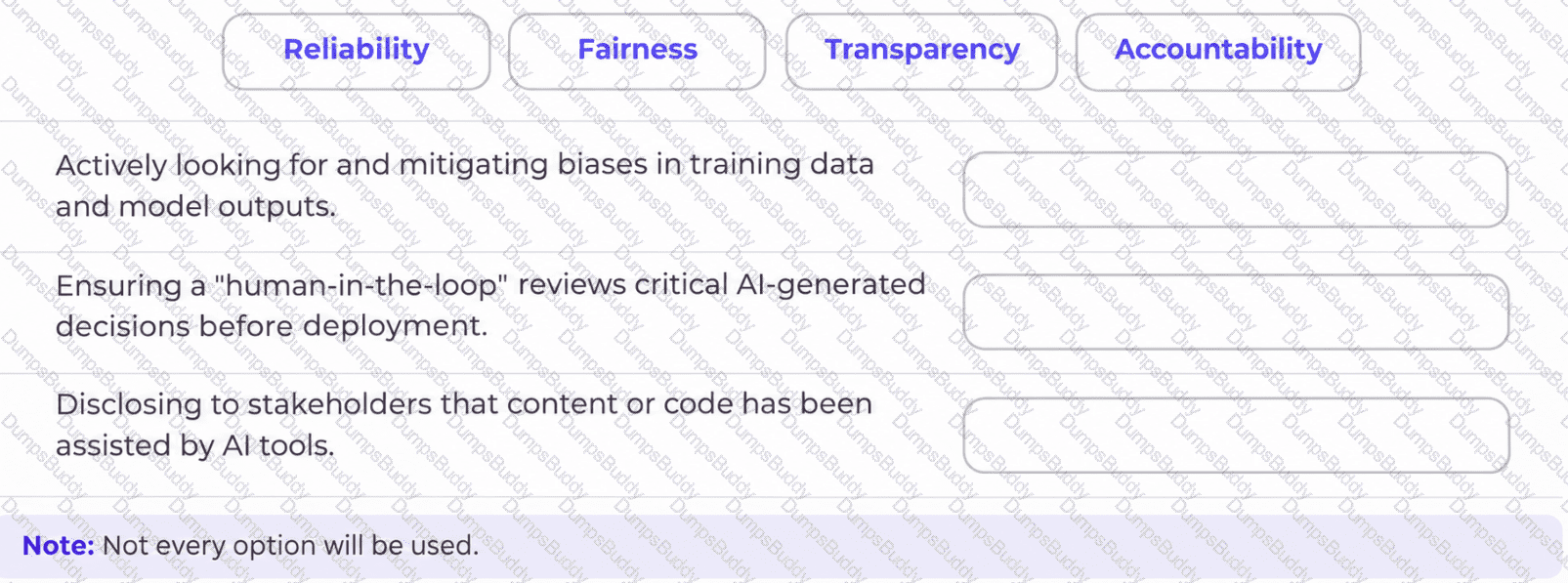
Options:
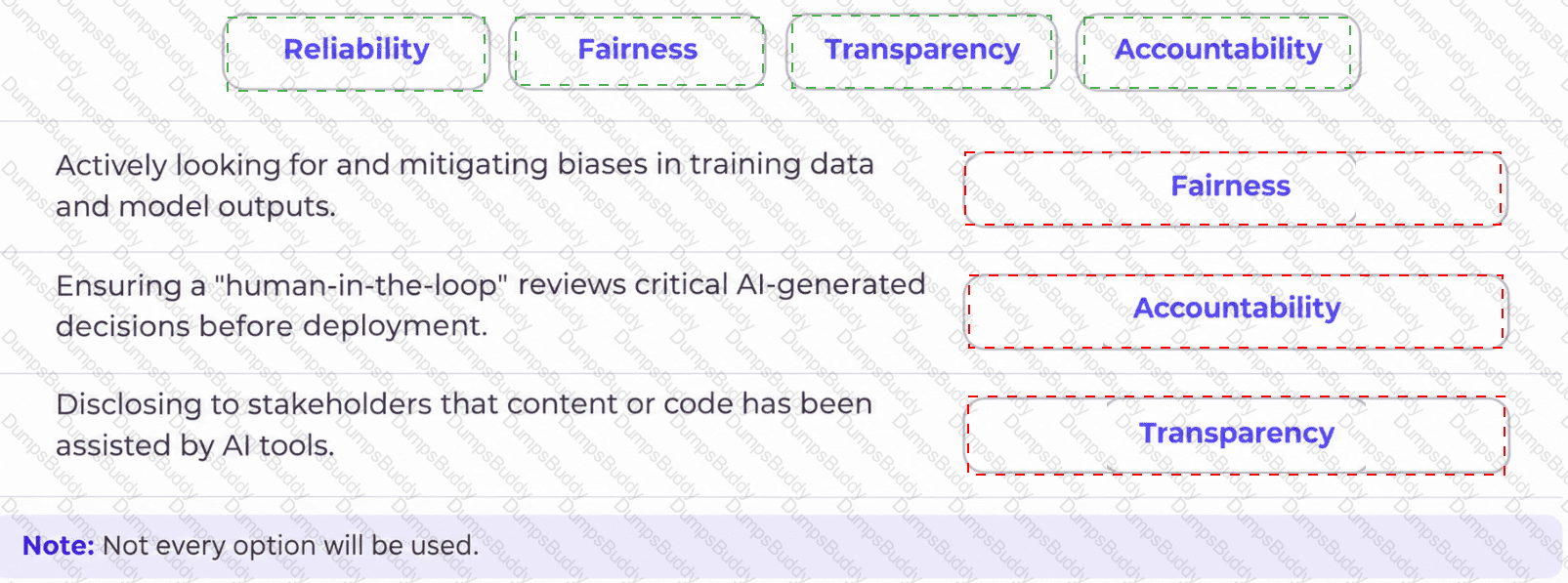
Answer:
Explanation:
Correct Drag-and-Drop Sequence:
Fairness
Accountability
Transparency
Responsible AI principles establish ethical and operational standards for developing, deploying, and governing artificial intelligence systems. The three scenarios illustrate Fairness, Accountability, and Transparency, which Cisco explicitly identifies under its Ethics and Security examination domain.
1. Fairness: This principle requires AI systems to minimize unjustified discrimination and systematically biased outcomes. Actively identifying and mitigating biases in training datasets and model outputs helps ensure that AI-generated recommendations do not unfairly disadvantage particular individuals or groups. Fairness audits, representative datasets, and subgroup performance evaluations are important mitigation techniques.
2. Accountability: Accountability establishes responsibility for AI-generated decisions and their consequences. Implementing Human-in-the-Loop (HITL) reviews ensures that qualified personnel examine critical recommendations before deployment or execution. Human oversight supports governance, provides opportunities to identify errors, and establishes clear decision-making responsibility.
3. Transparency: Transparency requires organizations to communicate relevant information about AI involvement in processes and outputs. Disclosing that documents, software code, or other content were produced with AI assistance enables stakeholders to understand the technology's role and evaluate its limitations.
Reliability is the unused option. Reliability concerns consistent, dependable system performance under expected operating conditions rather than the three specific actions described.
Specific Cisco AITECH Course Guide References:
Generative AI Security and Privacy Fundamentals
Responsible AI Principles and Bias Mitigation
AI Governance, Policy, and Risk Management
Exam Objective 3.1: Fairness, Transparency, Accountability, Bias Mitigation, and Safety
Exam Objective 3.4: AI Governance Considerations
Official Cisco Reference: Cisco AI Technical Practitioner (810-110) Exam Topics
PDF + Testing Engine

Testing Engine
PDF (Q&A)