- Home
- SAVE International
- Value Methodology
- CVS
- Certified Value Specialist Questions and Answers
CVS Certified Value Specialist Questions and Answers
Carpet and vinyl tile are acceptable alternatives for an owner to cover 1,000 square meters of floor. Carpet installation cost is $30 per square meter. What is the initial cost of the carpet?
Options:
$30,000
$32,500
$33,000
$36,000
Answer:
AExplanation:
The correct answer is A . Initial cost is the acquisition, construction, production, or installation expenditure incurred at the start of the alternative’s life. SAVE’s dictionary defines initial cost as the initial expenditure of resources to develop, acquire, produce, or construct a project, product, or process, and notes that it is interchangeable with capital cost.
Here, the calculation is direct:
1,000 square meters × $30 per square meter = $30,000.
The maintenance costs, shampooing cost, service life, and vinyl data are not needed for this specific question because it asks only for the initial cost of carpet , not the life-cycle cost. Options B, C, and D incorrectly include additional amounts or appear to mix operating/maintenance costs with initial cost. In CVS-style questions, the trap is often to include irrelevant life-cycle data. A disciplined evaluator first identifies the cost category being requested: initial cost, recurrent annual cost, single expenditure, salvage value, present worth, annualized cost, or total life-cycle cost.
References/topics: Evaluation Phase; Initial Cost; Life-Cycle Cost Analysis.
There is resistance to a new VM program in an organization. What should a VM program coordinator focus on to increase acceptance of VM?
Options:
Explain the difference between VM and other value-improving programs (TRIZ, Lean 6-Sigma, etc.)
Highlight that there are many areas with deficiencies that will be improved by VM.
Prepare a memo for the CEO to sign that requires staff to incorporate VM in all departments.
Identify a few subjects that would benefit from change and recommend a VM study through dialogue with staff.
Answer:
DExplanation:
The correct answer is D. Identify a few subjects that would benefit from change and recommend a VM study through dialogue with staff . When an organization resists a new VM program, the coordinator should build acceptance through participation, relevance, and early demonstrated value—not by forcing compliance or emphasizing deficiencies.
SAVE’s Study Guide describes VM as a systematic process used by a multidisciplinary team to improve value through function analysis, with value improvement achieved by identifying alternate ways to accomplish required functions. ( ) This means VM acceptance is strongest when people see how the method applies to real organizational problems. The Study Guide also emphasizes that management should support resources and implementation, while affected parties should be involved early to gain maximum benefit from a Value Study. ( )
Option A may help education, but it does not directly overcome resistance. Option B can sound accusatory and may increase defensiveness. Option C creates top-down compliance, not genuine acceptance. Option D is best because it uses dialogue, selects practical pilot opportunities, and allows staff to experience VM as useful rather than imposed.
References/topics: VM Programs; Program Acceptance; Value Manager Role; Stakeholder Engagement; Organizational Change; Value Study Selection.
The VM study team appears engaged but is not making progress. Which of the following is the most likely cause?
Options:
Groupthink
Uncomfortable environment
Social loafing
Group size
Answer:
AExplanation:
The correct answer is A. Groupthink . In VM facilitation, a team can appear active, cooperative, and verbally engaged while still failing to make meaningful progress if members are converging too quickly, avoiding disagreement, or reinforcing the same assumptions. This is characteristic of groupthink , where apparent harmony masks weak analysis and limited challenge to alternatives. Groupthink is defined as a negative group decision process involving conformity pressure, self-censorship, and reduced critical examination in cohesive groups.
This aligns directly with VM team-dynamics responsibilities. The SAVE International Study Guide states that the Job Plan supports team synergy within a structured process , not merely a collection of individual opinions. ( ) The team leader must keep the team focused, keep members involved in discussion and work, and act as a catalyst to keep the team moving and motivated. ( )
Option B would more likely produce visible discomfort or withdrawal. Option C, social loafing, reflects reduced individual effort, not an engaged but stalled team. Option D may influence participation, but it is not the best diagnostic cause here. The facilitation response should restore inquiry, challenge assumptions, and encourage constructive dissent.
References/topics: VM Facilitation and Team Dynamics; Team Leader Responsibilities; Job Plan Discipline; Groupthink; Team Progress Barriers.
What are key reasons to use a fine evaluation filter?
Choose 2 answers.
Options:
It uses weighted relative importance.
It slows the process to promote initial ideas.
It increases rigor in the evaluation process.
It allows differentiation between ideas.
Answer:
A, CExplanation:
The correct answers are A and C . A fine evaluation filter is used in the Evaluation Phase when the VM team needs a more disciplined and defensible method for screening ideas before selecting them for development. SAVE’s VM Job Plan states that evaluation factors and their relative importance should be agreed upon before ideas are evaluated, and that ideas are then ranked and rated against the most important evaluation criteria.
Option A is correct because the fine filter applies weighted relative importance to evaluation criteria. This prevents all criteria from being treated equally when some factors, such as cost, performance, risk, schedule, or customer impact, are more important than others. Option C is correct because this method increases rigor by moving the team from informal opinion to structured comparison. It supports rational selection of ideas for development and reduces bias, popularity-based decisions, and premature rejection of valuable alternatives.
Option B is incorrect because the purpose is not to slow the process or promote initial ideas. Option D may be a result of scoring, but it is not the primary distinguishing reason for using the fine filter.
References/topics: Evaluation Phase; Fine Evaluation Filter; Weighted Criteria; Ranking and Rating Ideas; Selection for Development.
A higher-order function
Choose 2 answers.
Options:
represents specific needs satisfied by the basic function.
describes the output of the basic function.
is fundamental to the subject scope.
describes input for the basic function.
Answer:
A, BExplanation:
The correct answers are A and B . In Function Analysis and FAST diagramming, a higher-order function is positioned to the left of the basic function and answers the question “Why is this function performed?” It represents the broader purpose or need that is satisfied when the basic function is successfully achieved. Therefore, option A is correct because the higher-order function expresses the customer, user, or project need served by the basic function.
Option B is also correct because the higher-order function can be understood as the output or result produced by accomplishing the basic function. In FAST logic, the basic function performs a required action, and the higher-order function explains the reason or outcome of that action. It is not normally the detailed mechanism for achieving the basic function.
Option C is incorrect because the basic function , not the higher-order function, is fundamental to the subject scope. The higher-order function often lies just outside or above the study scope as the reason the basic function is needed. Option D is incorrect because inputs or enabling actions are usually associated with lower-order or “how” functions, not higher-order “why” functions.
References/topics: Function Analysis Phase; FAST Diagramming; Higher-Order Function; Basic Function; How/Why Logic.
Which of the following are the purposes of function analysis?
Choose 4 answers.
Options:
Communicate ideas
Stimulate communication
Change viewpoints
Expand knowledge
Identify opportunities
Create opportunities
Answer:
B, C, D, EExplanation:
The correct answers are B. Stimulate communication, C. Change viewpoints, D. Expand knowledge, and E. Identify opportunities . Function Analysis is the central differentiator of the Value Methodology because it forces the team to define what the project, product, process, or service must do , rather than defending existing solutions. SAVE’s Study Guide states that Function Analysis is the foundation of VM and that functions are identified within the study scope using active verb/measurable noun descriptions. It further explains that naming functions enables clear thinking, helps multidisciplinary teams build shared understanding, and allows the team to identify where value-improvement opportunities exist. ( )
Function Analysis therefore stimulates communication by giving different disciplines a common functional language. It changes viewpoints by shifting discussion from components and preferred solutions to required purposes. It expands knowledge because team members learn how functions, resources, cost, worth, and performance relate. It also identifies opportunities by exposing inefficient, high-cost, unnecessary, or poorly performed functions.
Option A is less precise because Function Analysis does not primarily “communicate ideas”; idea communication occurs more strongly in Creativity, Development, and Presentation. Option F is incorrect because opportunities are identified in Function Analysis, while new alternatives are created in the Creativity Phase.
References/topics: Function Analysis Phase; Function Definition; Shared Understanding; Value Improvement Opportunities; FAST/Function Modeling.
What are key factors that cause VM programs to fail?
Choose 2 answers.
Options:
Locating the VM program within a department in the organization
An undefined implementation and change management process
Management support
Tracking VM study results
Answer:
A, BExplanation:
The correct answers are A and B . A VM program can fail when it is placed too narrowly inside one department because Value Methodology must operate as an organization-wide management process, not as the property of a single functional group. When VM is positioned inside one department, other departments may view it as that department’s agenda rather than as a neutral, cross-functional decision-support process. This weakens participation, reduces ownership of recommendations, and limits executive visibility.
An undefined implementation and change management process is also a major failure factor. VM studies produce recommendations, but the program succeeds only when those recommendations are reviewed, approved, assigned, tracked, and integrated into normal project or business controls. Without a defined implementation path, even technically strong VM proposals can remain unused. Change management is necessary because VM recommendations often alter scope, design, delivery approach, cost allocation, or stakeholder expectations.
By contrast, management support and tracking VM study results are success factors, not failure factors. Executive support gives authority and resources, while tracking verifies savings, value improvement, and accountability.
References/topics: VM Programs; Program Organization; Management Support; Implementation Process; Change Management; Tracking VM Results.
Which of the following situations are MOST appropriate for using a RACI matrix?
Choose 2 answers.
Options:
Process flow
Communication gaps
Validated assumptions
Misunderstood concepts
Answer:
B, DExplanation:
The correct answers are B and D . A RACI matrix is most appropriate when the VM facilitator needs to clarify involvement, responsibility, accountability, consultation, and communication among participants or stakeholders. In the SAVE International Value Methodology Core Competencies, the RACI matrix is listed under the Information Phase as a method used to transform information, while process flowcharts are listed separately as a different technique. This distinction is important because a RACI matrix does not map process sequence; it clarifies roles and involvement.
A RACI chart defines who is Responsible, Accountable, Consulted, and Informed for project tasks, and it is used to reduce confusion, improve communication pathways, and establish clear ownership. ( Atlassian ) Therefore, it directly addresses communication gaps and misunderstood concepts related to who should act, decide, advise, or be kept informed.
Option A is incorrect because process-flow issues are better handled with a process flowchart. Option C is incorrect because validated assumptions do not require role clarification; they are already confirmed information.
References/topics: Information Phase; RACI Matrix; Methods to Transform Information; VM Facilitation; Stakeholder Communication.
Place the process for building a work breakdown structure in the correct order:
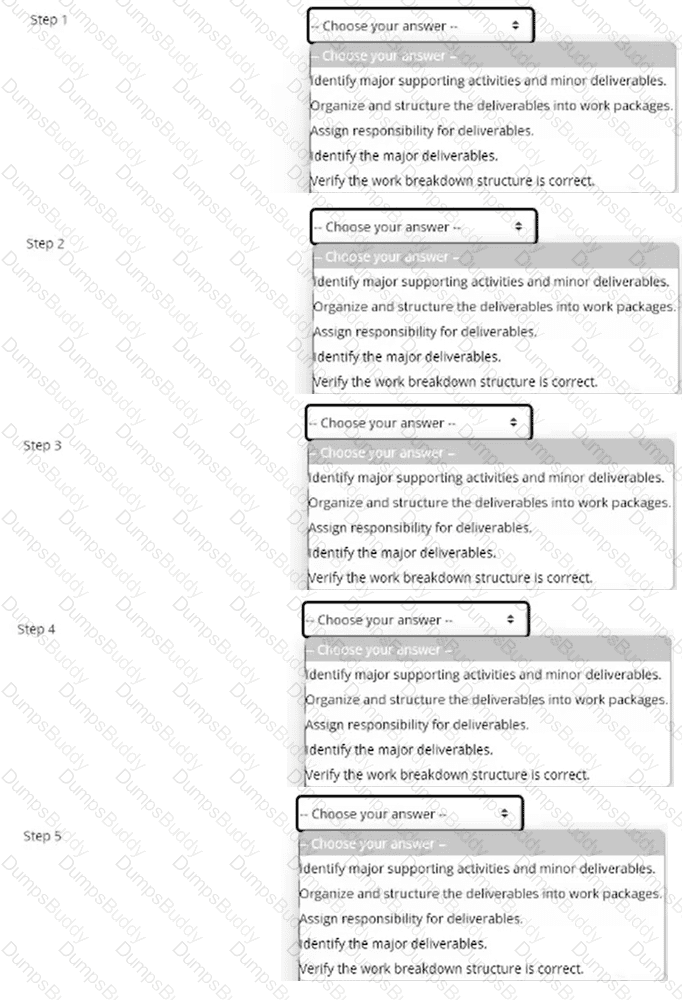
Options:
Answer:
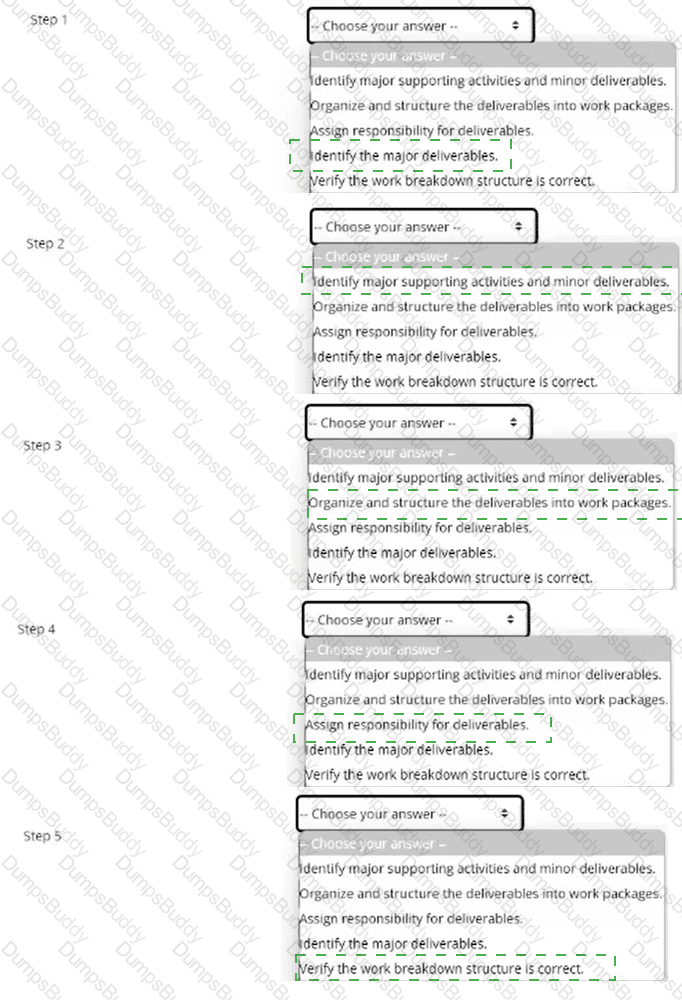
Explanation:
Step 1 — Identify the major deliverables
Step 2 — Identify major supporting activities and tasks
Step 3 — Organize and structure the deliverables
Step 4 — Assign responsibility for deliverables
Step 5 — Verify the work breakdown structure
The correct sequence begins with identifying the major deliverables because a Work Breakdown Structure is deliverable-oriented. The team must first define what must be produced before it can break the work into manageable parts. After the major deliverables are clear, the next step is to identify the major supporting activities and tasks required to complete each deliverable.
The third step is to organize and structure the deliverables into a logical hierarchy. This converts the project scope into a structured framework that can be planned, estimated, tracked, and controlled. The fourth step is to assign responsibility for deliverables , because the WBS must support accountability. Each work element should have clear ownership so that implementation actions do not remain vague or unmanaged.
The final step is to verify the work breakdown structure . Verification confirms that the WBS is complete, logical, non-duplicative, and aligned with the intended scope. In VM practice, this supports implementation planning by connecting proposals, deliverables, responsibilities, and follow-up control.
References/topics: VM Programs; Implementation Planning; Work Breakdown Structure; Deliverable Breakdown; Responsibility Assignment; Project Control.
A VM program manager has the resources to undertake one VM study, but 4 candidate subjects/projects are available, each costing $10 million. Which subject/project should be selected?
Options:
The subject design is complete, but there is concern the project will not deliver an ROI.
The subject is similar to a previous successful project, but design has not started. The project is expected to deliver the target ROI.
The subject is similar to a previous project and the design has not started. The previous project did not achieve the target ROI.
The subject is similar to a previous project, the design is 30% complete, and a detailed estimate is prepared. The previous project achieved the target ROI.
Answer:
DExplanation:
The correct selection is D because it provides the strongest balance of study readiness, timing, and probability of return . A VM program manager must allocate limited study resources to the candidate most likely to produce measurable value improvement. SAVE guidance states that VM produces the greatest benefit early in development when basic project information is established but major design resources have not yet been fully committed. ( cdn..com ) It also notes that later studies are more likely to increase implementation cost. ( cdn..com )
Option D is therefore superior because a 30% design with a detailed estimate gives the VM team enough factual information for function, cost, worth, and alternative analysis, while the project is still early enough for recommendations to be implemented economically. The fact that the previous similar project achieved the target ROI further supports selection because it indicates a credible return pattern. Option A is too late because the design is complete and ROI is already doubtful. Options B and C are too immature because design has not started; C is additionally weak because the similar previous project failed to meet ROI.
References/topics: VM Programs; Value Program Management; Study Selection; ROI; Timing of VM Studies; Preparation Phase.
Which factors influence the scheduling of the presentation at the end of the VM study workshop?
Choose 2 answers.
Options:
Size of the VM team
Number of participants
Level of management involvement
Number of VM proposals developed
Answer:
C, DExplanation:
The correct answers are C and D . The end-of-workshop presentation is part of the Presentation Phase , whose objective is to obtain concurrence and commitment from the designer, project sponsor, and management to proceed with implementation. SAVE’s VM Job Plan identifies Presentation Phase activities as presenting an oral report, preparing the written report, and obtaining implementation commitments. ( UW Courses )
Therefore, the level of management involvement directly affects scheduling because the presentation must be arranged when the decision-making body, sponsor, designer, and appropriate managers are available. The standard states that the VM team presents recommendations to the decision-making body and uses interactive discussion to obtain approval or direction for more information. ( UW Courses )
The number of VM proposals developed also affects scheduling because more proposals require more time for explanation, supporting data, benefit analysis, cost/schedule impacts, risks, and implementation requirements. The Development Phase requires each proposed alternative to include technical data, cost and performance data, schedule impact, and implementation planning before presentation. ( UW Courses )
Team size and general participant count may affect logistics, but they are not the primary scheduling drivers for the formal final presentation.
References/topics: Presentation Phase; Development Phase; VM Proposals; Management Commitment; Implementation Planning.
Which of the following are the effects of increasing the duration of a VM study?
Choose 2 answers.
Options:
Site visit duration is unchanged
Additional creative techniques can be used
Numerous FAST diagrams are constructed
Evaluation techniques are more thoughtful
More VM proposals are implemented
Answer:
B, DExplanation:
The correct answers are B and D . Increasing the duration of a VM study gives the team more working time inside the structured Job Plan. SAVE describes Value Methodology as a structured process following defined phases such as Information, Function Analysis, Creativity, Evaluation, Development, and Presentation. ( Value Engineering ) When more time is available, the team can apply additional creative techniques during the Creativity Phase rather than relying only on basic brainstorming. This may include checklists, attribute listing, analogy, morphological methods, or other structured idea-generation approaches.
A longer study also allows evaluation techniques to be more thoughtful . In the Evaluation Phase, ideas from the Creativity Phase are screened, grouped, compared, ranked, and selected for further development. With more time, the team can apply better criteria, discuss advantages and disadvantages more carefully, consider cost, performance, risk, constructability, operations, and maintenance impacts, and reach stronger consensus.
Option A is incorrect because site-visit time may change depending on study scope and complexity. Option C is incorrect because more duration does not mean numerous FAST diagrams must be produced. Option E is not guaranteed because implementation depends on management approval, feasibility, funding, and follow-through after the study.
References/topics: VM Programs; Study Duration; Creativity Phase; Evaluation Phase; VM Job Plan Planning.
A VM Facilitator has been asked to propose ways to reduce the value study time commitment of client VM team members who have specialized knowledge required for the study. What should the VM Facilitator propose to best reduce the time commitments of the specialists?
Options:
Recommend that all team members follow all the VM job plan phases to achieve value improvement.
Suggest that VM team members with specialized knowledge participate in the Development Phase to ensure reasonable value proposals.
Recommend VM members with specialized knowledge participate in the Creativity Phase to ensure the team understands their perspectives.
Suggest VM team members with specialized knowledge participate in the Function Analysis Phase because it leads to creativity.
Answer:
AExplanation:
The correct answer is A because the specialists described in the question are not casual reviewers or occasional outside advisers; they are VM team members whose specialized knowledge is required for the study. The CVS logic is that essential team members should remain engaged through the full Job Plan so that information, function thinking, creativity, evaluation, development, and presentation remain connected. The SAVE Study Guide identifies technical champions as team members selected for technical expertise and states that value team members are expected to “participate in all meetings,” gather and analyze information, identify functions, contribute ideas, and evaluate ideas using their experience and expertise. ( )
Options B, C, and D incorrectly isolate specialist participation to one phase. That weakens team continuity and can cause poor assumptions, missed functions, unrealistic ideas, or weak evaluation. The facilitator may manage time efficiently through preparation, agenda control, and disciplined facilitation, but should not remove required specialists from the VM Job Plan phases. The Study Guide also emphasizes keeping team members together whenever possible to maintain continuity. ( )
References/topics: VM Facilitation; Team Dynamics; Technical Champions; Value Team Member Responsibilities; Job Plan Discipline.
A team wants to skip Function Analysis because the design solution already appears obvious. What is the best CVS-level response?
Options:
Agree, because Function Analysis is optional when experts are present
Skip directly to Development to save time
Perform Function Analysis because it is essential to a valid VM study
Replace Function Analysis with procurement benchmarking only
Answer:
CExplanation:
The correct answer is C . Function Analysis is not an optional administrative exercise. SAVE’s VM Standard states that, for a study to qualify as a Value Study, the team must follow an organized Job Plan and perform Function Analysis as defined in the standard. It also states that the team defines functions using active verb/measurable noun language and analyzes them to determine which need improvement, elimination, or creation.
Option A is wrong because expert confidence does not replace the VM process. Experts are valuable, but they often carry design bias. Option B destroys the logic of the Job Plan because Development should refine selected ideas, not bypass function understanding. Option D may provide useful cost intelligence, but benchmarking does not identify required functions or function relationships. The disciplined CVS answer is that Function Analysis protects the team from solution fixation. It reveals what must be accomplished, which functions consume resources, and where value mismatches exist. Skipping it reduces VM to ordinary design review.
References/topics: Function Analysis Phase; Valid Value Study; VM Job Plan Discipline.
Which statement best describes a FAST diagram?
Options:
A schedule network used to calculate project float
A graphical model showing dependent relationships among functions
A cost spreadsheet used to calculate inflation
A procurement chart showing supplier lead times
Answer:
BExplanation:
The correct answer is B . FAST stands for Function Analysis System Technique. SAVE defines a FAST diagram as a graphical representation of dependent relationships of functions within a project, product, or process. The diagram uses logical relationships such as “How,” “Why,” and “When” to organize functions. It is a core Function Analysis tool because it forces the team to examine why functions exist, how they are accomplished, and which functions lie on the critical function logic path.
Option A is incorrect because schedule networks belong to project scheduling, not function modeling. Option C is wrong because cost spreadsheets may support resource analysis, but they do not show functional dependency logic. Option D is a procurement management artifact. FAST is valuable because it shifts the team from objects and components to function relationships. This enables better creativity because the team can ask, “How else can we perform this function?” rather than merely asking, “How can we make this component cheaper?”
References/topics: FAST Diagram; Function Analysis System Technique; How-Why Logic.
SMART stands for
Options:
Specific, Measureable, Attainable, Reasonable, and Timebound.
Specific, Measureable, Accountable, Relevant, and Timebound.
Standards, Measureable, Attainable, Relevant, and Timebound.
Standards, Measureable, Accountable, Relevant, and Timebound.
Standards, Measureable, Attainable, Reasonable, and Timebound.
Specific, Measureable, Attainable, Relevant, and Timebound.
Answer:
FExplanation:
The correct answer is F: Specific, Measurable, Attainable, Relevant, and Timebound . In Value Methodology, SMART thinking is used to make recommendations, implementation actions, objectives, and follow-up responsibilities clear enough to be managed. A VM proposal or implementation action should not be vague, general, or open-ended. It must state exactly what is to be done, how success will be measured, whether the action can realistically be achieved, how it supports the study objective or project need, and when it must be completed.
“Specific” requires a clear action or target. “Measurable” means the result can be checked through cost, performance, schedule, quality, or other defined criteria. “Attainable” confirms that the action is practical within available resources and constraints. “Relevant” ensures alignment with the value study objectives, functions, and stakeholder requirements. “Timebound” creates accountability through a completion date or defined time frame.
The incorrect options replace key SMART terms with weaker or incorrect words such as Standards , Accountable , or Reasonable . These may be useful concepts in management, but they do not form the standard SMART acronym used in VM action planning.
References/topics: Implementation Phase; VM Action Planning; Proposal Follow-Up; Performance Objectives; VM Programs.
Which statement best describes the Implementation Phase?
Options:
It occurs before the Information Phase to collect user attitudes
It converts accepted value proposals into executed changes and tracks results
It is identical to the Creativity Phase
It is where all unselected ideas are formally approved
Answer:
BExplanation:
The correct answer is B . Implementation is the post-presentation activity where accepted recommendations are converted into action. Although the six-phase workshop Job Plan ends with Presentation, SAVE’s VM process recognizes post-workshop documentation and implementation activity as part of the broader value study process. The VM Standard’s process flow shows pre-workshop, workshop, and post-workshop/implementation activities.
Option A is incorrect because collecting user attitudes and study preparation occur before or during early study activities, not Implementation. Option C is wrong because Creativity generates alternatives, while Implementation executes approved proposals. Option D is wrong because unselected ideas are not automatically approved. At CVS level, Implementation requires ownership, assigned responsibilities, schedules, change management, technical follow-through, documentation, and confirmation of achieved value. A proposal has no realized value until it is adopted and executed. Weak VM programs often generate impressive workshop reports but fail during implementation because accountability, funding, decision authority, and tracking mechanisms are missing.
References/topics: Implementation Phase; Post-Workshop Activities; Value Realization.
Which of the following actions is the most effective method for encouraging stakeholder engagement during the implementation phase?
Options:
Assign tasks to team members before informing stakeholders.
Use formal reports to streamline the process.
Provide stakeholders with the VM study report during the implementation meeting.
Coordinate with the project manager to distribute information to stakeholders.
Answer:
DExplanation:
The correct answer is D. Coordinate with the project manager to distribute information to stakeholders . In the Implementation Phase , the purpose is not merely to produce documentation; it is to ensure that approved VM proposals are converted into executed actions. SAVE’s VM Standard Reference states that during implementation, the sponsoring organization reviews VM study results, decides which proposals to implement, and develops and executes an implementation plan to actualize the value improvements.
Stakeholder engagement depends on timely, coordinated, and project-controlled communication. The project manager is normally the central execution authority, so coordinating with the project manager ensures that stakeholders receive the right information, understand decisions, know implementation responsibilities, and remain aligned with schedule, cost, quality, risk, and performance expectations.
Option A is ineffective because assigning tasks before informing stakeholders can create resistance and reduce buy-in. Option B supports documentation but does not actively engage stakeholders. Option C may be useful, but handing out the VM study report during a meeting is passive and often too late to build ownership. Coordinated information distribution through the project manager is the most effective engagement mechanism.
References/topics: Implementation Phase; VM Study Results; Implementation Plan; Stakeholder Communication; Project Manager Coordination.
Which creativity method is based on the consideration of the overall problem and brainstorming by function?
Options:
Intuitive Creativity Method
Ideation Creative Method
Discursive Creativity Method
Empirical Creativity Method
Answer:
AExplanation:
The correct answer is A. Intuitive Creativity Method . In the CVS® Value Methodology framework, the Creativity Phase is designed to generate a large quantity of ideas for performing the functions selected during Function Analysis. The SAVE VM Standard describes the Creative Phase as an effort to develop many ideas for “performing each function selected for study,” with judgment suspended and free idea flow encouraged.
The intuitive creativity method is based on considering the overall problem and allowing ideas to emerge freely through association, imagination, and non-linear thinking. The VM Guide states that intuitive creativity methods are based on the “overall problem” and that brainstorming by function is a prime example. This matches the question exactly.
Option C, Discursive Creativity Method , is incorrect because it follows a deliberate, structured, step-by-step procedure by breaking the problem into sub-problems. Option D, Empirical Creativity Method , is more experimental or data-driven. Option B is not the standard classification used here.
References/topics: Creativity Phase; Creativity Techniques; Intuitive Creativity Methods; Brainstorming by Function; Creating by Function
What tool could the VM study team use to show customer satisfaction?
Options:
Quality function deployment
Quality management plan
Customer FAST
Resource model
Answer:
CExplanation:
The correct answer is Customer FAST . In Value Methodology, FAST is used in the Function Analysis Phase to model how functions relate to each other and to clarify what the project must accomplish from a functional perspective. The customer-oriented version of FAST is specifically designed to reflect that the customer determines value in the function analysis process. The SAVE study guide describes the Customer-Oriented FAST model as a variation that adds customer-focused support functions such as “attract users,” “satisfy users,” “assure dependability,” and “assure convenience.” ( )
This makes Customer FAST the best tool when the study team wants to show customer satisfaction as part of the value logic. Quality Function Deployment can capture or translate the voice of the customer, but the question asks for a tool to show customer satisfaction within the VM function structure. A quality management plan is a project quality control document, not a VM function model. A resource model addresses inputs or resource use rather than customer-perceived value. Therefore, Customer FAST is the most technically precise answer.
References/topics: Function Analysis Phase; FAST Diagramming; Customer-Oriented FAST; Customer Attitude; Function Modeling.
The decision-makers agreed to implement a VM proposal requiring an organizational change. What should be done to improve success?
Choose 2 answers.
Options:
Encourage participation by those affected by the change
Strictly define the implementation plan
Hire a change management consultant
Appoint an oversight committee
Answer:
A, DExplanation:
The correct answers are A. Encourage participation by those affected by the change and D. Appoint an oversight committee . In the Implementation Phase, the approved VM proposal must be converted from an accepted recommendation into an actual organizational action. When the proposal requires organizational change, technical approval alone is not enough; successful implementation depends heavily on acceptance, ownership, coordination, and follow-through.
Encouraging participation by those affected by the change is essential because employees, managers, operators, and process owners who must live with the change often understand the practical barriers, workflow impacts, training needs, and resistance points. Their involvement improves buy-in and reduces implementation failure.
Appointing an oversight committee is also appropriate because organizational change normally crosses departments, responsibilities, and authority levels. Oversight provides governance, monitors progress, resolves conflicts, confirms accountability, and ensures the approved VM proposal remains aligned with the intended value improvement.
Option B is less suitable because an implementation plan should be clear and controlled, but not so rigid that it prevents adjustment during organizational transition. Option C is not required; a consultant may help in special cases, but it is not a primary VM implementation requirement.
References/topics: Implementation Phase; Change Adoption; Stakeholder Participation; Implementation Governance; VM Proposal Follow-Through.
The Value Methodology
Choose 2 answers.
Options:
Encourages multidisciplinary communication
Accelerates the design process
Maintains paradigms
Develops realistic budgets
Answer:
A, DExplanation:
The correct answers are A and D . Value Methodology is defined by SAVE International as a systematic process used by a multidisciplinary team to improve project value through the analysis of functions. Because the method intentionally brings together people from different technical, operational, cost, owner, user, and management perspectives, it naturally encourages multidisciplinary communication . The SAVE Study Guide also explains that function naming helps multidisciplinary teams build a shared understanding of project requirements, which supports clearer communication and better identification of value-improvement opportunities. ( )
The second correct answer is develops realistic budgets . VM evaluates required functions against resources such as materials, labor, price, time, and other cost drivers. This function/resource relationship helps teams understand what the project must accomplish and what resources are reasonably required. OMB’s Value Engineering policy also describes VE as a management tool used to ensure realistic budgets , remove nonessential costs, and maintain acceptable quality. ( George W. Bush White House Archives )
Option C is incorrect because VM does not maintain paradigms; it challenges assumptions and existing approaches. Option B may occur as an indirect benefit, but it is not the stronger core answer for this two-response item.
References/topics: Value Methodology Definition; Multidisciplinary Team; Function/Resource Relationship; VM Job Plan; VM Programs.
What should the VM facilitator consider for the title of a VM proposal?
Choose 2 answers.
Options:
Using a concise description of the proposal
Using specific technical language
Framing the title to help sell the concept
Using general non-specific jargon
Answer:
A, CExplanation:
The correct selections are A and C . A VM proposal title should be clear, concise, and persuasive because it is part of the communication package used to move a value alternative toward management understanding, acceptance, and implementation. In the Presentation Phase, the value team presents value alternatives to management, stakeholders, or decision makers, with the intent of helping them make informed decisions aligned with strategic objectives. The SAVE study guide identifies the Presentation Phase purpose as presenting value alternatives to management and other decision makers, and its outcome includes ensuring stakeholders understand the rationale of alternatives and generating interest to sanction implementation. ( cdn..com )
Therefore, a concise title helps the proposal communicate its central idea quickly without obscuring the function, benefit, or decision point. Framing the title to help sell the concept is also appropriate because a VM proposal must communicate value, not merely describe a technical change. The facilitator should avoid overly specific technical language when it narrows the audience’s understanding, and avoid general jargon because it weakens clarity, credibility, and decision usefulness. A strong title should express the value opportunity in management-facing terms.
References/topics: Presentation Phase; Development Phase; VM Proposal Communication; Value Alternatives; Management Decision Support.
Carpet and vinyl tile are acceptable alternatives for an owner to cover 1,000 square meters of floor.
Carpet
Installation cost, including pad = $30 / square meter
Service life = 10 years
Maintenance cost: vacuum weekly = $500 / month
Maintenance cost: shampoo once per year = $3,000 / shampoo
Vinyl
Installation cost, including pad = $10 / square meter
Service life = 15 years
Maintenance cost: vacuum weekly = $400 / month
Maintenance cost: strip and wax once per month = $1,000 / strip and wax
What is the initial cost of the carpet ?
Options:
$30,000
$32,500
$33,000
$36,000
Answer:
AExplanation:
The correct answer is A. $30,000 . The question asks only for the initial cost of the carpet, not its annual maintenance cost, life-cycle cost, present worth, or equivalent annual cost. In SAVE terminology, initial cost means the first expenditure required to acquire, produce, construct, or install the project, product, or process. The SAVE VM Dictionary identifies initial cost as the initial expenditure of resources and also treats it as interchangeable with capital cost. It separately defines life-cycle cost as the sum of initial cost, recurrent annual cost, single expenditures, and disposal or salvage value over a defined period. Therefore, the maintenance costs and service-life data are distractors for this specific calculation.
The carpet covers 1,000 square meters , and the installation cost is $30 per square meter . The calculation is:
1,000 × $30 = $30,000
Options B, C, and D incorrectly imply that additional costs have been added to the initial installation cost. In the Evaluation Phase, CVS candidates must identify the cost category being requested before performing the calculation. SAVE’s VM Standard places structured evaluation after creativity to compare alternatives while considering performance requirements and resource limits.
References/topics: Evaluation Phase; Initial Cost; Capital Cost; Life-Cycle Cost Analysis; Cost Classification.
Which of the following are the outputs of the Presentation Phase?
Choose 2 answers.
Options:
List of participants
Schedule the VM presentation
The VM study report
List of VM proposals and results
Answer:
C, DExplanation:
The correct answers are C and D . The Presentation Phase is where the VM facilitator and study team formally communicate the conclusions of the VM study to decision makers. SAVE’s VM Standard Reference states that, in this phase, the facilitator develops a report and/or presentation that documents and conveys the conclusions and results of the VM study.
Therefore, the VM study report is a direct output of the Presentation Phase. It records the developed value alternatives, supporting analysis, cost/performance implications, and the basis for management review. The list of VM proposals and results is also an output because decision makers must understand what proposals were generated, what benefits they offer, and what outcomes or decisions are associated with them.
Option A, list of participants, may appear in a report appendix or study record, but it is not a primary Presentation Phase output. Option B is incorrect because scheduling the VM presentation is a planning/logistics activity, not an output of the phase. The phase produces documented results and communicates VM proposals for decision and follow-up.
References/topics: Presentation Phase; VM Study Report; VM Proposals; Study Results; VM Job Plan.
How should the VM facilitator handle “conditionally accepted” VM proposals?
Choose 2 answers.
Options:
Identify modifications required for acceptance.
List the VM proposal as accepted.
Ask decision makers for timing of the final decision.
List deficiencies of the VM proposal.
Answer:
A, CExplanation:
A conditionally accepted VM proposal is not fully approved yet. It means the decision makers see value in the proposal, but acceptance depends on certain changes, clarifications, added data, or further review. Therefore, the facilitator should first identify the modifications required for acceptance . This creates a clear action path and prevents the proposal from being wrongly recorded as fully approved.
The facilitator should also ask decision makers for the timing of the final decision . In VM reporting and implementation follow-up, unresolved proposals must have ownership, required actions, and a decision schedule. Without a timing commitment, conditionally accepted proposals can remain open and lose implementation momentum.
Option B is incorrect because a conditionally accepted proposal is not the same as an accepted proposal. Listing it as accepted would misrepresent the decision status. Option D is weaker because the facilitator should not merely list deficiencies; the correct VM approach is to convert concerns into specific required modifications and next steps.
References/topics: Presentation Phase; Decision Documentation; Proposal Disposition; Implementation Planning; VM Facilitator Responsibilities.
Which of the following should the project manager use to support the implementation of proposals?
Choose 2 answers.
Options:
Previously gathered user experiences.
A detailed implementation plan including timelines and resources.
A contingency plan to address potential issues that may arise during implementation.
The implementation plan without assessing current policies and procedures.
Answer:
B, CExplanation:
The correct answers are B and C . In the VM Job Plan, implementation support requires more than approving an idea; it requires a controlled plan for turning accepted VM proposals into real changes. SAVE’s Value Methodology Standard identifies Create Implementation Plan and Prepare Final Proposals as Development Phase activities, followed by Presentation Phase commitment and Post-Study implementation tracking. ( UW Courses )
A detailed implementation plan is essential because the standard specifically requires an implementation plan with a proposed schedule, implementation activities, team assignments, and management requirements. ( UW Courses ) This directly supports option B . A contingency plan is also appropriate because implementation must account for risk, uncertainty, schedule impact, resource availability, policy limits, and potential barriers. The Development Phase includes implementation requirements that consider risk and uncertainty, making contingency planning a logical implementation-control tool. ( UW Courses )
Option A may be useful background information, but it is not the primary tool for implementing approved proposals. Option D is incorrect because implementation should not proceed blindly without assessing current policies, procedures, constraints, and organizational requirements.
References/topics: Implementation Phase; Development Phase; Implementation Plan; Risk and Uncertainty; Post-Study Implementation.
Which of the following is the most commonly used technique to identify functions?
Options:
FAST
Mind Mapping
Random Words
Random Function Identification
Answer:
DExplanation:
The correct answer is D. Random Function Identification . In the Function Analysis Phase, the team first identifies and defines functions of the product, project, process, or service being studied. The function statement is normally written in the classic VM format: active verb + measurable noun . SAVE-related VM guidance describes this first step as identifying and defining functions using active verbs and measurable nouns, often referred to as Random Function Definition . ( UC Homepages )
This is why Random Function Identification is the best answer. It is the direct technique used to generate the initial list of functions before the team classifies, organizes, models, or evaluates those functions.
FAST is important, but it is not primarily the first technique for identifying individual functions. FAST is mainly used after functions are listed, to show logical How/Why relationships between functions and to build a function model. SAVE material describes FAST as a technique that illustrates relationships among functions. ( cdn..com )
Mind Mapping and Random Words are creativity tools, not the standard VM function-identification method.
References/topics: Function Analysis Phase; Random Function Definition; Function Identification; Verb-Noun Function Format; FAST Diagramming.

Match the following to their appropriate “How” direction on the function logic path for the prescription eyeglasses:
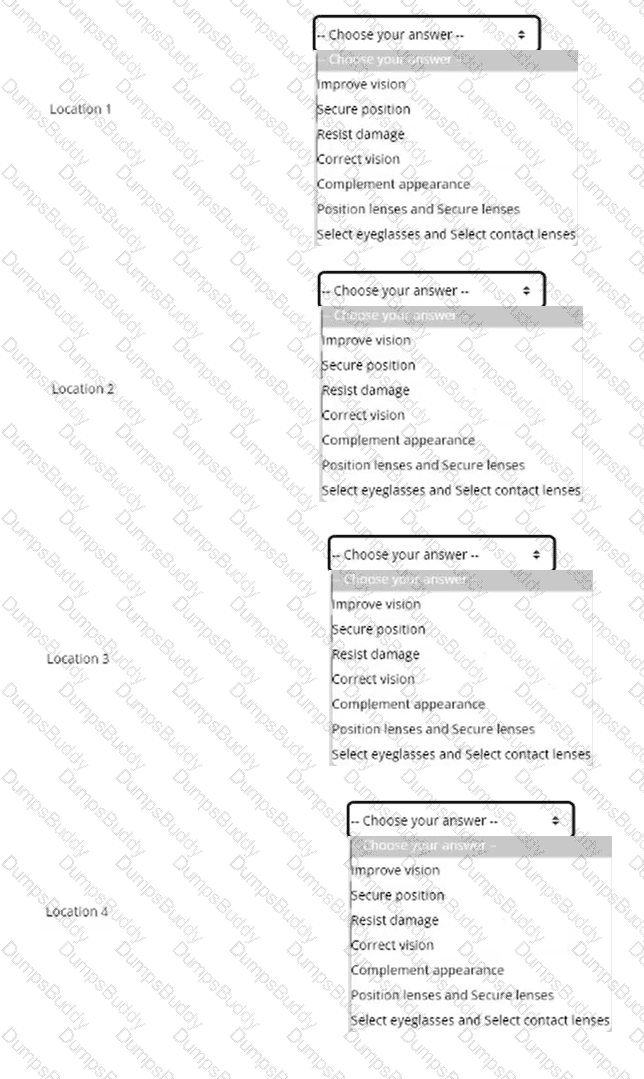
Options:
Answer:
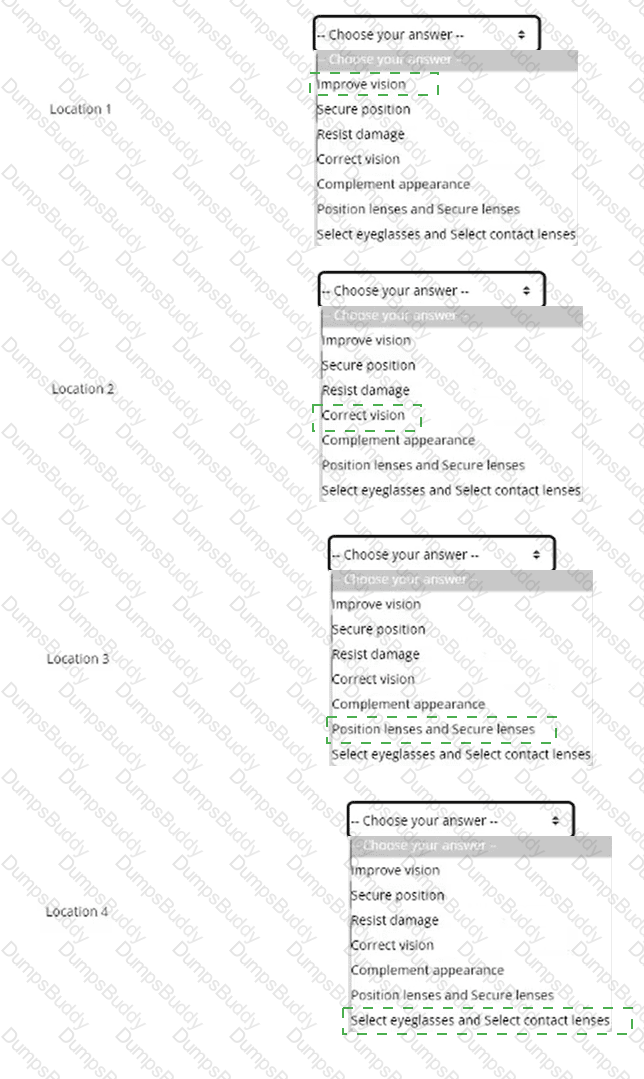
Explanation:
Location 1 — Improve vision
Location 2 — Correct vision
Location 3 — Position lenses
Location 4 — Select eyeglasses and Select contact lenses
The correct sequence is Improve vision → Correct vision → Position lenses and Secure lenses → Select eyeglasses and Select contact lenses . In a FAST diagram, the “How” direction moves from the broader purpose toward the more specific means of accomplishing that purpose. SAVE defines FAST as the Function Analysis System Technique, a diagrammatic representation of the HOW-WHY logic of functions and their interrelationships. It also defines the function logic path as the functions connected to each other in that HOW-WHY logic direction.
Improve vision is the higher-order purpose. Asking “How do we improve vision?” leads to Correct vision , which is the basic function of prescription eyeglasses. Asking “How do we correct vision?” leads to Position lenses and Secure lenses , because the corrective lenses must be properly located and held relative to the eyes. Asking “How do we accomplish that solution approach?” leads to Select eyeglasses and Select contact lenses , representing the lower-order choice of a corrective device or method.
The distractors are secondary/supporting functions. Secure position , Resist damage , and Complement appearance may support performance, durability, or user acceptance, but they are not the primary “How” logic path for correcting vision.
References/topics: Function Analysis Phase; FAST Diagram; HOW-WHY Logic; Function Logic Path; Higher-Order Function; Basic Function; Lower-Order Function.
A VM program’s standard operating procedures should include
Options:
a requirement that each VM team member be independent from the development team.
how subjects for VM studies are identified.
a listing of standard functions to be included in a VM study.
a required number of creative ideas to be generated in a study.
Answer:
BExplanation:
The correct answer is B . A VM program’s standard operating procedures should define how candidate subjects or projects are identified, screened, selected, prioritized, and authorized for VM studies. This belongs to VM program governance because limited VM resources must be applied to subjects with appropriate scope, timing, information availability, organizational importance, and value-improvement potential. SAVE’s Value Standard states that the standard assists managers and value program managers in applying VM within organizations in a consistent manner, and also guides practitioners and managers in determining when to apply VM to a project to maximize innovation and implementation benefits. ( wsdot.wa.gov )
Option A is too rigid. SAVE recognizes multidisciplinary teams of experienced professionals and stakeholders; people outside the project may be added for perspective, but every team member is not required to be independent from the development team. ( wsdot.wa.gov ) Option C is incorrect because functions are not pre-listed generically; they are identified specifically for the study subject during Function Analysis. Option D is also incorrect because creativity should encourage broad idea generation, but the SOP should not prescribe a fixed number of ideas as a universal requirement. VM procedures should standardize the management process, not force artificial technical outputs.
References/topics: VM Programs; Program SOPs; Study Subject Identification; Value Program Management; Study Selection Criteria.
What reviews should be conducted during the development of VM proposals?
Choose 2 answers.
Options:
Discard controversial VM proposals.
All VM study team members review VM proposals.
Conduct a midpoint review with stakeholders.
Only the VM facilitator reviews the VM proposals.
Answer:
B, CExplanation:
The correct answers are B and C . During the Development Phase , selected ideas are converted into workable VM proposals. This phase requires disciplined review because recommendations must be technically sound, cost-supported, practical, and aligned with project objectives. All VM study team members should review the proposals because VM is a team-based methodology. The proposal must reflect multidisciplinary input, including function, cost, performance, risk, schedule, constructability, operations, and implementation concerns. A proposal developed or checked by only one person may miss critical impacts.
A midpoint review with stakeholders is also appropriate. Stakeholder review helps confirm that the developing proposals are moving in a useful direction before the team spends additional time preparing final recommendations. It allows early correction of misunderstandings, validation of assumptions, and identification of acceptance issues. This improves the quality and credibility of the final presentation.
Option A is incorrect because controversial proposals should not be discarded automatically. They should be analyzed objectively if they improve value. Option D is incorrect because the facilitator guides the process but does not serve as the sole technical reviewer.
References/topics: Development Phase; VM Proposal Development; Team Review; Stakeholder Review; Value Study Process; Proposal Validation.
Which of the following assists the VM Facilitator in creating a collaborative client relationship?
Choose 3 answers.
Options:
Diagnosing client needs and creating appropriate VM Job Plan elements to achieve intended outcomes
Focusing on structure
Analyzing organizational involvement
Dictating tasks, deliverables, roles, and responsibilities
Clarifying mutual involvement
Answer:
A, C, EExplanation:
The correct answers are A, C, and E . A VM Facilitator creates a collaborative client relationship by first diagnosing client needs and then tailoring the VM Job Plan to produce the intended outcomes. Value Methodology is not a rigid checklist; it is a systematic, function-oriented team process led by a qualified facilitator to improve value. ( Value Engineering ) Therefore, the facilitator must understand the client’s objectives, constraints, decision environment, and expected deliverables before structuring the study.
Analyzing organizational involvement is also essential because successful VM depends on the correct sponsor, decision-makers, technical experts, users, and stakeholders being involved at the right level. The SAVE certification study material identifies Pre-Workshop responsibilities such as identifying team members, obtaining commitment, and preparing the study structure. ( )
Clarifying mutual involvement completes the collaborative relationship by defining how the facilitator, client, sponsor, team, and management will participate. This builds shared ownership and prevents misunderstanding. Option B is too narrow because structure alone does not create collaboration. Option D is incorrect because “dictating” tasks and responsibilities is directive, not collaborative.
References/topics: VM Facilitation; Client Relationship; Preparation Phase; Team Dynamics; VM Job Plan Planning.
The project team expresses uncertainty about how their tasks align with the overall objectives of the VM Job Plan. What steps should the VM facilitator take to enhance understanding of the VM Job Plan?
Choose 2 answers.
Options:
Encourage a collaborative environment by pairing project and VM team members for more in-depth discussions of each other’s roles.
Facilitate a discussion to improve their understanding of how their tasks contribute to the VM Job Plan.
Present the VM Job Plan in detail with minimal interaction, allowing team members to ask questions at the end.
Establish a deadline for project members to complete their preparation.
Answer:
A, BExplanation:
The correct answers are A and B . The issue in the scenario is not lack of a deadline; it is lack of shared understanding of how individual responsibilities support the VM Job Plan. SAVE describes Value Methodology as a multidisciplinary team process used to improve project value through function analysis, and the VM Standard requires the Value Study Team to include experienced professionals and project stakeholders selected for their expertise and project experience. Therefore, pairing project and VM team members for deeper role discussion is appropriate because it builds cross-functional understanding, clarifies responsibilities, and improves team integration.
Option B is also correct because the facilitator should actively guide discussion so team members understand how their tasks contribute to the structured Job Plan. SAVE’s Study Guide states that the Job Plan supports team synergy within a structured process rather than a collection of individual opinions, and each phase provides information and understanding needed for the next phase. SAVE’s glossary also defines a facilitator as a substantively neutral person who enables the group to improve problem solving, decision making, and effectiveness while leading the group through the VM Job Plan.
Option C is weaker because a low-interaction lecture does not address uncertainty effectively. Option D manages schedule compliance, not understanding or alignment.
References/topics: VM Facilitation; Team Dynamics; VM Job Plan; Multidisciplinary Team; Facilitator Role.
When a higher discount rate is used to calculate life cycle costs, which change occurs to the value of money over time?
Options:
The discount rate is not needed.
There is no change.
The life cycle cost is increased.
The life cycle cost is reduced.
Answer:
DExplanation:
The correct answer is D. The life cycle cost is reduced . In Value Methodology, life cycle cost analysis is used to compare alternatives over the full ownership period, not just by initial cost. Future costs such as operation, maintenance, replacement, repair, and disposal are converted to present value using a discount rate. When the discount rate is higher, future costs are discounted more heavily, meaning their present value becomes smaller.
This does not mean the actual future cash payment disappears; it means that, in present-value terms, money spent in the future is worth less today. Therefore, increasing the discount rate reduces the present value of future cost streams and normally lowers the calculated present-value life cycle cost, especially for alternatives with large costs occurring later in the study period.
Option A is incorrect because discounting is essential when costs occur at different times. Option B is incorrect because changing the discount rate directly changes present-value calculations. Option C is incorrect because a higher discount rate does not increase the present value of future costs; it reduces them.
References/topics: Development Phase; Life Cycle Costing; Economic Analysis; Present Value; Discount Rate; VM Proposal Development.
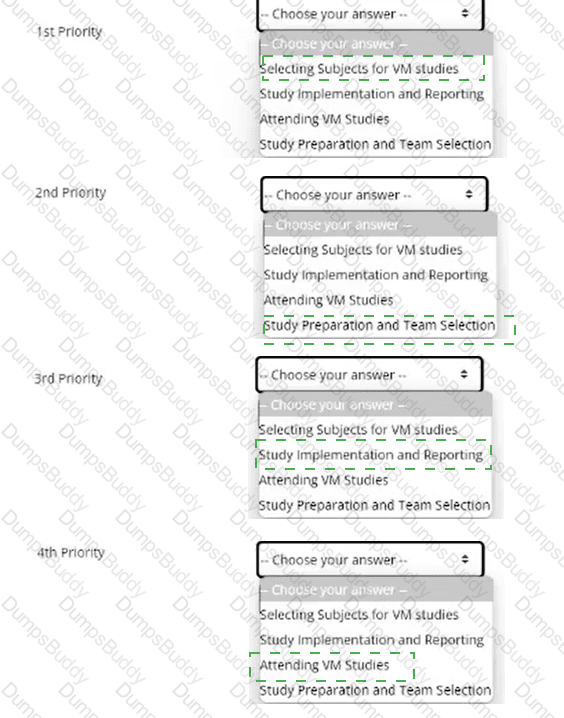
A VM program manager has limited time available to coordinate VM studies. Rank their priorities.
Options:
Answer:
Explanation:
1st: Selecting Subjects for VM Studies
2nd: Study Preparation and Team Selection
3rd: Study Implementation and Reporting
4th: Attending VM Studies
The correct priority order reflects the highest-leverage responsibilities of a VM Program Manager. The first priority is selecting subjects for VM studies because the program’s value depends on choosing projects with meaningful improvement potential, management relevance, and timing suitable for influence. SAVE’s Value Methodology Standard identifies a typical duty of the value program unit as selecting projects for VM study, obtaining approval, and securing team members.
The second priority is study preparation and team selection . A VM study can fail before the workshop begins if scope, data, logistics, and team composition are weak. The Standard specifically requires team composition to be reviewed so customer, technical, and management areas are represented, and the team leader confirms schedule, location, support needs, and data-gathering assignments.
The third priority is study implementation and reporting , because accepted proposals must be tracked and benefits verified. SAVE guidance assigns the value program unit responsibility for progress reporting and monitoring implementation of accepted VM proposals. Attending VM studies is lowest because personal attendance is less critical than governance, study selection, preparation, and implementation control.
References/topics: VM Programs; Value Program Manager Responsibilities; Study Selection; Team Selection; Implementation Tracking and Reporting.
A higher-order function
Choose 2 answers.
Options:
represents specific needs satisfied by the basic function.
describes the output of the basic function.
is fundamental to the subject scope.
describes input for the basic function.
Answer:
A, BExplanation:
The correct answers are A and B . In Function Analysis and FAST diagramming, a higher-order function is positioned to the left of the basic function and answers the question “Why is this function performed?” It represents the broader purpose or need that is satisfied when the basic function is successfully achieved. Therefore, option A is correct because the higher-order function expresses the customer, user, or project need served by the basic function.
Option B is also correct because the higher-order function can be understood as the output or result produced by accomplishing the basic function. In FAST logic, the basic function performs a required action, and the higher-order function explains the reason or outcome of that action. It is not normally the detailed mechanism for achieving the basic function.
Option C is incorrect because the basic function , not the higher-order function, is fundamental to the subject scope. The higher-order function often lies just outside or above the study scope as the reason the basic function is needed. Option D is incorrect because inputs or enabling actions are usually associated with lower-order or “how” functions, not higher-order “why” functions.
References/topics: Function Analysis Phase; FAST Diagramming; Higher-Order Function; Basic Function; How/Why Logic.
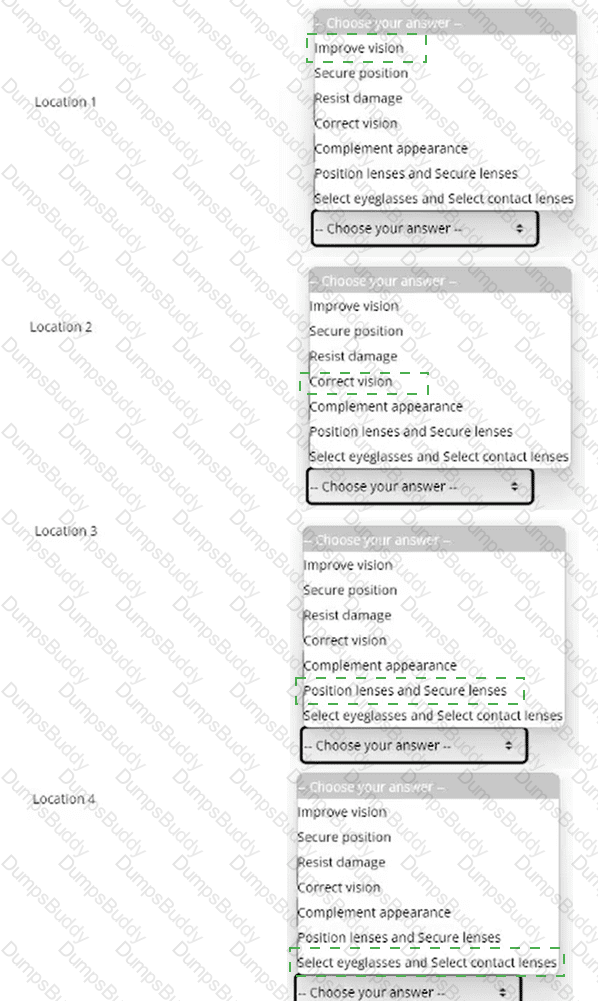
Match the following to their appropriate “How” direction on the function logic path for the prescription eyeglasses.

Options:
Answer:
Explanation:
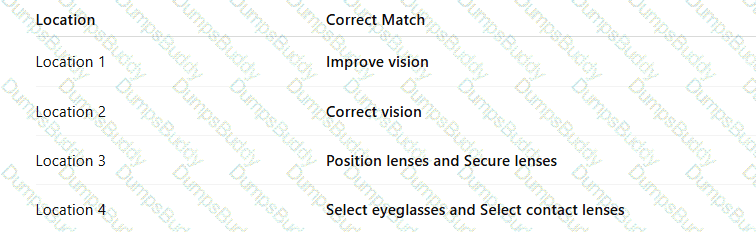
The correct “How” direction follows the classical FAST logic path from the broader purpose toward the dependent means of accomplishment. SAVE defines FAST as a graphical representation of dependent relationships between functions and states that a Classical FAST model displays function interrelationships using how-why logic . In this eyeglasses example, Improve vision is the higher-order purpose: it explains why the basic function exists. The basic function is Correct vision , because prescription eyeglasses exist primarily to correct the user’s vision. Moving in the “How” direction, the system corrects vision by Position lenses and Secure lenses ; the frame, bridge, arms, and nose pads exist to keep corrective lenses in the proper relationship to the eyes. The farthest “How”/lower-order decision is Select eyeglasses and Select contact lenses , representing the selected means or alternative correction approach.
The distractors are not on the critical function logic path. Secure position and Resist damage are supporting or secondary dependability functions. Complement appearance is a sell/aesthetic function, because it improves user acceptance but does not define the primary functional logic. SAVE’s glossary distinguishes higher-order, lower-order, and secondary functions and explains that secondary functions support the basic function through a specific design approach.
References/topics: Function Analysis Phase; FAST Diagramming; How-Why Logic; Critical Function Logic Path; Basic, Higher-Order, Lower-Order, and Secondary Functions.
During the Presentation Phase, the team leader should primarily do which of the following?
Options:
Document and communicate developed alternatives and value improvement opportunities
Begin random function identification
Generate all possible alternatives without evaluation
Replace the owner’s decision-making authority
Answer:
AExplanation:
The correct answer is A . SAVE’s VM Standard defines the Presentation Phase as the phase where the team leader develops a report and/or presentation that documents and conveys the adequacy of the developed alternatives and the associated value improvement opportunity. The purpose is to communicate recommendations clearly so decision makers can assess whether to accept, modify, defer, or reject them.
Option B belongs to Function Analysis. Option C belongs to Creativity. Option D is wrong because the VM team recommends; it does not take over governance or ownership authority. A strong CVS-level presentation must be technically credible and management-focused. It should explain what is recommended, why the alternative satisfies required functions, how it affects performance and risk, what costs change, what life-cycle benefits are expected, and what implementation actions are required. The Presentation Phase is not a sales pitch based on vague savings claims. It is a disciplined transfer of decision-ready information from the VM team to accountable decision makers.
References/topics: Presentation Phase; VM Report; Decision-Maker Communication.
Which of the following are typically documented in the “accepted” VM proposal status report?
Choose 3 answers.
Options:
Next update
Report number
VM study presentation
Tracking identification number
Performance impacts
Answer:
A, D, EExplanation:
The correct answers are A. Next update, D. Tracking identification number, and E. Performance impacts . In the Implementation Phase, accepted VM proposals must be tracked so that the organization can confirm whether the approved value improvement is actually being carried into execution. The VM Guide explains that implementation status reports formally document and track the status of VM proposals and are used by VM program managers to follow implementation progress. It specifically identifies a tracking identification number as the code used to track the change within the organization, and it also requires discussion of performance impacts , including any deviation from the VM team’s original performance assessment. ( pdfcoffee.com )
A next update is also appropriate because implementation status reporting is not a one-time record; it is a continuing control mechanism. The guide identifies “Next update” as the date of the next implementation status update. ( pdfcoffee.com )
Option C is incorrect because the VM study presentation is an input used earlier to resolve proposals, not a documented element of an accepted proposal status report. Option B is administrative and may appear in some organizations, but the essential accepted-proposal tracking content focuses on traceability, implementation follow-up, and validated impacts.
References/topics: Implementation Phase; Implementation Status Reports; Accepted VM Proposals; Tracking Identification Number; Performance Impacts; Next Update.
SWOT stands for
Options:
strengths, weaknesses, organization, and threats.
strengths, weaknesses, opportunities, and threats.
standards, weaknesses, organization, and threats.
standards, weaknesses, organization, and thresholds.
Answer:
BExplanation:
The correct answer is B. strengths, weaknesses, opportunities, and threats . SWOT is a strategic assessment tool used to examine both internal and external conditions affecting an organization, program, project, or study subject. In the SAVE International certification study context, SWOT is identified as a tool under VM program and organizational assessment practices, specifically as Strengths, Weaknesses, Opportunities, and Threats . ( )
The distinction between the four terms is important. Strengths and weaknesses normally describe internal factors, such as organizational capability, resources, skills, process maturity, or limitations. Opportunities and threats normally describe external factors, such as market conditions, stakeholder expectations, regulatory changes, competing priorities, risks, or environmental influences. In a VM program, SWOT can help managers understand where the program is strong, where corrective improvement is needed, where expansion or innovation is possible, and where resistance or risk may affect implementation.
Options A, C, and D are incorrect because “organization,” “standards,” and “thresholds” are not part of the SWOT acronym. They may be relevant management terms, but they do not define SWOT.
References/topics: VM Programs; Strategic Assessment; SWOT Analysis; Program Planning; Organizational Readiness.
When facilitating a VM study team without experience with function analysis, which of the following are effective methods to introduce the topic?
Choose 2 answers.
Options:
Prepare a FAST diagram in advance of the meeting.
Show the VM study team an example of function analysis.
Have the VM Team identify functions of items in the room.
Classify functions prior to identifying functions.
Answer:
B, CExplanation:
The correct answers are B and C . When a VM study team has little or no experience with function analysis, the facilitator should introduce the concept through simple demonstration and participative learning. SAVE guidance identifies Function Analysis as the foundation of Value Methodology and explains that functions are expressed in two-word active verb / measurable noun form to describe what work is being performed. ( ) Showing an example of function analysis helps the team see how physical items are translated into functional language before applying the method to the study subject.
Having the team identify functions of items in the room is also effective because it creates a low-risk practice exercise. The SAVE study material provides simple item-based examples such as a table performing “Support Weight” and a screwdriver performing “Transmit Torque,” which directly supports this teaching approach. ( ) This builds confidence before moving to more complex project functions.
Option A is not preferred because preparing the FAST diagram in advance removes team discovery, ownership, and consensus-building. Option D is incorrect because functions must first be identified before they can be classified, analyzed, or evaluated; function analysis is defined as the process of defining, classifying, and evaluating functions. ( )
References/topics: VM Facilitation; Team Learning; Function Analysis Phase; Function Identification; FAST Introduction.
A baseline design has a function cost of $120,000 and the team estimates the function worth at $80,000. Using VI = FC ÷ FW, what is the Value Index?
Options:
0.67
1.00
1.50
2.00
Answer:
CExplanation:
The correct answer is C . Using the stated formula, Value Index = Function Cost ÷ Function Worth = $120,000 ÷ $80,000 = 1.50 . SAVE’s dictionary defines Function Cost as the directly related resources allocated to a function and Function Worth as the lowest overall cost to perform a function without regard to criteria or code. It also defines Value Index as the monetary relationship of function cost to function worth, expressed as FC ÷ FW, where good value is VI ≤ 1.0.
Option A reverses the formula and calculates FW ÷ FC. Option B would mean cost equals worth, which is not true here. Option D has no mathematical basis from the numbers given. A VI of 1.50 indicates a value mismatch: the current function cost exceeds the function worth. This does not automatically mean the function should be eliminated, but it does identify a strong candidate for creativity and evaluation. CVS candidates must be careful because some older materials express the ratio in reverse; the exam stem controls the formula.
References/topics: Evaluation Phase; Function Cost; Function Worth; Value Index.
PDF + Testing Engine

Testing Engine
PDF (Q&A)