Big Cyber Monday Sale 70% Discount Offer - Ends in 0d 00h 00m 00s - Coupon code: best70

EFM Certified - Electronic Fetal Monitoring Questions and Answers

Questions 4

(Full question statement)

A dysrhythmia is noted. The pregnancy and labor course has been normal with no complications. The next step in management is to

Options:

A.

administer maternal oxygen

B.

continue to observe

C.

start an IV fluid bolus

Buy Now
Questions 5

A characteristic of early decelerations is that they

Options:

A.

are episodic

B.

are thought to be caused by a vagal reflex

C.

commonly fall below 100 beats per minute

Buy Now
Questions 6

A woman at 36-weeks gestation comes in because of uterine contractions radiating to the back. She has no insurance. In accordance with the Emergency Medical Treatment and Active Labor Act (EMTALA), she is obligated to be:

Options:

A.

Admitted without delay

B.

Stabilized and receive a medical screening examination

C.

Transferred to a safety-net hospital

Buy Now
Questions 7

A sentinel or reportable event as defined by the Joint Commission or other regulatory bodies/agencies is one that
Options:

A.

must involve malpractice or negligence

B.

requires investigation and response

C.

requires mandatory education for providers

Buy Now
Questions 8

(Full question)

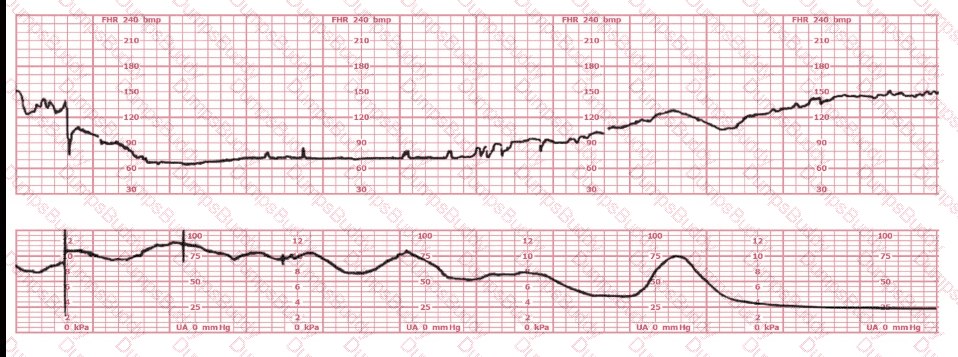
This tracing would be categorized as a

EFM Question 8

Options:

A.

Category I

B.

Category II

C.

Category III

Buy Now
Questions 9

A woman (G1P0) arrives in triage with a pain score of 4/10 at 39-weeks gestation. The fetal heart rate tracing shown is obtained. The best intervention is to:
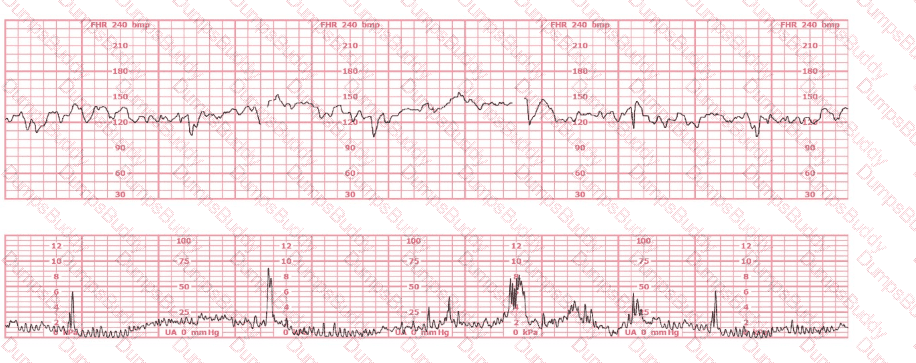
EFM Question 9

Options:

A.

Adjust tocotransducer and continue to monitor

B.

Admit for induction

C.

Discharge to home

Buy Now
Questions 10

A woman at 39-weeks gestation is in early labor, 2–3 cm dilated, 85% effaced, and –2 station. Based on the fetal heart rate tracing shown, what is the most appropriate first intervention?
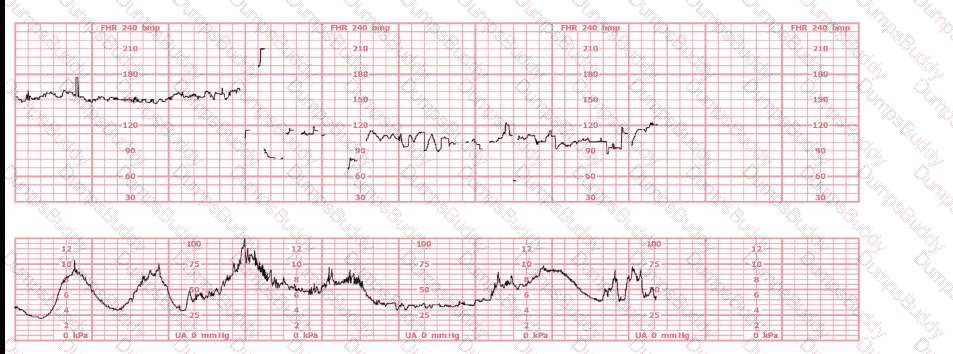
EFM Question 10

Options:

A.

Adjust the fetal monitor

B.

Administer an IV fluid bolus

C.

Administer terbutaline

Buy Now
Questions 11

In the event of recurrent variable decelerations with thick meconium, amnioinfusion is recommended to:
Options:

A.

Dilute thick meconium

B.

Restore uterine blood flow

C.

Treat oligohydramnios

Buy Now
Questions 12

Maternal–fetal exchange during labor is diminished by:

Options:

A.

An increase in maternal cardiac output

B.

Open-glottis pushing in second stage

C.

Placental calcifications

Buy Now
Questions 13

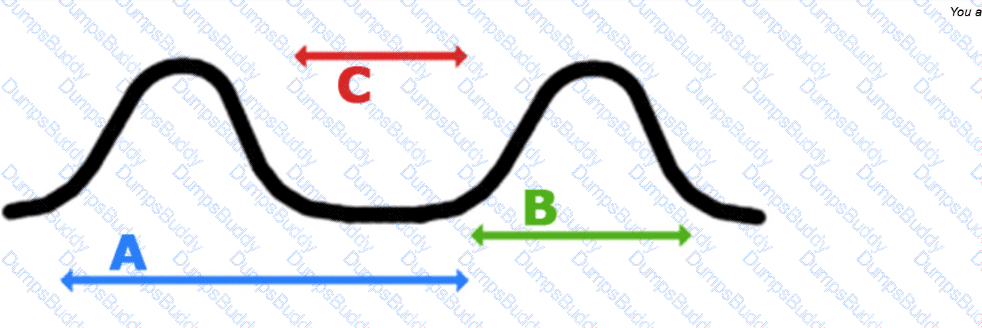
The duration of a contraction is best represented by which colored arrow?

EFM Question 13

Options:

A.

Blue (A)

B.

Green (B)

C.

Red (C)

Buy Now
Questions 14

The decelerations seen in the fetal monitoring tracing shown are best described as:

Options:

A.

Early

B.

Late

C.

Variable

Buy Now
Questions 15

A woman at 38-weeks gestation is admitted to labor and delivery following a fall down the stairs three hours ago. She started feeling contractions in the ambulance. The fetal heart rate tracing shown is on initial evaluation and represents 25 minutes. This tracing is most consistent with a
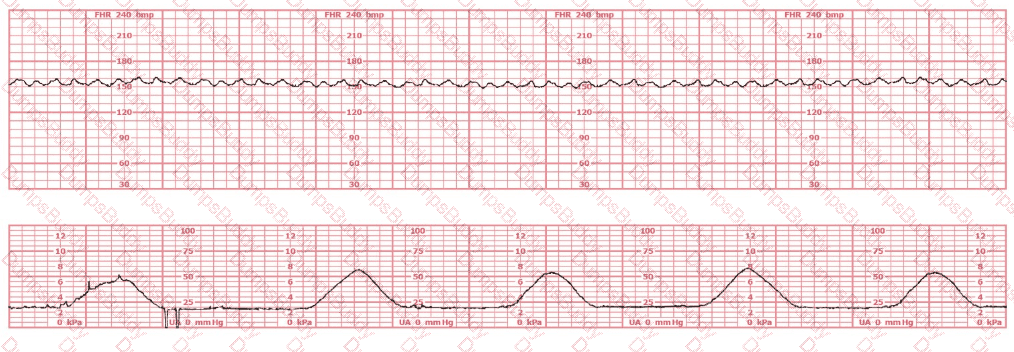
EFM Question 15

Options:

A.

category I tracing

B.

category II tracing

C.

category III tracing

Buy Now
Questions 16

The baseline heart rate of a 28-week fetus is 170 bpm. The next step is to:

Options:

A.

Assess maternal vital signs

B.

Continue observation

C.

Perform a biophysical profile

Buy Now
Questions 17

When evaluating a baseline fetal heart rate change, the fetal heart rate is assessed for a minimum of:

Options:

A.

10 minutes

B.

15 minutes

C.

30 minutes

Buy Now
Questions 18

A woman has been 5 cm dilated for the past 3 hours. The tracing shown has developed over the last 30 minutes. The best initial course of action is to:
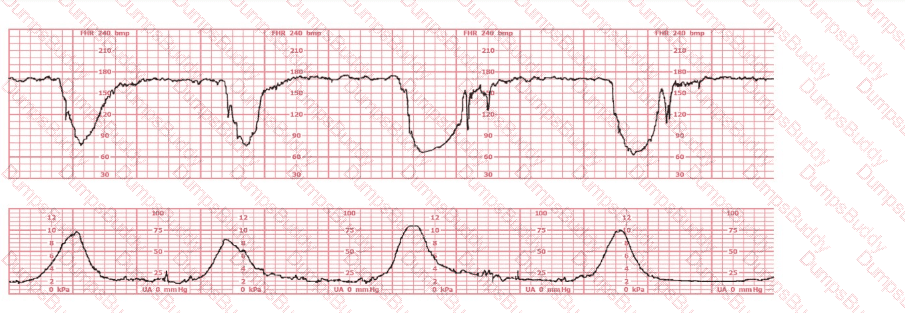
EFM Question 18

Options:

A.

Continue to monitor

B.

Perform intrauterine resuscitative measures

C.

Proceed with cesarean section

Buy Now
Questions 19

This patient received an epidural 15 minutes prior to the tracing shown. The next course of action is to:
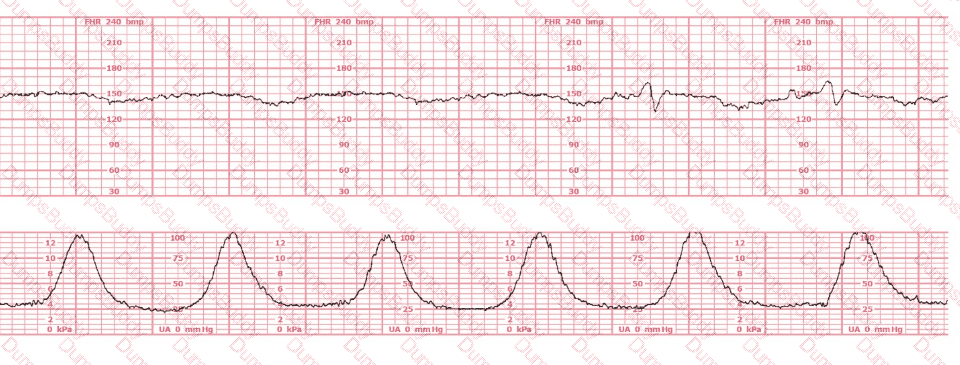
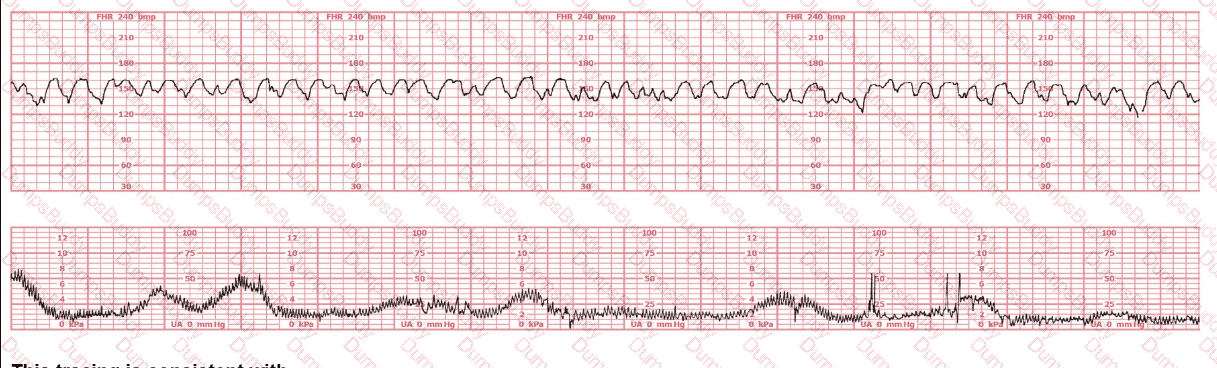
EFM Question 19

Options:

A.

Check maternal blood pressure

B.

Continue to monitor

C.

Perform a cervical exam

Buy Now
Questions 20

(Full question statement)

This tracing is consistent with:

EFM Question 20

Options:

A.

Atrial flutter

B.

Effects of butorphanol administration

C.

Fetal-maternal transfusion

Buy Now
Questions 21

A woman in active labor at 8 cm experiences spontaneous rupture of membranes and acute bright red vaginal bleeding. The uterus is soft and nontender to palpation. The fetal monitor tracing has been normal and now shows tachycardia followed by bradycardia with minimal variability. The maternal blood pressure is 130/76 mm Hg, and the pulse is 86 beats per minute. The most likely cause of these findings is:

Options:

A.

Abruptio placenta

B.

Placenta previa

C.

Ruptured vasa previa

Buy Now
Questions 22

A 45-year-old woman at 36-weeks gestation presents for a nonstress test. Vital signs are:
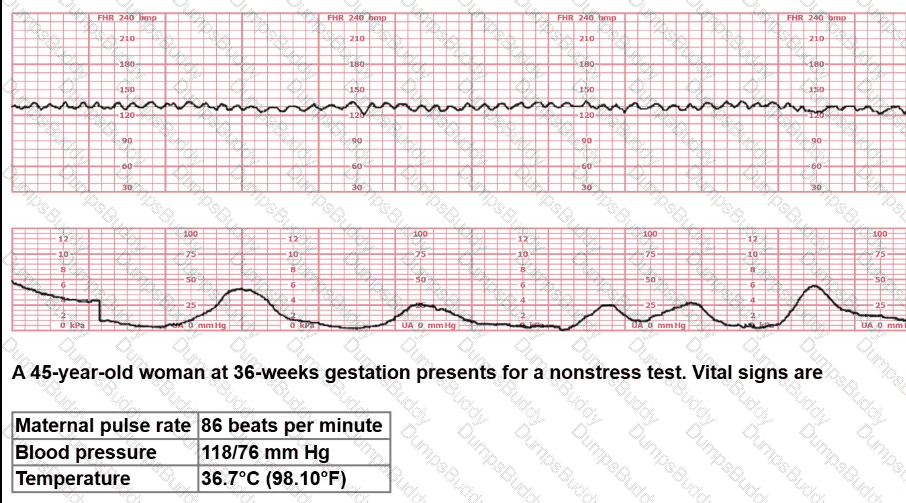
EFM Question 22

    Maternal pulse rate: 86 beats per minute

    Blood pressure: 118/76 mm Hg

    Temperature: 36.7°C (98.1°F)

The next course of action would include:
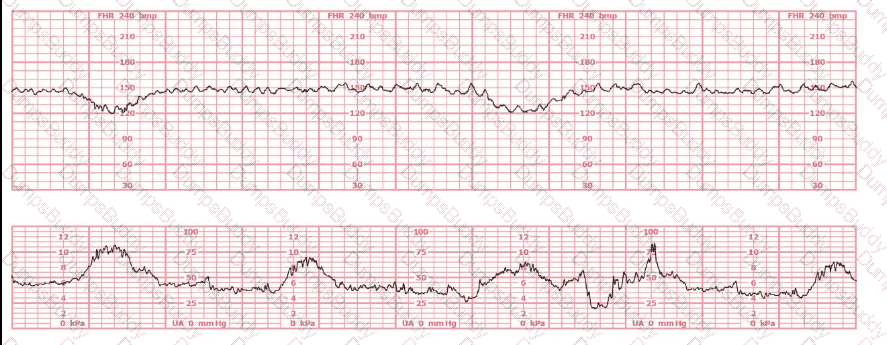
Options:

A.

Discharge home

B.

Induce labor

C.

Perform a Kleihauer-Betke test

Buy Now
Questions 23

The fetal heart rate tracing shown represents

EFM Question 23

Options:

A.

category I

B.

category II

C.

category III

Buy Now
Questions 24

Interventions undertaken to address fetal tachycardia are targeted at maximizing

Options:

A.

maternal circulation

B.

sympathetic autonomic tone

C.

uteroplacental perfusion

Buy Now
Questions 25

The black pattern represents the heart rate pattern for Baby A. The blue pattern represents the heart rate pattern for Baby B. A possible etiology of the baseline fetal heart rate of Baby A is:
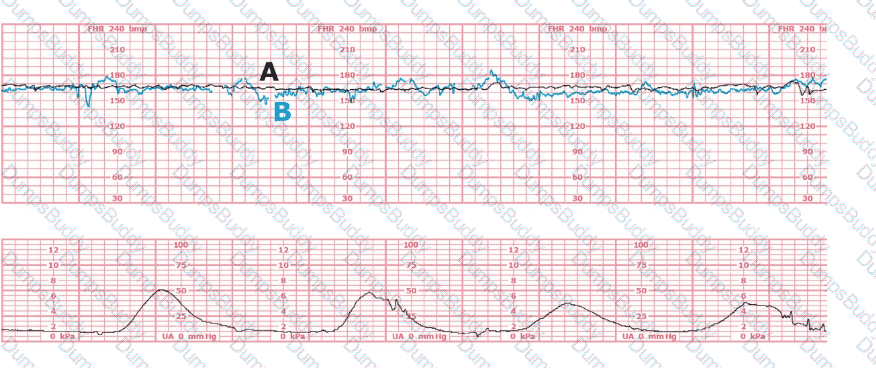
EFM Question 25

Options:

A.

Fetal positioning

B.

Infection

C.

Magnesium sulfate

Buy Now
Questions 26

Patient safety is enhanced when alarms:

Options:

A.

Are determined by the unit leaders

B.

Can be called by anyone

C.

Occur infrequently

Buy Now
Questions 27

Accelerations that last 10 minutes or more are considered:

Options:

A.

A baseline change

B.

Baseline variability

C.

Tachycardia

Buy Now
Questions 28

This fetal heart rate tracing is obtained upon the woman's admission to labor and delivery. This tracing is most reflective of:
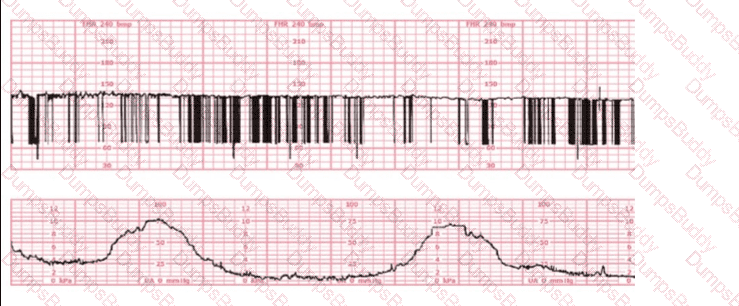
EFM Question 28

Options:

A.

Atrial flutter

B.

Complete heart block

C.

Fetal dysrhythmia

Buy Now
Questions 29

A 20-year-old woman (G1P0) at 40-weeks gestation was admitted for cervical ripening with dinoprostone (Cervidil) four hours ago. She developed the pattern shown one hour ago. She has been changed to a lateral position and given a fluid bolus, and the pattern continues. An appropriate intervention would be to:
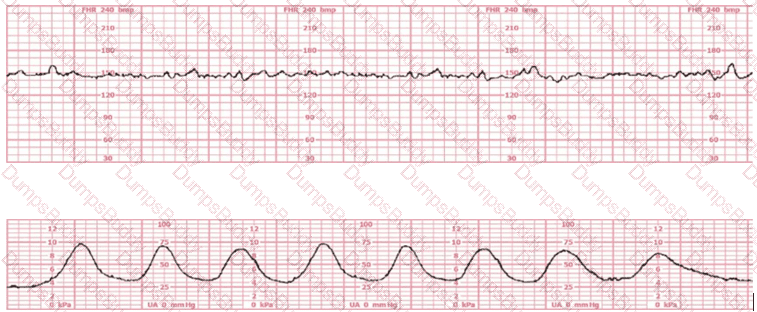
EFM Question 29

Options:

A.

Continue to observe

B.

Give 0.25 mg of terbutaline subcutaneously

C.

Remove the dinoprostone (Cervidil) insert

Buy Now
Questions 30

The decelerations seen in the fetal monitoring tracing shown are best described as:
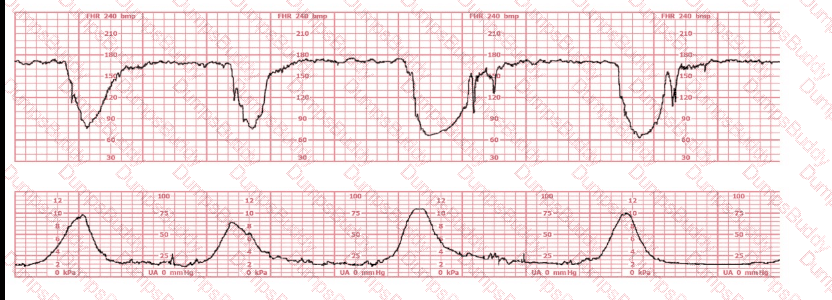
EFM Question 30

Options:

A.

Early

B.

Late

C.

Variable

Buy Now
Questions 31

The most highly oxygenated blood in the fetal circulation is found in the

Options:

A.

descending aorta

B.

ductus venosus

C.

pulmonary arteries

Buy Now
Questions 32

This fetal heart rate tracing is from a woman in the second stage of labor. This tracing is best interpreted as:
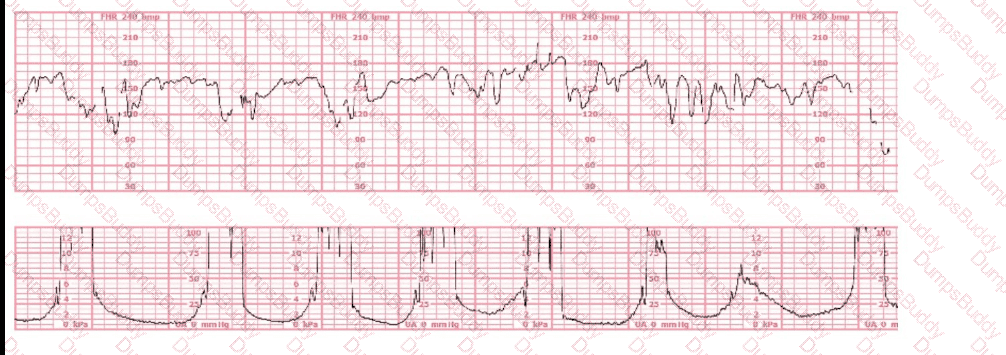
EFM Question 32

Options:

A.

Intermittent late decelerations

B.

Variable decelerations

C.

Wandering baseline

Buy Now
Questions 33

Fetal cardiac output is essentially dependent on the fetal:

Options:

A.

Activity

B.

Baroreceptors

C.

Heart rate

Buy Now
Questions 34

Usually, the duration of an early deceleration in comparison with the contraction is:

Options:

A.

Longer

B.

Shorter

C.

The same

Buy Now
Questions 35

When accelerations precede a variable deceleration pattern, this is caused by

Options:

A.

hypoxic reflex response

B.

occlusion of the umbilical vein

C.

oligohydramnios

Buy Now
Questions 36

A woman reports 12 fetal movements over one hour. The best recommendation is to:

Options:

A.

Administer a nonstress test

B.

Continue to monitor for one hour

C.

Instruct her to count again the next day

Buy Now
Questions 37

The factor that differentiates a prolonged deceleration from bradycardia is:

Options:

A.

Baseline rate

B.

Length of time it lasts

C.

Relationship to contractions

Buy Now
Exam Code: EFM
Exam Name: Certified - Electronic Fetal Monitoring
Last Update: Dec 5, 2025
Questions: 125

PDF + Testing Engine

$134.99

Testing Engine

$99.99

PDF (Q&A)

$84.99