New Year Sale 70% Discount Offer - Ends in 0d 00h 00m 00s - Coupon code: best70

AE-Adult-Echocardiography AE Adult Echocardiography Examination Questions and Answers
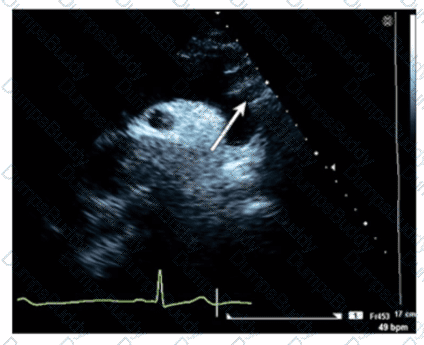
Questions 4

Which artery is identified by the arrow on this image?

AE-Adult-Echocardiography Question 4

Options:

A.

Left common carotid

B.

Brachiocephalic

C.

Left subclavian

D.

Right common carotid

Buy Now
Questions 5

A patient presents with tender, red lesions on their fingers and toes (Osier nodes). Which finding is most likely?

Options:

A.

Carcinoid heart disease

B.

Lambl excrescences

C.

Papillary fibroelastoma

D.

Infective endocarditis

Buy Now
Questions 6

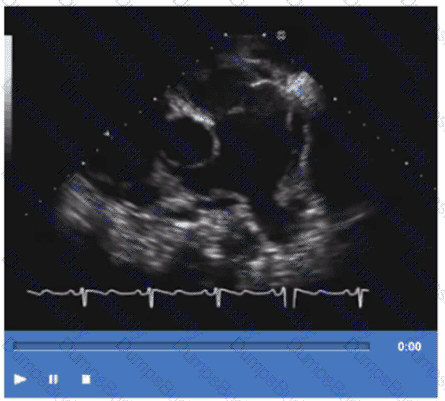
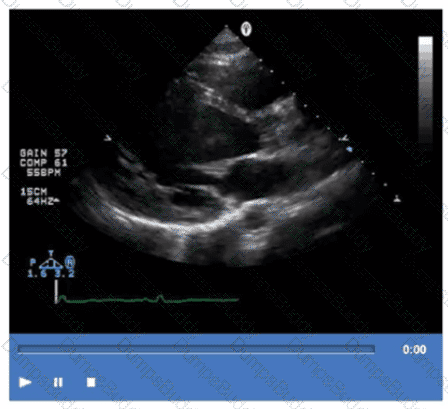
Which maneuver aids in uncovering potential diastolic dysfunction while performing pulsed wave Doppler of the mitral valve?
Options:

A.

Valsalva

B.

Hand grip

C.

Leg air cycling

D.

Squatting

Buy Now
Questions 7

Which vessel is indicated by the arrow on this video?

AE-Adult-Echocardiography Question 7

Options:

A.

Right upper pulmonary vein

B.

Left upper pulmonary vein

C.

Right pulmonary artery

D.

Left pulmonary artery

Buy Now
Questions 8

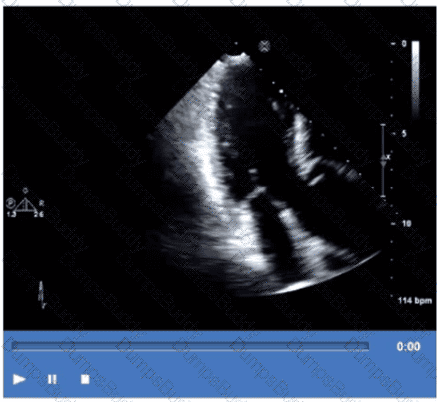
Which pathology is demonstrated in this video clip?

AE-Adult-Echocardiography Question 8

Options:

A.

Amyloidosis

B.

Sarcoidosis

C.

Apical hypertrophic cardiomyopathy

D.

Isolated left ventricular noncompaction

Buy Now
Questions 9

Which patient body positioning and respiration technique is optimal for obtaining the subcostal view?

Options:

A.

Supine; knees bent and breath inhaled

B.

Supine; legs extended and breath exhaled

C.

Left lateral decubitus; knees bent and shallow breathing

D.

Left lateral decubitus; legs extended and normal breathing

Buy Now
Questions 10

Which valve and secondary finding are associated with the 'flying W sign on spectral Doppler and M-mode?

Options:

A.

Pulmonic; pulmonary hypertension

B.

Pulmonic; pulmonary bioprosthesis

C.

Tricuspid; tricuspid regurgitation

D.

Tricuspid; flail tricuspid leaflet

Buy Now
Questions 11

What is the route of ventricular depolarization?

Options:

A.

Right bundle to left bundle branch

B.

Sinoatrial to atrioventricular nodes

C.

Bundle of His to atrioventricular node

D.

Bundle of His to Purkinje fibers

Buy Now
Questions 12

Which of the following measurements is required for calculating the Qp/Qs ratio?

Options:

A.

Mitral valve velocity time integral (VTI)

B.

Aortic valve VTI

C.

Tricuspid valve VTI

D.

Right ventricular outflow tract (RVOT) VTI

Buy Now
Questions 13

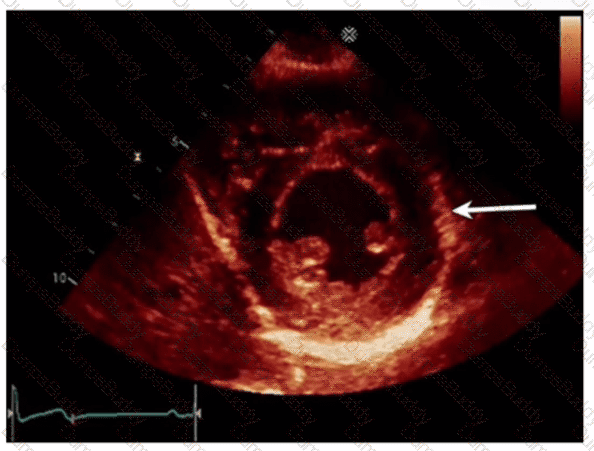
Which left ventricular regional wall segment is indicated by the arrow on this image?
AE-Adult-Echocardiography Question 13

Options:

A.

Anterior

B.

Anterolateral

C.

Inferior

D.

Inferolateral

Buy Now
Questions 14

Which technique best determines a trileaflet aortic valve from a bicuspid aortic valve?

Options:

A.

Visualize all three leaflets simultaneously during systole

B.

Visualize all three leaflets simultaneously during diastole

C.

Use pulsed wave Doppler to demonstrate normal flow velocity

D.

Use continuous wave Doppler to demonstrate normal flow velocity

Buy Now
Questions 15

Which procedure is most appropriate for evaluation of an atrial septal defect in the presence of an atrial septal aneurysm?

Options:

A.

Cardiac MRI

B.

Cardiac catheterization

C.

Agitated saline contrast echocardiogram

D.

Transesophageal echocardiogram

Buy Now
Questions 16

Which condition is commonly associated with cardiac tamponade?

Options:

A.

Decreased jugular venous pressure

B.

Bradycardia

C.

Hypertension

D.

Hypotension

Buy Now
Questions 17

Which sonographic views allow visualization of a patent ductus arteriosus (PDA)?
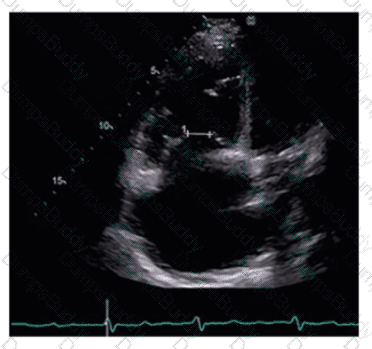
Options:

A.

Suprasternal notch and basal parasternal short axis

B.

Basal parasternal short axis and right ventricular inflow tract

C.

Parasternal long axis and apical long axis

D.

Parasternal long axis and apical five-chamber

Buy Now
Questions 18

What can be concluded about the tricuspid valve demonstrated in this image?

AE-Adult-Echocardiography Question 18

Options:

A.

Malcoaptation

B.

Normal coaptation

C.

Stenotic

D.

Endocarditis

Buy Now
Questions 19

Which syndrome is associated with pulmonic stenosis?

Options:

A.

Turner

B.

Eisenmenger

C.

Noonan

D.

Marfan

Buy Now
Questions 20

Which is an abnormal response to a stress echocardiogram?

Options:

A.

Hyperdynamic wall motion

B.

Increased end-systolic volume

C.

Increased ejection fraction

D.

Decreased end-diastolic volume

Buy Now
Questions 21

Which echocardiography assessment requires mitral inflow pulsed wave, pulmonary venous pulsed wave, and tissue Doppler of the mitral annulus?

Options:

A.

Left ventricular diastolic function

B.

Left ventricular systolic function

C.

Myocardial performance index

D.

Mitral regurgitation severity

Buy Now
Questions 22

Which method is appropriate for measuring the left atrial diameter in parasternal long axis?

Options:

A.

Inner edge to inner edge, perpendicular to the aortic root, at end-diastole

B.

Inner edge to inner edge, parallel to the aortic root, at end-diastole

C.

Inner edge to inner edge, perpendicular to the aortic root, at end-systole

D.

Outer edge to outer edge, perpendicular to the aortic root, at end-systole

Buy Now
Questions 23

Which next step is appropriate after obtaining the Doppler signal in this image?
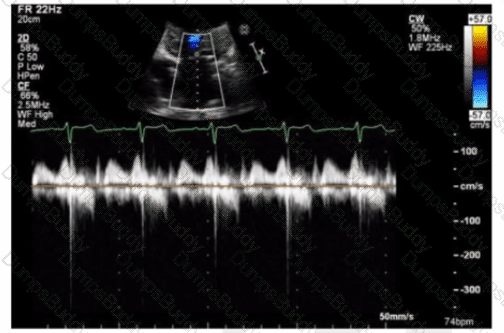
AE-Adult-Echocardiography Question 23

Options:

A.

Pulsed wave at various levels of the left ventricle to localize intracavitary gradient.

B.

Pulsed wave at the level of the mitral valve leaflet tips to assess for mitral stenosis

C.

Continuous wave through the left ventricle to localize intracavitary gradient

D.

Continuous wave through the mitral valve to assess for mitral stenosis

Buy Now
Questions 24

Which of the following can be calculated from the peak tricuspid regurgitant velocity?

Options:

A.

Right atrial pressure

B.

Pulmonary artery diastolic pressure

C.

Mean pulmonary artery pressure

D.

Right ventricular systolic pressure

Buy Now
Questions 25

Which of the following occurs during the strain phase of the Valsalva maneuver?
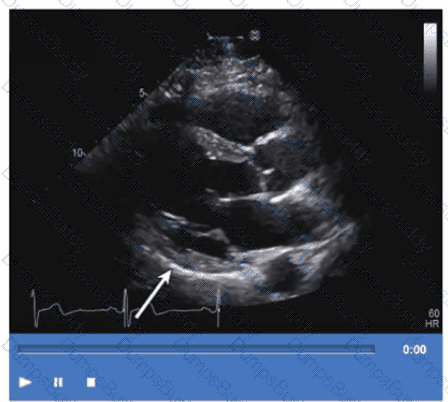
Options:

A.

Decreased preload

B.

Decreased afterload

C.

Increased preload

D.

Increased afterload

Buy Now
Questions 26

When should the left ventricular end-diastohc diameter be measured?

Options:

A.

Onset of P wave

B.

Onset of QRS complex

C.

First frame after aortic valve closure

D.

First frame after mitral valve closure

Buy Now
Questions 27

Which wall is indicated by the arrow on this video?

AE-Adult-Echocardiography Question 27

Options:

A.

Anteroseptum

B.

Anterolateral

C.

Inferoseptum

D.

Inferolateral

Buy Now
Questions 28

Where would a Swan-Ganz catheter be best visualized?

Options:

A.

Left ventricular outflow tract

B.

Pulmonary veins

C.

Descending aorta

D.

Right ventricular outflow tract

Buy Now
Questions 29

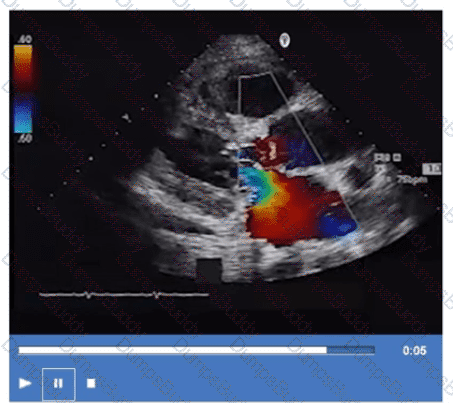
What is the direction of the mitral regurgitant jet in this video clip?

AE-Adult-Echocardiography Question 29

Options:

A.

Anterior

B.

Posterior

C.

Medial

D.

Lateral

Buy Now
Questions 30

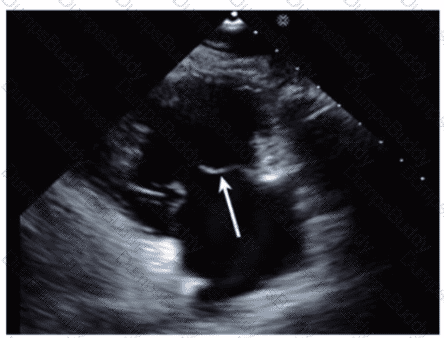
Which anatomic structure is represented by the arrow on this image?

AE-Adult-Echocardiography Question 30

Options:

A.

Left leaflet

B.

Posterior leaflet

C.

Septal leaflet

D.

D. Anterior leaflet

Buy Now
Questions 31

A continuous flow murmur is most likely due to which abnormality?

Options:

A.

Ventricular septal defect

B.

Patent ductus arteriosus

C.

Concomitant aortic stenosis and mitral regurgitation

D.

Ebstein anomaly with atrial septal defect

Buy Now
Questions 32

Which parameter is necessary to calculate a 2D left atrial volume index?

Options:

A.

Age

B.

Height

C.

Blood pressure

D.

Cardiac output

Buy Now
Questions 33

Which finding is best demonstrated in this video?

AE-Adult-Echocardiography Question 33

Options:

A.

Aortic root dilatation

B.

Systolic anterior motion of the mitral valve

C.

Mid-anteroseptal hypokinesis

D.

Left atrial elongation

Buy Now
Questions 34

Which patient positioning is best for obtaining the waveform seen in this image obtained by a non-imaging transducer?
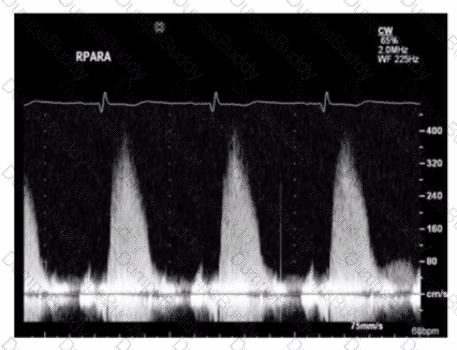
AE-Adult-Echocardiography Question 34

Options:

A.

Laying on left side

B.

Laying on right side

C.

Laying on back with chin down

D.

Laying on stomach with left arm raised

Buy Now
Questions 35

Which finding is associated with coarctation of the aorta?

Options:

A.

Atrial septal defect

B.

Ventricular septal defect

C.

Left ventricular hypertrophy

D.

Right ventricular hypertrophy

Buy Now
Questions 36

How must the sonographer angle the transducer from the apical four-chamber view in order to visualize the aortic valve in the apical five-chamber view?

Options:

A.

Anteriorly

B.

Posteriorly

C.

Medially

D.

Laterally

Buy Now
Questions 37

Which parameter is expected to increase in the presence of cardiac tamponade?

Options:

A.

Heart rate

B.

Oxygen saturation

C.

Systolic blood pressure

D.

Diastolic blood pressure

Buy Now
Questions 38

Acute severe aortic regurgitation leads to a marked increase in which pressure?

Options:

A.

End-diastolic

B.

End-systolic

C.

Early-diastolic

D.

Early-systolic

Buy Now
Questions 39

What is indicated by the arrow on this video clip?

Options:

A.

False tendon

B.

Moderator band

C.

Chiari network

D.

Eustachian valve

Buy Now
Questions 40

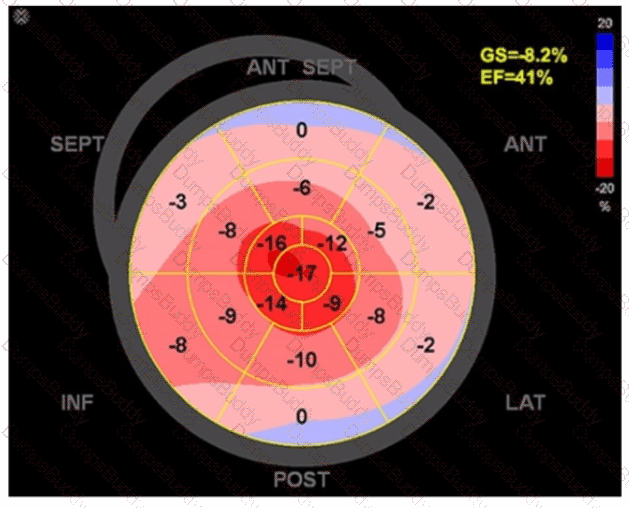
Which type of mass is typically attached to the fossa ovalis of the left atrium?
Options:

A.

Myxoma

B.

Fibroelastoma

C.

Sarcoma

D.

Lipoma

Buy Now
Questions 41

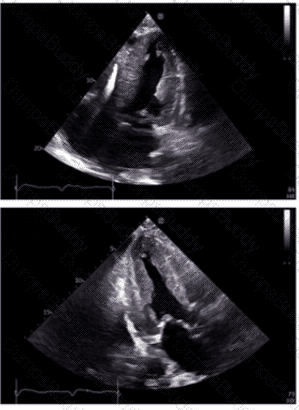
Which diagnosis is most consistent with the findings in these images?

AE-Adult-Echocardiography Question 41

AE-Adult-Echocardiography Question 41

Options:

A.

Takotsubo cardiomyopathy

B.

Apical hypertrophic cardiomyopathy

C.

Hypertrophic obstructive cardiomyopathy

D.

Restrictive cardiomyopathy from amyloidosis

Buy Now
Exam Name: AE Adult Echocardiography Examination
Last Update: Dec 25, 2025
Questions: 137

PDF + Testing Engine

$134.99

Testing Engine

$99.99

PDF (Q&A)

$84.99