3V0-24.25 Advanced VMware Cloud Foundation 9.0 vSphere Kubernetes Service Questions and Answers
An administrator is building a secure, multi-tenant container registry strategy for their vSphere Kubernetes Services deployment running on VMware Cloud Foundation. Each workload domain hosts a Supervisor Cluster, and multiple development teams require private repositories to store and distribute container images for Kubernetes clusters. The organization enforces strict image security posture due to compliance requirements. The operations team deploys Harbor as an add-on service through the Supervisor control plane, and developers push/pull images from Harbor through Kubernetes manifests.
What requirement describes the role and purpose of Harbor?
An administrator is adding a kubernetes cluster to an existing namespace. Click where the administrator navigates to create the cluster.
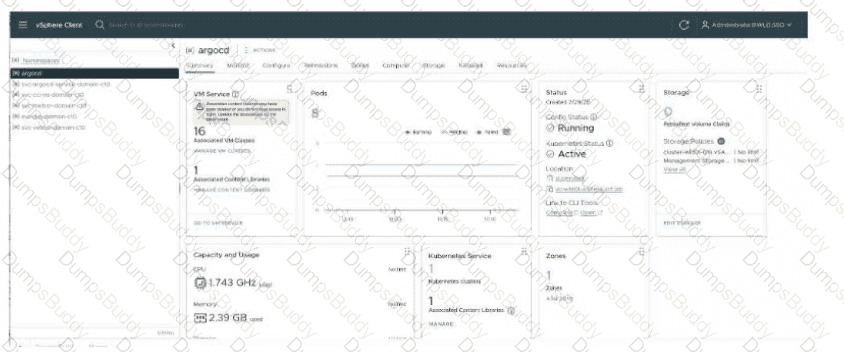
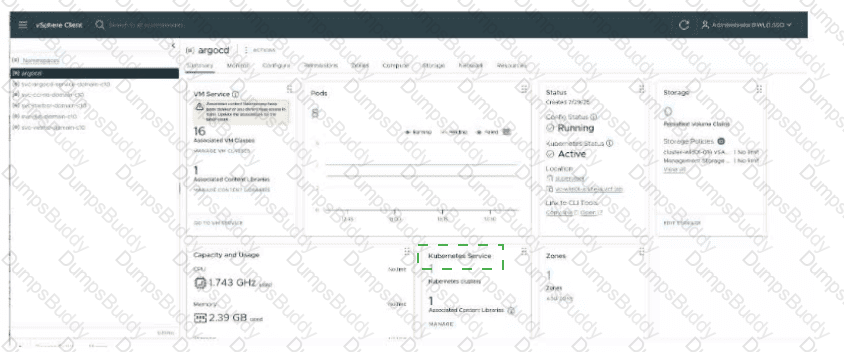
An administrator is tasked to protect a VKS cluster at a point in time. To satisfy the request, the administrator creates a pre-provisioned snapshot of the target cluster.
Drag and drop the four configuration tasks Into the correct order from " Configuration Steps " on the left and place them into the " Configuration Order " on the right. (Choose four.)


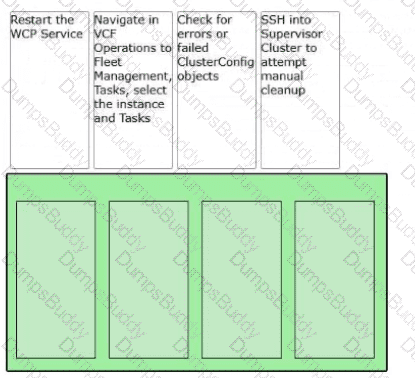
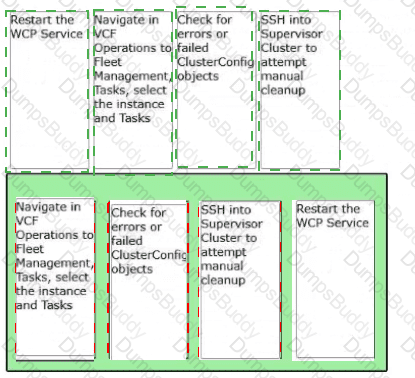
An administrator upgrades a VMware Cloud Foundation (VCF) Supervisor and the upgrade fails. Order the steps the administrator should take to determine the cause of the failure.
Refer to the exhibit in the following StorageClass manifest, which field is used to specify the Volume Plugin driver used for the underlying storage array?
YAML
apiVersion: storage.k8s.io/v1
kind: StorageClass
metadata:
name: standard
provisioner: kubernetes.io/aws-ebs
parameters:
type: gp2
reclaimPolicy: Retain
allowVolumeExpansion: true
mountOptions:
- debug
volumeBindingMode: Immediate
An administrator is operating a sovereign private cloud built on VMware Cloud Foundation (VCF) and is providing isolated Supervisor Namespaces as well as associated Kubernetes clusters. The architecture must ensure consistent provisioning, management, and monitoring of these clusters across tenants while maintaining compliance with internal governance and automation frameworks, considering:
• Deploying and scaling Kubernetes clusters
• Managing Supervisor Namespaces and configurations
• Monitoring cluster health, workloads, and resources across tenants
What three clients are supported for provisioning, managing, and monitoring VMware vSphere Kubernetes Service (VKS) clusters? (Choose three.)
Which two resources can be configured in a VM Class in VMware vSphere with vSphere Supervisor? (Choose two.)
An administrator has been tasked with enabling backup for a vSphere Kubernetes cluster. How does the administrator configure a backup?
What statement describes the vSphere Supervisor in VMware Cloud Foundation (VCF)?
Which feature in VMware vSphere Kubernetes Service (VKS) provides vSphere storage policy integration that supports provisioning persistent volumes and their backing virtual disks?
The DevOps Engineer was tasked to deploy a new application on a local cluster. When the application was deployed in the Namespace, it was decided that a newer version of Kubernetes was required. The DevOps Engineer requested the vSphere Admin to upgrade their Kubernetes version. The vSphere Admin checked compatibility between the Supervisor and all running VKS clusters, and then successfully upgraded vSphere Supervisor to the latest version. The DevOps Engineer could not get the application to work. What caused the application to fail?
An administrator is tasked with installing Istio Service Mesh for VMware vSphere Kubernetes Service (VKS). Which command installs Istio?
A customer is required to enhance the security for a set of VMware vSphere Kubernetes Service (VKS) clusters that host services interacting with sensitive customer data. The solution must encrypt the transport and communications between services.
The VKS Admin recommends enabling Istio Service Mesh to satisfy the requirement. What type of encryption does Istio Service Mesh provide?
What are three resource limitations defined on a vSphere Namespace? (Choose three.)
What is the purpose of the VMware vSphere Kubernetes Service (VKS) Service Mesh?
An administrator is deploying a vSphere Supervisor with NSX. What will determine the deployment size for the load balancer?
PDF + Testing Engine

Testing Engine
PDF (Q&A)