3V0-23.25 Advanced VMware Cloud Foundation 9.0 Storage Questions and Answers
During maintenance on hosts in a four-node vSAN cluster, a host is placed in maintenance mode with the “Ensure Accessibility” option.
All VMs are running with the Default Storage Policy (RAID-1, FTT=1) which has not been modified from the default settings.
While one of the hosts in the cluster is down for firmware upgrade, a second host in the cluster loses network connectivity.
How will the cluster be affected?
An administrator is troubleshooting a vSAN performance issue. In the vSAN cluster performance charts there is a high latency on the vSAN cluster.
What is a possible cause of the performance issue?
An administrator is tasked with replacing the existing Witness Host for a 2-node vSAN Edge Cluster.
During the replacement procedure, the new Witness Host does not appear as an available selection.
What is the cause of this configuration issue?
An administrator is planning the deployment of a new VMware Cloud Foundation (VCF) Workload Domain. The storage design decisions for the solution are:
• NFS
• NVMe over RDMA
• No local storage is available to the hosts
What is the storage solution build order for the Workload Domain?
A cache drive failed on one of the vSAN OSA nodes in the cluster.
When the drive failed, vSAN started a resync to ensure the health of the data, and all objects are showing a healthy and compliant state.
The vSAN administrator needs to replace the failed cache drive.
Which set of steps should the vSAN administrator take?
A multinational corporation is deploying a VMware Cloud Foundation (VCF) Workload Domain cluster to host tier-1 business applications with the following requirements:
• Deliver high performance to all workloads.
• Integration with automated VM placement.
• Reuse of existing infrastructure including multiple Fibre Channel (FC) arrays partitioned by business unit.
• The storage architecture must avoid vSAN.
• Meet organizational separation requirements.
Which two deployment approaches meet these requirements? (Choose two.)
An administrator is managing a stretched vSAN ESA cluster where each site has three hosts.
The following parameters apply to the storage policy being configured at the datastore level:
• The policy is configured at the datastore level
• Site disaster tolerance = Site mirroring - stretched cluster
• Failures to tolerate = 1 failure - RAID-1 (mirroring)
• Number of disk stripes = 1
When inspecting some of the Virtual Machines (VMs), why do objects have 3 disk stripes?
As part of standard operating procedures, when an administrator leaves the organization, a shallow rekey operation must be performed on a vSAN ESA cluster with vSAN Data-at-Rest Encryption enabled.
Which key is rotated during a shallow rekey operation?
An architect is designing a vSAN storage solution for a remote site. The following requirements have been given:
• There is enough rack space for two hosts, each with 36 CPU cores and 256 GB of RAM.
• The physical network at the remote site supports 10 Gb maximum.
• The network connecting the remote site to corporate has 10 Gb of bandwidth with an average RTT of 25 ms.
• High availability is expected for all the Virtual Machines running at the remote site.
• The solution must provide additional storage to 16 graphic design Windows based workstations.
• Active Directory is configured and available at the remote site.
• The graphic design application requires native NTFS permissions.
What vSAN advanced technology is required for configuring this remote site?
An administrator is tasked with attaching an FC-based VMFS datastore to an existing Workload Domain cluster.
Which option reflects the correct process?
The Windows team is planning to deploy a Windows Server Failover Cluster. This requires a disk shared between all members of the cluster.
Which two options are available to fulfill this requirement on a vSAN ESA cluster? (Choose two.)
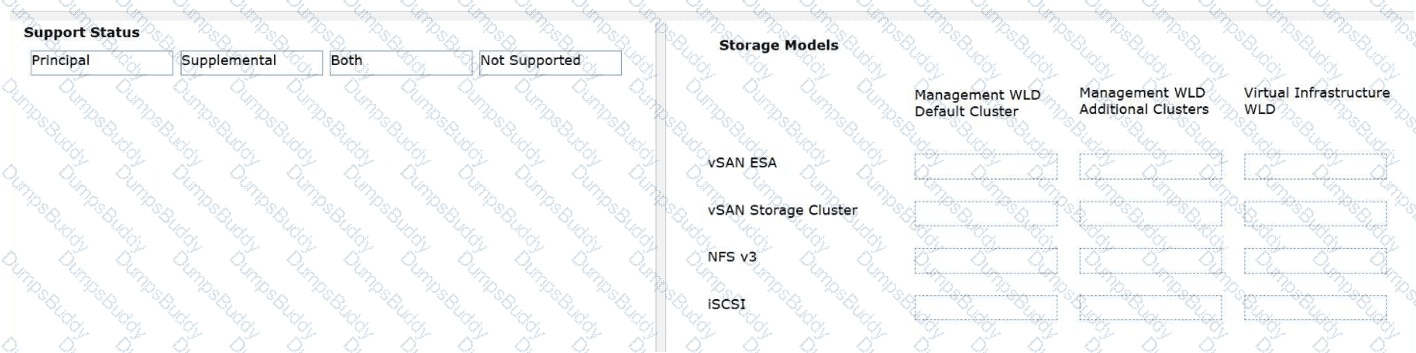
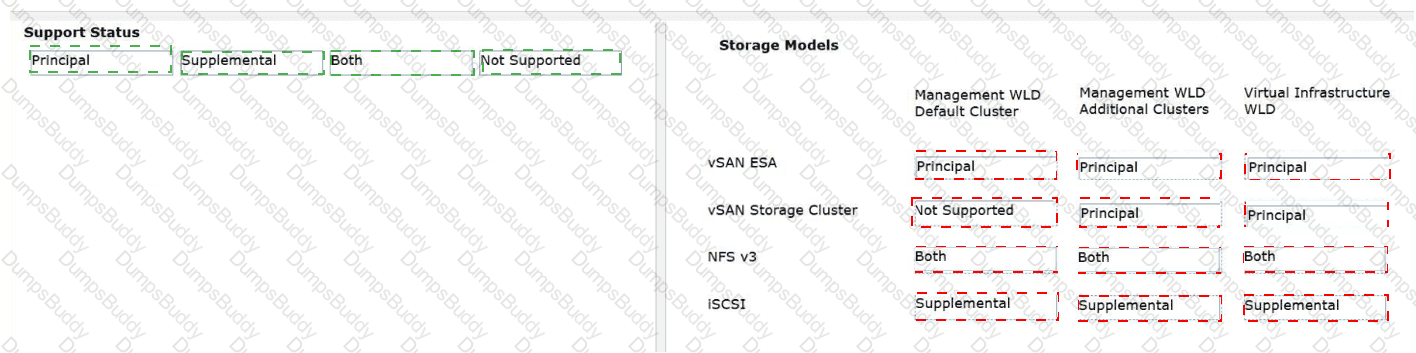
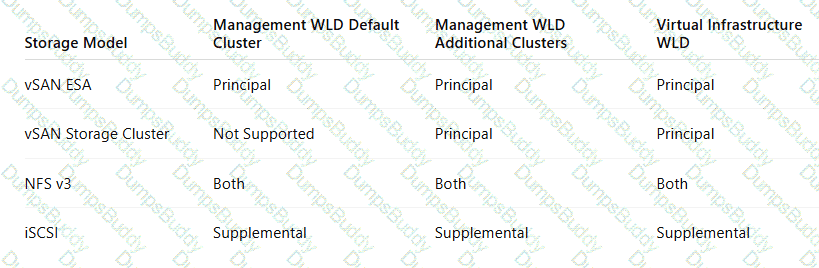
An administrator is responsible for a VMware Cloud Foundation (VCF) Private Cloud and has been tasked with identifying which storage model is supported in the different VCF Workload Domains.
Drag and drop the Support Status of each storage model on the left to each type of Workload Domain on the right.
A VMware Cloud Foundation (VCF) environment runs mixed workloads (Online Transaction Processing (OLTP) + analytics), with the following vSAN configuration:
• 8 hosts (all-flash), ESA enabled.
• Each host: 2 x 3.2 TB NVMe devices.
• Compression is Enabled.
• Checksum is Enabled.
• Storage Policy: FTT=1 (RAID-5/6), Failures to Tolerate = 1 and Object Space Reservation = 0%.
During peak OLTP load, vSAN resync I/O and backend congestion increase latency despite having sufficient network bandwidth.
What is the direct action the administrator can perform to improve write performance while maintaining data protection compliance?
An administrator is tasked with configuring the vSAN File Service to deliver NFS file shares for an Edge environment.
Which three are required to deliver the service? (Choose three.)
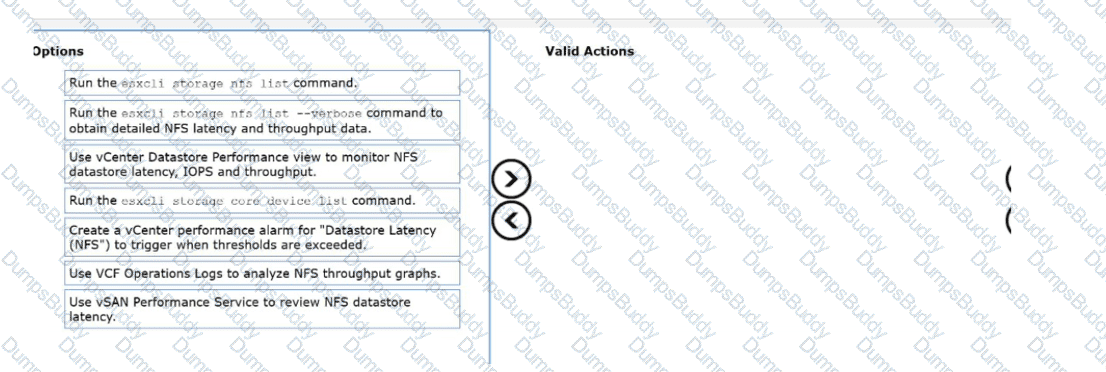
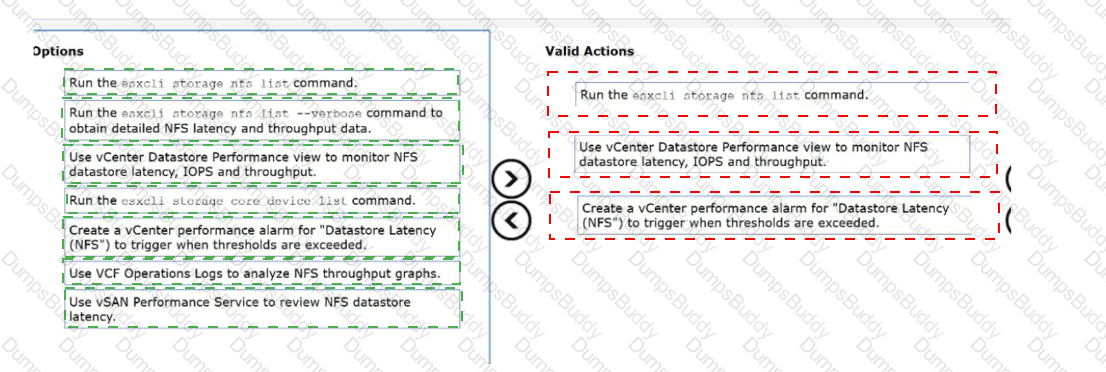
An administrator needs to monitor an external NFS datastore attached to a VMware Cloud Foundation (VCF) cluster to confirm that it meets latency and throughput targets.
Drag and drop the three correct options to monitor NFS performance from the Options list on the left and place them into the Valid Actions on the right in any order. (Choose three.)
An administrator is tasked with deploying a vSAN ESA Stretched Cluster for a VMware Cloud Foundation (VCF) workload domain. The stretched cluster must meet the following requirements:
• Ensure the cluster supports a storage policy with a secondary level of resilience of FTT=2 using RAID-6 erasure coding.
• Allow vSAN to regain its prescribed level of resilience in the event of a sustained host outage.
What is the minimum number of hosts required in each availability zone?
An administrator has been tasked with making changes to a VMware Cloud Foundation (VCF) Workload Domain cluster that is configured with NFS for both Principal storage and Supplemental storage.
The cluster has the following configuration:
• There are 3 x ESX host servers.
• There are 3 x NFS Datastores allocated to host Virtual Machines workloads.
• There is a single NFS Datastore allocated for hosting ISO files.
The administrator has the following concerns with the existing configuration:
• Every time a new Virtual Machine is deployed to the Workload Domain, the administrator must choose which datastore should be used.
• When reviewing the Datastores in VCF Operations:
One of the datastores has no Virtual Machines running in it.
The other two datastores have an imbalance of Virtual Machines and this is causing resource contention. The administrator has the following requirements: • Virtual Machines must be placed automatically on the most appropriate datastore based on utilization. • Migration recommendations on Virtual Machine placement should be made when one datastore reaches 50% utilization. • Virtual Machines must only be migrated to another datastore after being approved by an administrator. What four actions must the administrator take to meet all of the requirements? (Choose four.)
An enterprise is planning to deploy a new vSAN ESA enabled cluster to their existing VMware Cloud Foundation (VCF) Private Cloud Workload Domain. The following requirements have been given:
• 2 x 4 TB NVMe disks per host
• FTT=1/RAID-5 for all deployed Virtual Machines
• Expected dedupe/compression ratio = 1.5 (50%)
• Reserve enough capacity to rebuild a host completely in case of a failure (Host Rebuild Reservation)
• Operational Reserve of 10%
• Expected overhead for filesystem, object, etc. of 25%
How many hosts are required to meet a minimum usable capacity of 12 TB?
An administrator is using an external Key Management Server (KMS) with a vSAN Data-at-Rest Encryption cluster.
The KMS becomes temporarily unavailable.
What happens if a host without a Trusted Platform Module in the cluster is rebooted during this outage?
A storage administrator is being presented with the following VMware Cloud Foundation (VCF) architectural details:
• The applications data will require 2.5 PB of capacity.
• The production applications will be hosting archival solutions and gateways.
• There will be some applications deployed for the purpose of testing and development.
What is the optimal principal storage that the administrator can recommend?
PDF + Testing Engine

Testing Engine
PDF (Q&A)